Magnetic Fields from Cosmic Ripples express
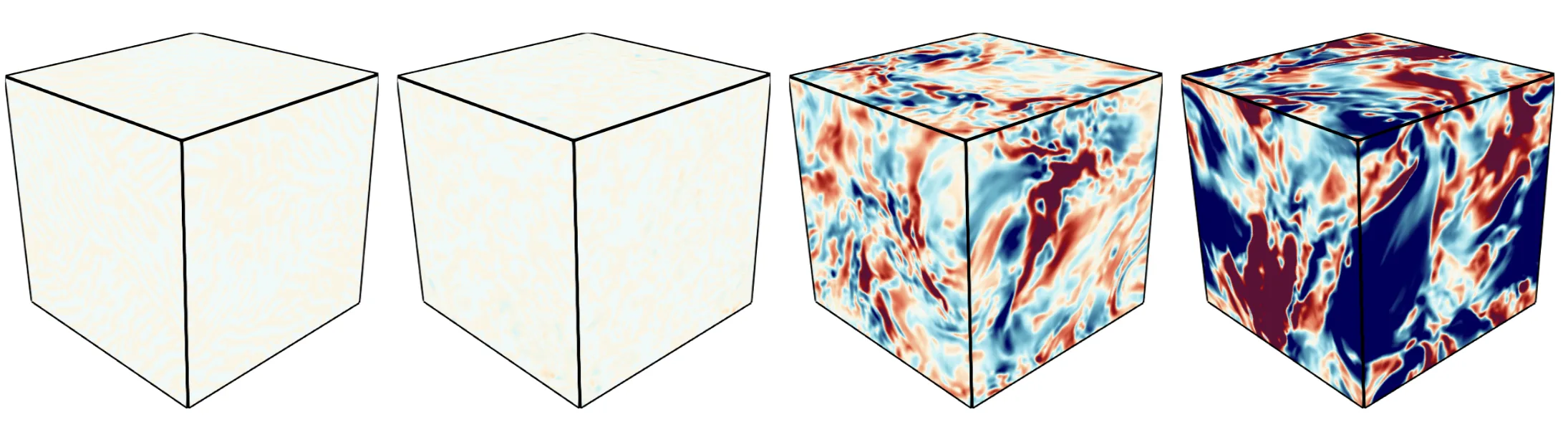
In the vast clouds of rarefied gas that fill the space between stars, something is always churning. Supernova explosions, colliding streams — all of it shakes the plasma. And in this rippling, as it turns out, hides the mechanism that gives birth to magnetic fields.
The new simulation showed that it all starts with electrons. When plasma is continuously stirred, electrons develop a pressure difference along and across their motion — anisotropy. This triggers electron vortices — tiny magnetic loops. But that's just a warm-up. A bit later, ions join the game. They are 1836 times heavier than electrons, so they need more time to get going. But once their own anisotropy reaches the threshold, ion vortices are born — far more powerful. At the same time, the 'Biermann battery' also works: in swirling flows, electrons and ions shift differently, creating an electric current, and a current always means a magnetic field.
The result is staggering: the field is amplified tenfold compared to the case where plasma consists of particles of equal mass (as in electron-positron pairs). The shaking continues — the field grows until equilibrium is reached. This self-consistent mechanism explains why magnetic fields permeate even those corners of the Universe where no one expected to find them.
Original abstract
as written by the authors arXiv:2607.04437
Using fully kinetic simulations that capture unprecedentedly large (from electron to ion) scales, we study magnetogenesis driven by continuous large-scale forcing until nonlinear dynamo saturation. We uncover a two-stage mechanism in collisionless ion-electron plasmas whose dynamics diverge dramatically from the pair-plasma case. In the first phase, electron pressure anisotropy triggers electron-Weibel modes, seeding small-scale magnetic fields. Then, a second growth phase emerges when the more massive ions develop their own strong anisotropy and drive ion-Weibel-type modes; concurrently, a Biermann-battery mechanism contributes to amplifying the magnetic field. This combined dynamics provides a tenfold amplification of the magnetic field in comparison to the pair-plasma case. Over long times, dynamo action continues until the system reaches a statistical steady state. This self-consistent kinetic mechanism provides a plausible explanation for robust magnetogenesis wherever an external forcing continuously stirs the plasma.
A hydrogen ion (proton) is 1836 times more massive than an electron. If an electron weighed as much as a one-gram coin, a proton would weigh almost two kilograms.
In Isaac Asimov's novel 'The Gods Themselves', an alien civilization from a parallel universe exploits differences in physical laws to pump energy through particle exchange — sounds like an echo of the 'Biermann battery', doesn't it?