Supernova from the Universe's Childhood express
A massive galaxy cluster acts like a giant lens. Its gravity warps the fabric of space, and light from distant objects, bending around this dip, gets amplified and split. It was exactly this natural magnifier that helped the James Webb Space Telescope spot the faint flash of a supernova in a tiny galaxy at the edge of the visible universe.
Supernova SN Eos exploded when the Universe was just a billion years old. Its light traveled 13 billion years to reach us, and along the way, the spacetime of the cluster deflected it, creating multiple images. The flash’s spectrum, its dispersed light, showed that the progenitor star contained almost no elements heavier than helium. Astronomers call such elements “metals” (not iron or copper, but anything heavier than helium). This is the first direct evidence that massive stars were born in a metal-poor young Universe.
Each such discovery is an extra lens through which we see the early epoch more clearly. It lets us calculate how often the first stars ignited and how quickly galaxies grew.
Original abstract
as written by the authors arXiv:2601.04156v2
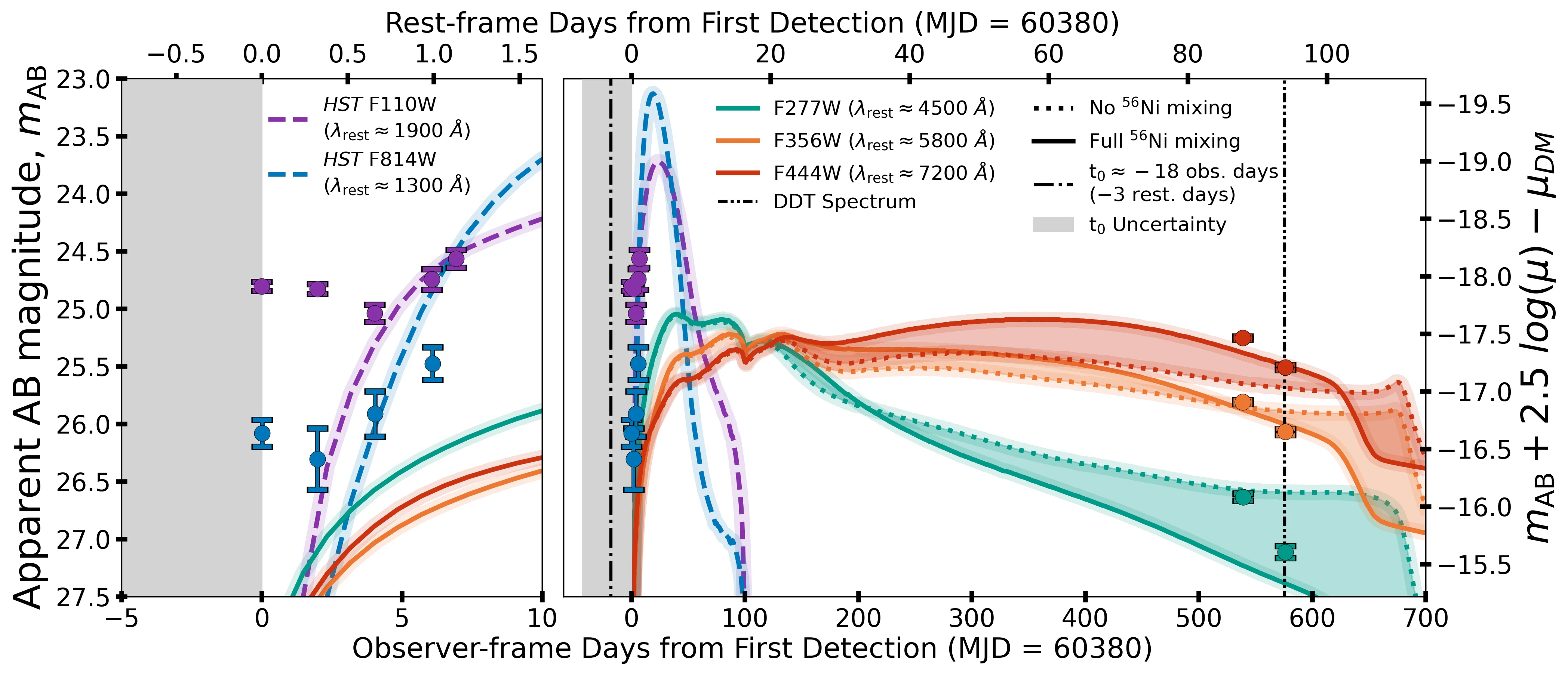
Observing supernovae (SNe) in the early Universe (z > 3) provides a window into how both galaxies and individual stars have evolved over cosmic time, yet a detailed study of high-redshift stars and SNe has remained difficult due to their extreme distances and cosmological redshifting. To overcome the former, searches for gravitationally lensed sources allow for the discovery of magnified SNe that appear as multiple images - further providing the opportunity for efficient follow-up. Here we present the discovery of "SN Eos": a strongly lensed, multiply-imaged, SN II at a spectroscopic redshift of z = 5.133 +/- 0.001. SN Eos exploded in a Lyman-{\alpha} emitting galaxy when the Universe was only ~1 billion years old, shortly after it reionized and became transparent to ultraviolet radiation. A year prior to our discovery in JWST data, archival HST imaging of SN Eos reveals rest-frame far ultraviolet (~1,300{\AA}) emission, indicative of shock breakout or interaction with circumstellar material in the first few (rest-frame) days after explosion. The JWST spectroscopy of SN Eos, now the farthest spectroscopically confirmed SN ever discovered, shows that SN Eos's progenitor star likely formed in a metal-poor environment (<= 0.1 Z_{\odot}), providing the first direct evidence of massive star formation in the metal-poor, early Universe. SN Eos would not have been detectable without the extreme lensing magnification of the system, highlighting the potential of such discoveries to eventually place constraints on the faint end of the cosmic star-formation rate density in the very early Universe.
At the moment of SN Eos's explosion, neither Earth nor the Sun existed. They only appeared 8 billion years later.