A Supernova from the Universe's Childhood express

Original: "A spectroscopically confirmed, strongly lensed, metal-poor Type II supernova at z = 5.13"
· David A. Coulter, Conor Larison, Justin D. R. Pierel, Seiji Fujimoto, Vasily Kokorev, Joseph F. V. Allingham, Takashi J. Moriya, Matthew Siebert, Yoshihisa Asada, Rachel Bezanson, Maruša Bradač, Gabriel Brammer, John Chisholm, Dan Coe, Pratika Dayal, Michael Engesser, Steven L. Finkelstein, Ori D. Fox, Lukas J. Furtak, Anton M. Koekemoer, Thomas Moore, Minami Nakane, Masami Ouchi, Richard Pan, Robert Quimby, Armin Rest, Johan Richard, Luke Robbins, Louis-Gregory Strolger, Fengwu Sun, Tommaso Treu, Hiroto Yanagisawa, Abdurro'uf, Aadya Agrawal, Ricardo Amorín, Joseph P. Anderson, Rodrigo Angulo, Hakim Atek, Franz E. Bauer, Larry D. Bradley, Volker Bromm, Mateusz Bronikowski, Christopher J. Conselice, Christa DeCoursey, James M. DerKacy, Guillaume Desprez, Suhail Dhawan, Jose M. Diego, Eiichi Egami, Andreas Faisst, Brenda Frye, Sebastian Gomez, Mauro González-Otero, Massimo Griggio, Yuichi Harikane, Kohei Inayoshi, Saurabh W. Jha, Yolanda Jiménez-Teja, Jeyhan S. Kartaltepe, Patrick L. Kelly, Lindsey A. Kwok, Zachary G. Lane, Xiaolong Li, Ivo Lobbe, Paulo A. A. Lopes, Ray A. Lucas, Georgios E. Magdis, Nicholas S. Martis, Jorryt Matthee, Ashish K. Meena, Rohan P. Naidu, Gaël Noirot, Masamune Oguri, Estefania Padilla Gonzalez, Massimo Pascale, Tanja Petrushevska, Massimo Ricotti, Daniel Schaerer, Stefan Schuldt, Melissa Shahbandeh, William Sheu, Koji Shukawa, Akiyoshi Tsujita, Eros Vanzella, Qinan Wang, John Weaver, Robert Williams, Rogier Windhorst, Yi Xu, Yossef Zenati, Adi Zitrin
arXiv:2601.04156v2 · 2026-01-07 · CC BY 4.0 · 1 min
A cosmic lens formed by a galaxy cluster helped spot a supernova from the universe's childhood.

A massive galaxy cluster acts like a giant lens. Its gravity warps the fabric of space, and the light of distant objects, bending around this dent, is amplified and split. This natural magnifier helped the James Webb Space Telescope spot a faint flash of a supernova in a tiny galaxy at the edge of the observable universe.

The supernova SN Eos exploded when the universe was only a billion years old. Its light traveled 13 billion years to reach us, and along the way, the spacetime curvature of the cluster deflected it, creating multiple images. The flash's spectrum, its broken-down light, revealed that the progenitor star contained almost no elements heavier than helium. Astronomers call such elements "metals" (not iron or copper, but anything heavier than helium). This is the first direct evidence that massive stars were born in the metal-poor young universe.

SN Eos is the most distant supernova with a spectrum obtained. It flared up just after the "dark ages," when the universe was becoming transparent to ultraviolet light.

Each such discovery is another lens through which we see the early epoch more clearly. It allows us to calculate how often the first stars ignited and how quickly galaxies grew.
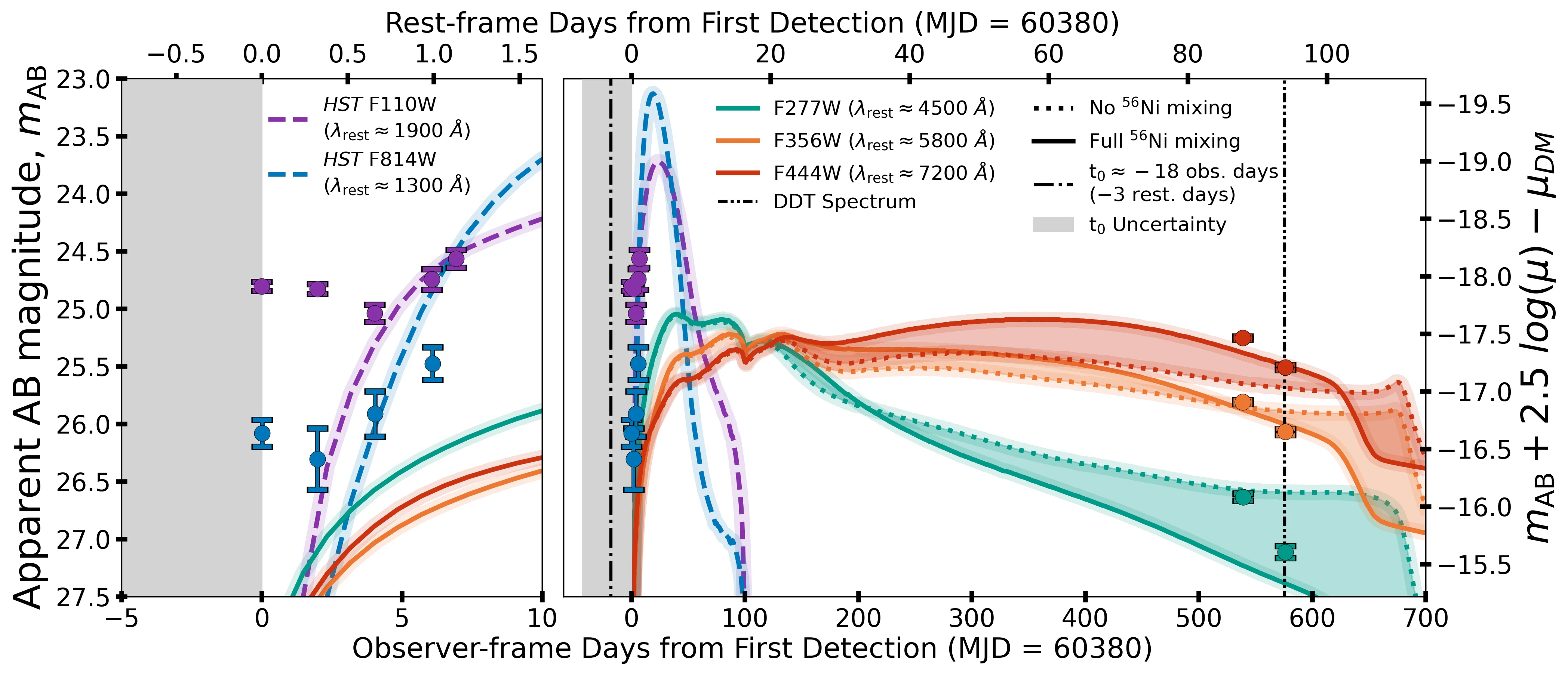
At the moment SN Eos exploded, neither Earth nor the Sun existed. They emerged only 8 billion years later.

Scientists
Ludwig BoltzmannSubrahmanyan ChandrasekharEnrico FermiRainer SachsJames JeansCecilia Payne-Gaposchkin
Concepts
cassiopeia a early universe star formation first stars nucleosynthesis stellar explosion supernova nucleosynthesis young stellar object supernova observable universe cosmic dawn jwst red sources neutron star structure progenitor james webb space telescope population iii stars high redshift galaxies red giant cosmic neutrino nustar Reionization JWST