Astrophysical spectroscopy is the analysis of light emitted, absorbed, or scattered by celestial objects to determine their physical and chemical properties. By spreading starlight into its constituent colors, astronomers can read the fingerprints of elements, measure temperatures, densities, and velocities, and even probe magnetic fields and dark matter distributions. This technique is the foundation of modern astrophysics, transforming distant points of light into rich sources of information about the composition and evolution of stars, galaxies, and the universe itself.
History
The technique was pioneered in the 19th century by Joseph von Fraunhofer, who mapped hundreds of dark lines in the solar spectrum, and later by Gustav Kirchhoff and Robert Bunsen, who established the connection between spectral lines and chemical elements. The first stellar spectra were obtained by Angelo Secchi in the 1860s.
How it works
When light passes through a prism or a diffraction grating, it is split into a spectrum. Dark absorption lines or bright emission lines appear at specific wavelengths, corresponding to electronic transitions in atoms and molecules. The positions of these lines reveal which elements are present, while their shifts (Doppler effect) indicate motion toward or away from us. The widths and intensities of the lines provide information about temperature, pressure, and density. For galaxies, spectroscopy of the integrated light reveals stellar populations, star formation rates, and the presence of active galactic nuclei.
In practice
Astrophysical spectroscopy is used to measure the expansion of the universe (redshift), to discover exoplanets via radial velocity method, and to classify galaxies in large surveys like SDSS.
Fun fact
The element helium was discovered in 1868 as a bright yellow line in the spectrum of the Sun before it was ever found on Earth.
The night sky looks calm, but in reality, invisible particles, cosmic rays, are constantly flying through us. Among them are electrons and their antimatter counterparts, positrons. When they collide with detectors on satellites or balloons, the instruments record their energy.
One hundred forty parsecs, a distance light traverses in four and a half centuries, separate us from the Taurus molecular cloud. Within its depths hide dark condensations: prestellar cores, where gas and dust slowly contract under their own weight.
An artist makes a quick charcoal sketch, and the face in the portrait is already recognizable. Astrophysicists face a similar challenge: the spectrum of a star is its individual portrait, revealing temperature, composition, and gravity.
The early universe expanded at a breakneck pace: this phase is called inflation. But how exactly did it do it? Some models describe the expansion as a steep exponential surge, others as a more gentle power-law motion.
Light waves are never perfectly smooth — they are constantly jittered by quantum ripples. These almost invisible nudges were studied by Nobel laureate Roy Glauber, who laid the foundations of quantum optics. Now physicists have learned to freeze these ripples.
To spot a dim star above a brightly lit city, astronomers subtract one image from another — removing the glare of streetlights. They do the same with living neurons: their faint flashes drown in noise, but if you subtract everything unchanging, only they remain.
Light from a distant star, after passing through air and telescope lenses, loses its sharpness, like looking at a streetlamp through wet glass. Astronomers call this blur the telescope's "fingerprint": each instrument has its own, and you need to know it down to the smallest detail.
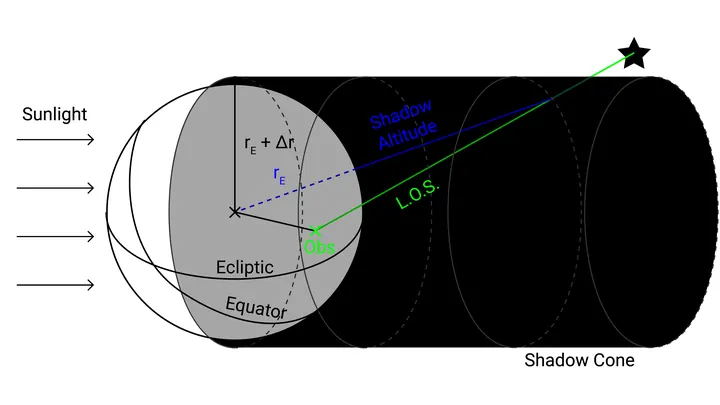
At night, the sky is never completely black. Even far from cities, the upper atmosphere glows faintly: sunlight makes hydrogen atoms emit a reddish glow that astronomers call geocoronal emission. For a telescope, it's like a fogged-up window: it adds extra light and hinders seeing distant galaxies.
Quantum light is not just a stream of particles but an intricate pattern woven from space and time. A single photon can be stretched, squeezed, smeared across different directions.
Astronomers read the history of galaxies by their portraits. Previously, they used either lengthy analysis of light by colors or quick filtered snapshots, losing the details of shape.