Orbiting Clocks Hunt for Invisible Fields express
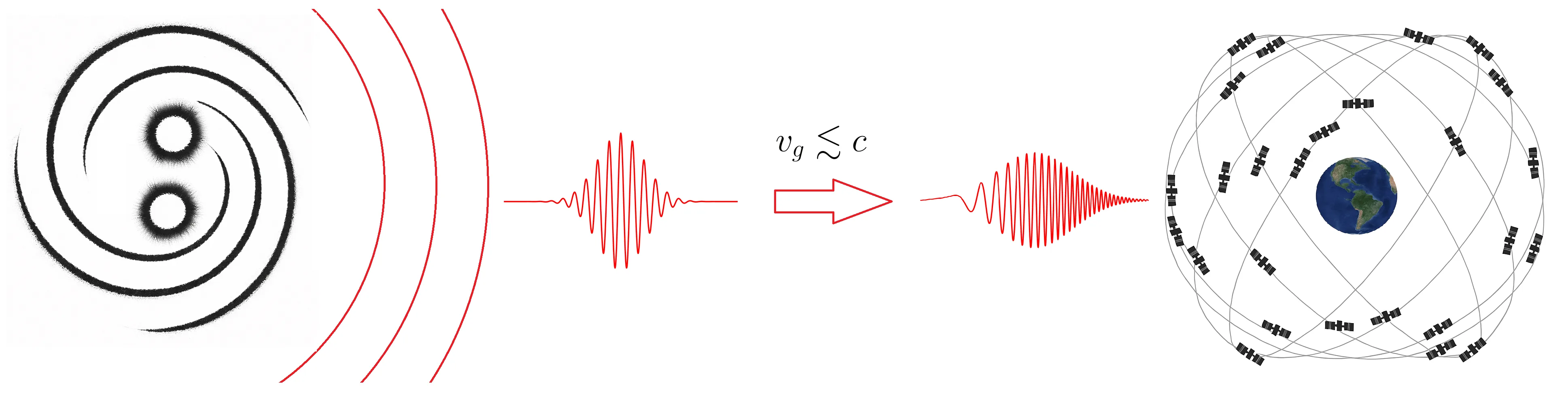
In August 2017, gravitational wave detectors caught a signal from the merger of two neutron stars — the ultra-dense remnants of exploded stars. At that very moment, life on Earth was business as usual: planes were landing, cars were driving, and navigators were plotting routes. Their operation relies on atomic clocks aboard GPS satellites — clocks that tick with incredible precision, measuring time by the vibrations of atoms.
Now these clocks have become more than just navigators; they are hunters of the invisible. Physicists took archival records of the ticking of eighteen satellite clocks from those days and checked whether their rhythm faltered after the cosmic merger. If an unknown light field had been released by the stellar collision, it could have momentarily changed the clocks' rate, like a gust of wind altering the tempo of a metronome. They searched for such a signal by comparing satellite readings with ground-based hydrogen maser clocks.
No sign of anything like that was found. But the search was not in vain: we now know that if such a field exists, it must be weaker than a certain limit. This limit is stricter than previous astronomical observations for a whole range of energies — roughly from 10⁻¹⁸ to 10⁻¹⁴ electronvolts. For comparison, visible light has an energy of about 2 electronvolts.
Thus, an ordinary navigation system has become a tool for fundamental physics. Archival data, accumulated over years for earthly needs, now serves as a telescope in time: we can return to the moment of the stellar merger and check whether something invisible passed through Earth. And although this time it was silence, the method remains — in case the sky again sends us a gravitational burst, and with it a chance to catch new physics.
GPS atomic clocks are so precise that without correction, navigation would drift by 10 kilometers per day due to relativistic effects.