The Universe's Radio Concert: How 30 Seconds of Silence Are Changing Physics ✛ ✎ ✦
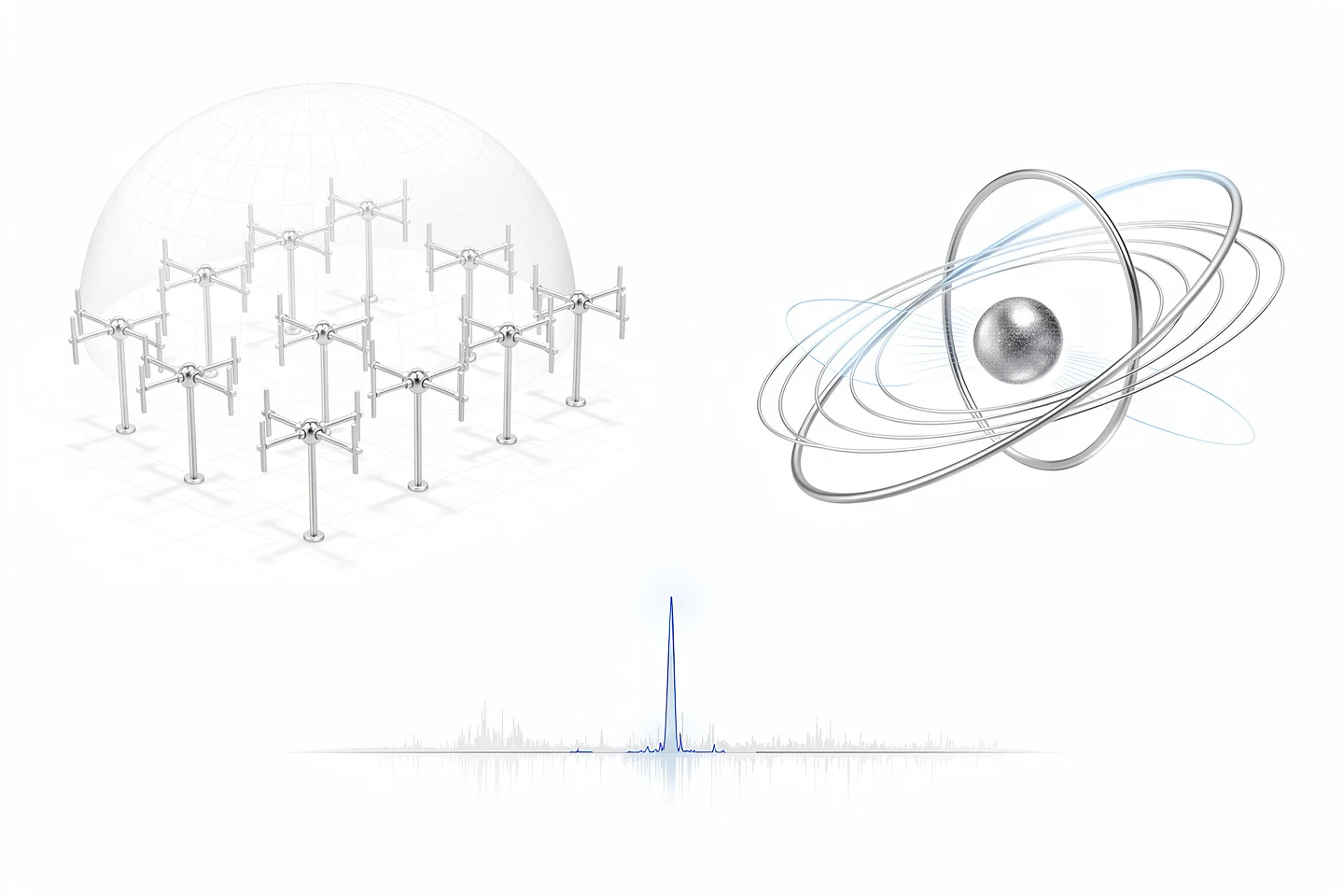
Listening to the cosmos requires patience and a finely tuned ear. Astronomers chose the most sensitive low-frequency instrument for this: the OVRO–LWA antenna array — 352 dipole antennas scattered across two and a half kilometers of California desert. In one incredibly short 30-second exposure, this device produced over three million images of the entire sky, slicing the radio noise into half a million frequency strips just 10 Hz wide. Spectroscopy on this scale is like trying to pick out a single person's whisper in a crowd, where every star and galaxy is shouting at its own frequency, and we're looking for a note that isn't supposed to be there.
The endeavor is simple yet absurdly bold: either we catch an artificial 'beep' from other intelligences — a narrowband signal from an alien civilization — or we get a gift from fundamental physics. Back in the 1970s, Vera Rubin showed that dark matter orchestrates the motion of galaxies, but its composition remains a mystery. One of the best hypotheses involves ultralight axion-like particles that can transform into radio waves in the powerful magnetic fields of neutron stars. The very pulsars discovered by Jocelyn Bell Burnell in 1967 become natural laboratories for the search for new physics. And each of the millions of exoplanets in the field of view might hide a technologically advanced species.
Careful calibration and automated cleaning of terrestrial interference left three candidates with a signal-to-noise ratio above ten. Alas, detailed analysis shattered the illusions: one source broke down into spatial components, the second appeared irregularly and wandered across the sky, and the third turned out to be our own interference again. Silence. But this silence is a priceless trophy. It means that any narrowband transmitter in this band beaming a signal our way must be weaker than $10^{14}$ watts at a distance of 10 parsecs — hundreds of times more than the entire energy consumption of modern humanity. The nearest stars are silent.
Yet the same dataset opens a second, even more tantalizing window. If an axion of a certain mass decays near a neutron star, it produces a monochromatic radio line — its frequency is linearly related to the particle's mass. By not detecting such lines, the authors set upper limits on the radio photon flux, still far from theoretical predictions, but the method itself works flawlessly. Accumulating not seconds but hours of observations and stacking data from multiple neutron stars would boost sensitivity by an order of magnitude. Moreover, synchronizing with gravitational-wave detectors could offer a chance to catch radio echoes from mergers, and the streamlined pipeline on fast NVMe drives is ready for real-time all-sky monitoring. The same telescope will concurrently embark on studying the cosmic dawn — the era of the first stars — by peering into the 21 cm hydrogen line.
These 30 seconds have blazed a trail toward two of the greatest discoveries imaginable: life beyond Earth and the nature of dark matter. The radio spectrum is still silent, but for the first time, we've embraced millions of worlds with our attention all at once. The next step is to listen longer, feel deeper, and not miss that one note that will overturn physics. And yes, there's a nagging thought: what if we're a million years too late — and all the 'concerts' in our galaxy have already ended?
The survey's sensitivity is such that it could detect a television transmitter equivalent to Earth's from hundreds of light-years away — if someone were broadcasting analog shows into space.
The search for narrowband signals is familiar from Carl Sagan's 'Contact': the heroine picked up a transmission from Vega, while we are listening to millions of stars at once — and so far, we only hear static.