The Entire Sky in Radio Lines: Hunting for Alien Signals and Dark Matter ✛ ✎ ✦
Context
The search for extraterrestrial intelligence is one of the fundamental tasks of modern science. The radio band remains the primary window for detecting technosignatures (engineered signals from civilizations), and low frequencies like decameter waves have been largely unexplored. They can pick up powerful transmitters or even radio leakage similar to Earth's TV broadcasts. Way back when Vera Rubin showed that dark matter dominates the universe, and now this same band is perfect for hunting its manifestations—hypothetical particles that can turn into radio waves in the strong magnetic fields of neutron stars. As Jocelyn Bell Burnell, who discovered pulsars, found out, these objects are true cosmic laboratories where we can search for signs of new physics. Moreover, the survey covers millions of star systems, many of which contain exoplanets.
Methods
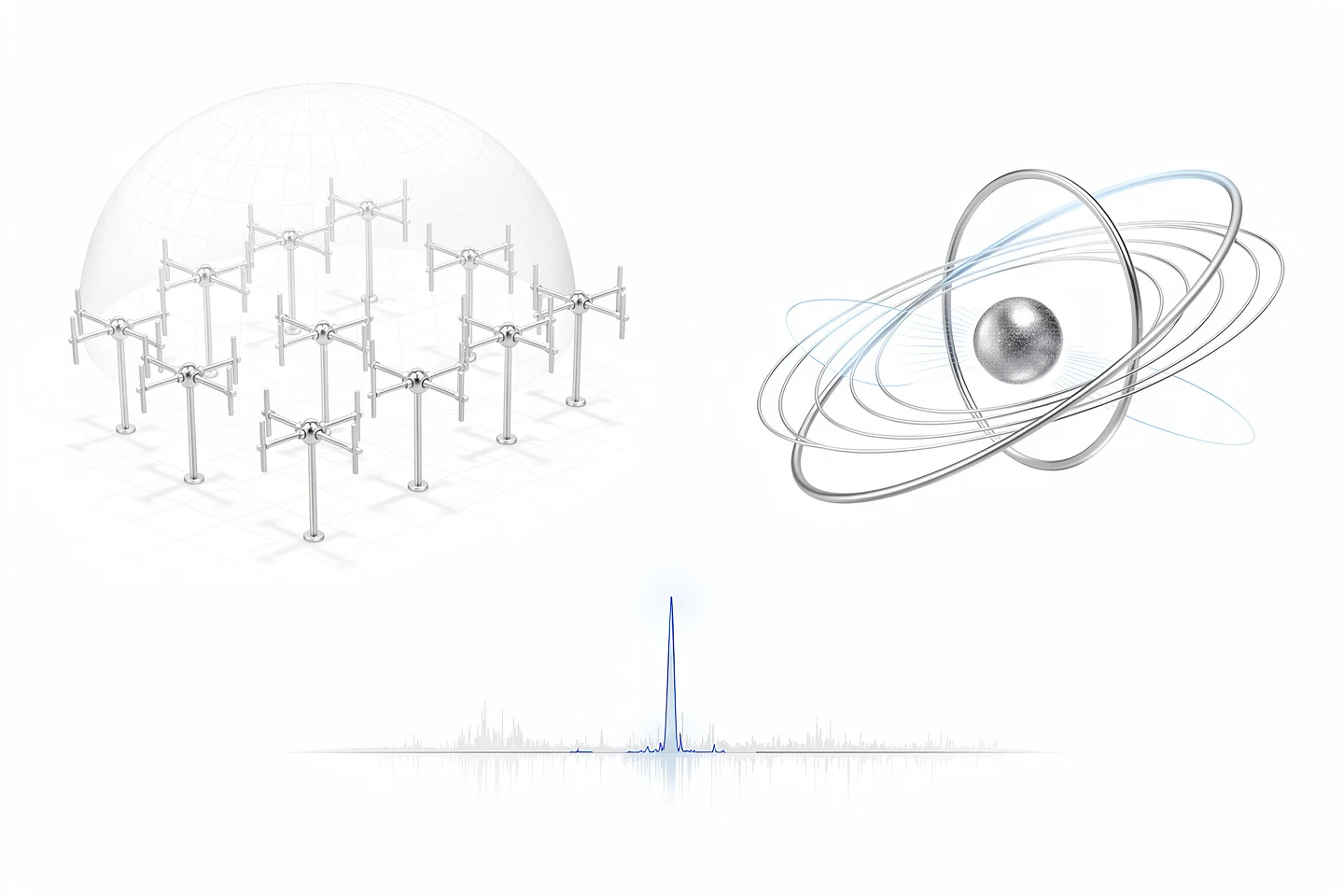
Observations were made with the OVRO–LWA array, consisting of 352 dipole antennas spread over distances up to 2.4 km. Raw data from each element underwent digital processing: first, splitting into fine frequency channels (down to 10 Hz), then cross-correlation between antennas on GPUs, calibration, and construction of all-sky images. In essence, this was spectroscopy at ultra-high resolution. A key step was spectral filtering to remove the smooth background and reveal narrow lines. Candidate detection employed matched filtering with kernels of varying widths—from 10 Hz to 1 kHz—and significance was assessed with false-positive control.
Results
In a single 30-second epoch, over 3 million images were formed at each frequency. After quality cuts and automatic removal of extended sources and obvious radio interference, three candidates with signal-to-noise ratio above 10 remained. Detailed analysis with higher time and spectral resolution showed that none of them are compact point sources: two candidates at 60 MHz break up into spatially separated components, and the third at 84 MHz appears irregularly and shifts between frames. Thus, all three are identified as terrestrial radio interference. The survey sensitivity was ~100 Jy per channel, yielding 10-sigma upper limits on equivalent isotropically radiated power (EIRP): ~$10^{14}$ W for a source at 10 parsecs and ~$10^{18}$ W at 1 kiloparsec. Even in the plane of the Galaxy, where emission is brightest, no narrowband signals were found.
Implications
The results demonstrate that even short observations with extreme spectral resolution and a wide field of view can cover millions of star systems without pre-selecting targets. The absence of bright, continuous narrowband signals in this band constrains hypothetical technosignatures, but does not rule out weaker, pulsed, or frequency-drifting sources. For dark matter physics, this is just the beginning: current limits on the radio photon flux from axion conversion are still far from theoretical predictions, but the method can be scaled up.
Future development
In the future, increasing integration time (to hours or more) and applying drift searches will lower the detection threshold by an order of magnitude. Additionally, coherently stacking images of many neutron stars can boost the signal from axion-like particles. Advances in software processing on NVMe drives, as tests have shown, will speed up the pipeline severalfold, opening the path to real-time all-sky monitoring. Synchronization with gravitational wave detectors is also possible, allowing rapid follow-up of radio emission from mergers. A separate direction will be observations of the 21 cm hydrogen line to study the cosmic dawn.
Impact
This work lays the groundwork for future decameter-wave surveys and strengthens the connection between astronomy and fundamental physics. It will influence SETI programs and dark matter particle detection experiments.
Next steps
Next steps include deeper integrations, accounting for frequency drift due to planetary motion, and joint analysis of multiple epochs. There are also plans to apply the method for detailed mapping of terrestrial radio interference and improving its removal algorithms.
Key open problems
The study is directly connected to two unsolved problems: the nature of dark matter and the question of the existence of extraterrestrial civilizations. Detection of an axion line in the radio band would be a revolution in particle physics, and any technosignature would be the greatest discovery in human history.
The knowledge machine's view
This section is addressed to the author of the paper and their colleagues. Neighbouring works were found by meaning-based search across our archive, not by word overlap. We do not review: we show the field around the work.
What the work does
The paper describes an all-sky survey in the decameter range using OVRO-LWA with high spectral resolution, searching for narrowband signals from technosignatures and dark matter axions. Over a 30-second epoch, 3 million images were obtained, three candidates were found that turned out to be radio frequency interference, and upper limits on EIRP were set at ~10^14 W at 10 pc and ~10^18 W at 1 kpc.
Where its strength is
The strength of the work lies in combining a wide field of view, high spectral resolution, and fast processing, which allows covering millions of stellar systems in a short time and placing constraints on narrowband signals without preselection of targets.
Where it could go next
- It might be interesting to compare the methodology with the FAST approach in the work on searching for axion emission from neutron stars: there, a single antenna with high time resolution is used, while here an interferometer with a wide field is used, and a joint analysis could improve sensitivity to axion lines.based on: Message from the Invisible World: FAST Listens to Axions arXiv:2606.17067v1
- Nearby is a work on searching for laser pulses from extraterrestrial civilizations using optical telescopes; one could consider adapting their candidate selection algorithms to the radio band, especially for searching for pulsed signals.based on: Space Fireflies: Hunting for the Laser Pulse of Extraterrestrial Civilizations arXiv:2607.12106
- In the archive, there is a discussion of using the Earth as a dark matter detector via radio waves; perhaps it is worth combining constraints on axion-photon conversion in neutron star magnetospheres with the global limits obtained in this survey.based on: Earth as a Dark Matter Detector arXiv:2509.15783
Worth trying
- Apply matched filtering to data from other OVRO-LWA epochs to increase integration time and lower the detection threshold.
- Use polarization data to separate technosignatures from natural narrowband sources such as pulsars.
- Assess sensitivity to axion lines from specific neutron stars using the object catalog and magnetosphere models.
Why this may matter
Such surveys are important for systematic coverage of the low-frequency range, which remains poorly explored in the context of SETI and dark matter searches, and could lead to the discovery of new astrophysical phenomena or constraints on physics beyond the Standard Model.
Nearby works in our archive
- Radio Bursts to Map the Invisible Universesimilarity 0.66
- Message from the Invisible World: FAST Listens to Axionssimilarity 0.65
- A Lunar Telescope Will Reveal the Shadows of Distant Black Holessimilarity 0.63
- Hunting the Invisible at the Heart of the Milky Waysimilarity 0.62
- Earth as a Dark Matter Detectorsimilarity 0.62
- Invisible Particles Leave Their Mark on Ancient Lightsimilarity 0.62
- Space Fireflies: Hunting for the Laser Pulse of Extraterrestrial Civilizationssimilarity 0.61
The closest work in the archive sits at 0.66 by meaning — the usual level for our corpus.
Interestingly, in 30 seconds the OVRO–LWA telescope produced more images than all Instagram users during the same time span. And none of them had aliens in them.
The very idea of searching for narrowband signals from our cosmic siblings is familiar to us from Carl Sagan's novel and film 'Contact.' There, the heroine Dr. Arroway perseveringly listened to the radio noise until she caught a mysterious signal from the Vega system. Our telescope is also listening, but so far only hears static.
Key numbers
- Frequency range: 50–86 MHz
- Spectral resolution: 10 Hz
- Integration time: 30 s
- Sensitivity (1σ): ~100 Jy
- EIRP limit (10σ, 10 pc): ~1014 W