The tau lepton is the heaviest of the charged leptons, weighing nearly twice as much as a proton. It is extremely short-lived, decaying within a trillionth of a second into lighter particles, often producing neutrinos. Because of its mass, it is a unique probe for studying the weak force and searching for physics beyond the Standard Model, such as lepton flavor violation or new heavy particles.
History
The tau lepton was discovered in 1975 by Martin Perl and colleagues at SLAC, who found anomalous events in electron-positron collisions; Perl received the Nobel Prize in 1995 for this work.
How it works
The tau decays via the weak interaction, typically into a tau neutrino plus either hadrons (like pions) or a lighter lepton (electron or muon) with neutrinos. Its short lifetime means it travels only a fraction of a millimeter before decaying, leaving a distinctive 'kink' in particle tracks. Experiments at colliders identify taus by these decay signatures, which are challenging to reconstruct due to missing energy carried away by neutrinos.
In practice
Tau leptons are used to test the Standard Model's predictions for lepton universality and to search for new particles in high-energy collider experiments like ATLAS and CMS.
Fun fact
The tau lepton's lifetime is so short that even traveling at nearly the speed of light, it covers less than a millimeter before decaying.
In a tank holding three tons of liquid xenon, buried deep underground, something stirred one day. Not the xenon itself, but one of its atomic nuclei: it received a kick with an energy of 248 thousand electronvolts and recoiled like a billiard ball struck by an invisible cue ball.
High in the mountains, where the air is clear and still, physicists are preparing to catch elusive visitors from space — neutrinos. These particles, like ghosts, pass straight through the Earth, leaving almost no trace. But occasionally a neutrino does slam into an atom, producing a shower of particles that can be seen.
A massive star exhausts its fuel, and its core collapses in a fraction of a second. A supernova is born, along with a brief but powerful shower of neutrinos. These particles barely interact with matter, so they fly away freely, carrying information about the catastrophe.
In 2021, the LHAASO observatory registered gamma quanta with energies above a petaelectronvolt from sources like the Crab Nebula — a supernova remnant with a pulsating neutron star at its heart.
In the depths of a neutron star, the remnant of an exploded star, matter is compressed so tightly that a teaspoon would weigh billions of tons. Within this superdense material, a special kind of force might be at work, one that affects only muon and tau neutrinos.
The tau lepton is a short-lived particle, a heavy cousin of the electron. When it decays, quarks inside it exchange gluons, like players in a closed room tossing a ball back and forth. You can't see the throws themselves, only the final score: two pions flying off at certain angles.
Electrons and muons are tiny magnets. Their magnetism is slightly more than two (in special units), and this 'excess fraction' (anomalous magnetic moment) arises from constant ripples in the vacuum: particle pairs momentarily pop into existence and vanish.
On one side of the scale lies all the matter in the Universe; on the other, all the antimatter. According to the laws of physics, at the moment of the Universe's birth, the pans should have been balanced. But we see one pan tipping: around us are stars, planets, people, and almost no antimatter. This imbalance is one of the greatest mysteries.
Deep underground in Japan, a huge tank of ultrapure water waits for rare visitors — neutrinos arriving from distant stellar explosions. Such guests are few and far between: over years of observation, Super-Kamiokande registers only a handful of events.
A noisy train station at rush hour. Thousands of people hurry past, voices merging into a dull roar. Somewhere in the crowd, two people try to shake hands with a special, barely visible gesture. Spotting such a handshake is nearly impossible.
A firework bursts, and one point explodes into four sparks at once. That's how the Z boson, the particle that carries the weak force, behaves when it decays into four charged leptons (electrons or muons). The process is extremely rare: for every million Z bosons produced, only about five decay this way.
At the SuperKEKB accelerator, electrons collide with positrons, and among the debris, B-mesons are found. These heavy particles live briefly and break apart into lighter ones. Recently, the Belle II detector recorded a suspiciously high number of cases where a B-meson transforms into a K-meson (kaon) and something invisible—2.7 sigma more than expected.
A translator halfway across the hall suddenly starts rendering the message backwards. That's roughly how a neutrino, a ghost particle that barely notices matter, might behave if it encounters a cloud of ultralight dark matter.
A coin landing on its edge is about as rare as a heavy B meson decaying into a light pion and an electron-positron pair. Over a decade of collider operation, only a handful of such events have accumulated, but physicists have finally managed to spot them.
The decay probability is about 2.4×10⁻⁸.
The speed of light in a vacuum is physics' metronome: it sets the rhythm for all processes. If it falters, the familiar harmony collapses. Neutrinos, ubiquitous but almost intangible particles from space, can check if this rhythm ever stumbles under extreme conditions.
In the CMS detector at the Large Hadron Collider, protons accelerated to nearly the speed of light collided. Among billions of such collisions, physicists searched for a rare signature: the production of a single heavy particle that immediately decays into a W boson and a b quark.
Inside every atom lives a proton. For a long time, it was considered as eternal as matter itself. But theories that unify all forces of nature predict that, sooner or later, the proton will decay. The only question is how long we have to wait.
In the Japanese detector Super-Kamiokande — a giant tank of ultra-pure water — physicists searched for signs of such a decay.
Colliding two lead nuclei at the Large Hadron Collider is like throwing two hefty bags of marbles at each other. Usually, the marbles scatter in all directions, but sometimes one bag passes so close that the marbles don't collide: they just exchange glances.
A ring road around the Sun, where the traffic is not cars but clumps of matter. The diameter of this road is measured in light-years: it encircles our planetary system at its outer edge, in the Oort Cloud, where the star's weak gravity still holds sway.
A tiny superconductor, levitating above a magnet, is like a cork on the surface of an invisible ocean. The slightest breath of dark matter makes it shudder. Scientists examined two kinds of such 'wind'. The first – gravitational waves, which stretch and squeeze space itself, like ripples on the fabric of the cosmos.
The tau lepton is a heavy cousin of the electron, living less than a trillionth of a second. It usually decays into lighter particles, but never directly into three muons: such a transition is forbidden by known laws of particle physics. If it did happen, it would mean unknown forces are at play.
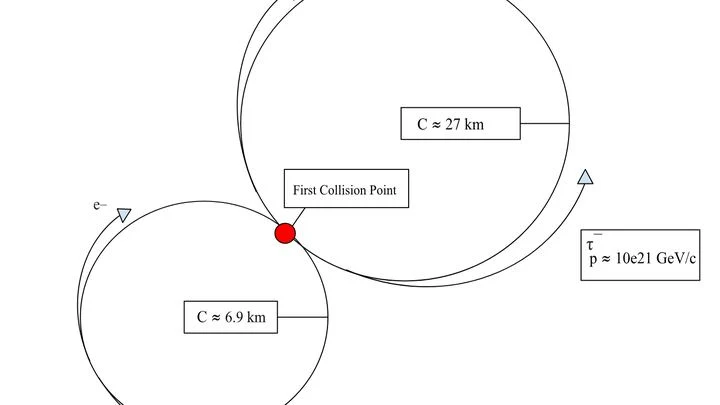
In an underground ring 27 kilometers in circumference, protons are accelerated to nearly the speed of light and smashed head-on. At the collision point, conditions briefly recreate those of the first trillionth of a second after the birth of the universe.
In the ATLAS detector at the Large Hadron Collider, particles leave tracks like skiers in the snow. Some tracks break off after a couple of centimeters: that's what a particle would look like if it were born, flew a little way, and then decayed into something invisible.
The Large Hadron Collider doesn't just smash protons: it also collides entire atomic nuclei. When two nuclei smash together at tremendous speed, they create a tiny blob of matter so hot that protons and neutrons melt into a 'soup' of quarks and gluons.
In the CMS detector at the Large Hadron Collider, protons smash together with enormous energy, producing a shower of particles. Most of them decay almost instantly, right at the collision point.
A pebble drops into a pond, and ripples spread across the water. But sometimes the pebble doesn't sink right away: it skims beneath the surface, travels a few meters, and only then surfaces, creating ripples in an unexpected spot.
When a massive star exhausts its thermonuclear fuel, its core collapses and the outer layers are blown off in a colossal explosion — a supernova (a term coined by Fritz Zwicky while studying these catastrophes).
In the thirties, Pauli realized: without tiny ghost-like particles, the energy of stars doesn't add up. Thus neutrinos were born — intangible wanderers that permeate everything.
High above the Antarctic ice sheet, a balloon with a detector floated for twenty days. It caught tiny particles that had been traveling toward us for millions of years from distant stellar explosions. Now scientists have sorted through the catch and reported how much energy the protons and nuclei of different elements carried.