A voxel is the three-dimensional analogue of a pixel, representing a single sample point in a regular grid of volumetric data. Where a pixel describes a small square of a 2D image, a voxel describes a tiny cube of space, carrying information such as density, color, or material type. Voxels are the fundamental building blocks of volumetric representations, allowing complex 3D shapes and fields to be stored and manipulated numerically.
History
The term 'voxel' emerged in the 1970s in computer graphics, with early uses in medical imaging and terrain rendering. The concept of volumetric sampling predates the name, appearing in tomography and scientific visualization.
How it works
Voxels are arranged in a regular 3D lattice, each with coordinates (x, y, z) and one or more scalar values. The resolution of the grid determines the level of detail: smaller voxels yield finer representations but require more memory. Algorithms process voxel grids by iterating over the lattice, enabling operations like rendering, boolean geometry, and physical simulation. The simplicity of the regular grid makes voxel data highly amenable to parallel processing and GPU acceleration.
In practice
Voxels are used in medical imaging (CT and MRI scans), 3D printing, video game engines (e.g., Minecraft), and scientific simulations of fluids and materials.
Fun fact
A single high-resolution CT scan of a human body can contain over a billion voxels.
A sheet of paper tears where tension exceeds strength. Epithelium, the cell sheet lining our organs, behaves similarly, but until recently models could not show how tears appear in it. The classical vertex model describes tissue as a network of polygons tightly packed together and forbids cells from detaching.
Getting lost in a hall of mirrors is easy: every wall reflects another, and you feel like you've been here before. The brain gets similarly confused when surrounded by many similar places. Neurons responsible for the spatial map can fire the same signal for two different corners of a room. This is called spatial ambiguity.
Spacetime resembles a giant crystal. Gravitational waves, born from collisions of black holes, not only make it tremble — they leave indelible defects: edge ones, as if an extra plane of atoms was inserted into the crystal, and screw ones, where the layers twist.
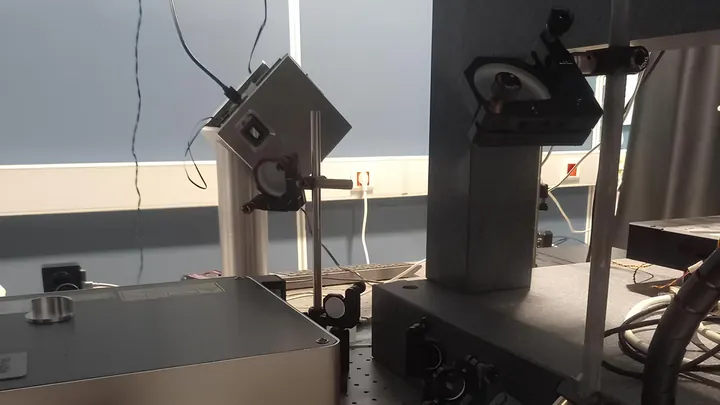
A silicon detector is like photographic film, but instead of light, it senses charged particles. When a particle flies through the silicon, it knocks out electrons, and we see a signal. But how do you look inside the detector itself and see where the electric field is strong and where it's weak? One way is to use a laser.
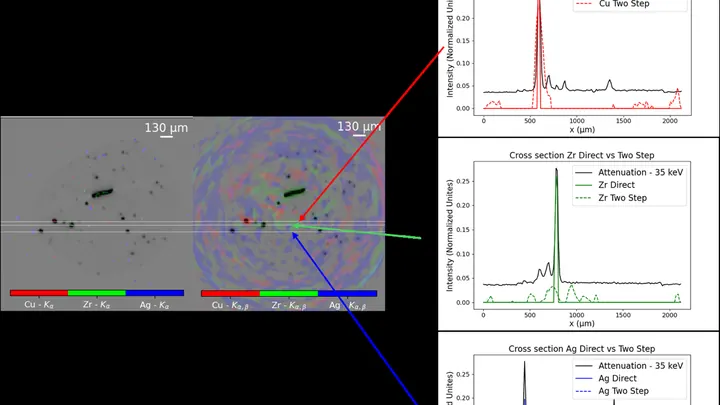
Conventional X-ray fluorescence analysis works like a meticulous scribe: to learn the composition of a picture, it walks over every square centimeter and logs whether lead or copper is present. For a flat sheet, that's tolerable, but for a three-dimensional object, it's torture.
A PET scanner catches flashes of light that occur when a radioactive tracer introduced into the body meets electrons in tissues. Usually, the device merely notes where a flash occurred. But between the birth of the tracer and the flash, there is a pause — tiny, in billionths of a second.
A living cell is like a bustling city: cargo moves continuously along its streets, and traffic flows are regulated so that everything needed arrives on time. But while you can watch a city from a helicopter, the cell's interior has long been observable only through a narrow slit — the microscope showed just a flat picture.
Strike a tuning fork, and it rings with a single pure note. But if the fork is trembling and people are chattering nearby, the sound won't be perfect. Same with molecules: each one absorbs light of a specific color, but due to its own vibrations and the jostling of neighbors, that color gets smeared out.
The authors of the paper figured out how to show this to students without complex formulas.
A typical 3D printer squeezes out plastic like a pastry chef piping cream from a bag. Here, instead of plastic, it's light. A laser beam draws in liquid resin, making it solidify at precise points. This creates parts too small to see without a microscope.
Until now, such printers were slow: the beam crawled across the surface like a pen on paper.
As light passes through a patterned plate, it folds inside a transparent liquid into a three-dimensional pattern. Where the light is brighter, the resin hardens. After 7.5 seconds, a finished part is lifted out of the liquid — complete with cavities, channels, and tiny protrusions.
A regular 3D printer prints point by point or layer by layer.