Cosmic Radio Bursts: A Magnet Reveals the Distance ✛
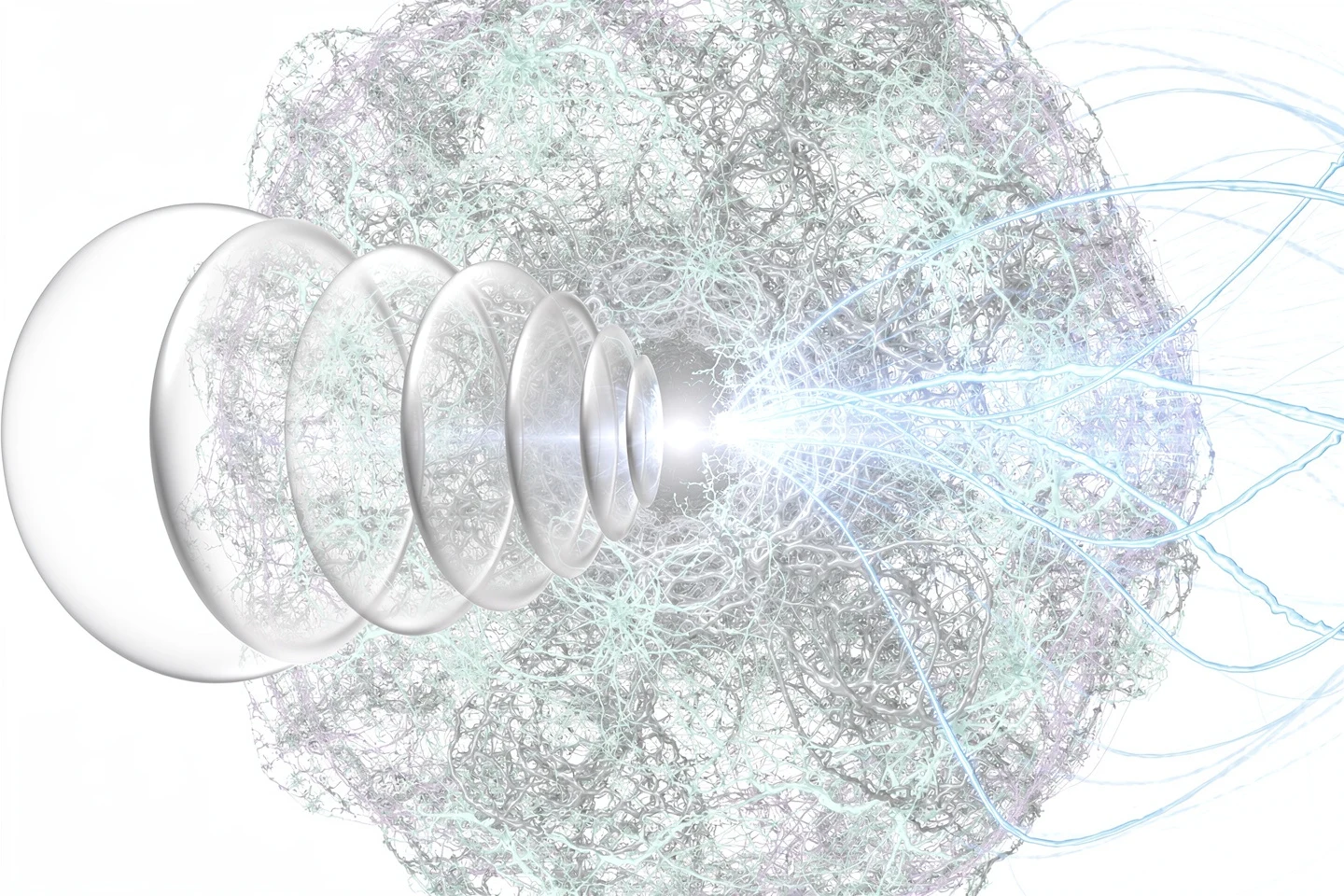
Imagine looking at a streetlamp through a dirty, spinning window. The lamp light is a fast radio burst (a short, powerful flash of radio waves from space), and the dirty glass is a cloud of magnetized plasma. The glass spins, and the light shifts between red and blue, while its brightness flickers. By how quickly the image changes, you can tell if the glass is close to the lamp.
That's exactly what astronomers did: they combined three types of radio signal distortions to measure, without guesswork, the distance from the burst source to the magnetic cloud. It turned out that for some neutron stars — dense remnants of exploded suns — the cloud is right nearby, like a planet near a star (just a few hundred million kilometers). This is typical of binary systems where a pulsar (a rapidly spinning magnetized star, discovered by Jocelyn Bell Burnell) and a normal star coexist. For other bursts, the magnetic curtain stretches across light-years — like a vast nebula after a supernova explosion (a phenomenon described back in the day by Fritz Zwicky).
This method is a sort of spectroscopy (analyzing signals by frequency), except it looks not at chemical composition but at magnetic swirls. By knowing the speed of light and how the signal is delayed in plasma, scientists turn distortions into a ruler. Now there's no need to guess where the source of these mysterious bursts hides — the very hydrogen and helium (the primary elements of stars, as proved by Cecilia Payne-Gaposchkin) in the magnetic cloud give the distance away. This helps sort all fast radio bursts into two families and understand what cosmic catastrophes give rise to them.
The host galaxy of the most famous repeating burst is tiny, but stars are born there at a frantic pace, and the burst itself smashes magnetic records.
In science fiction, like Carl Sagan's novel "Contact", fast radio bursts were thought to be signals from alien civilizations. In reality, they're produced by ultra-strong magnetic fields on dead stars — which is no less thrilling.