Magnetic Echolocation: Measuring the Cosmic Cocoons of Fast Radio Bursts ✛
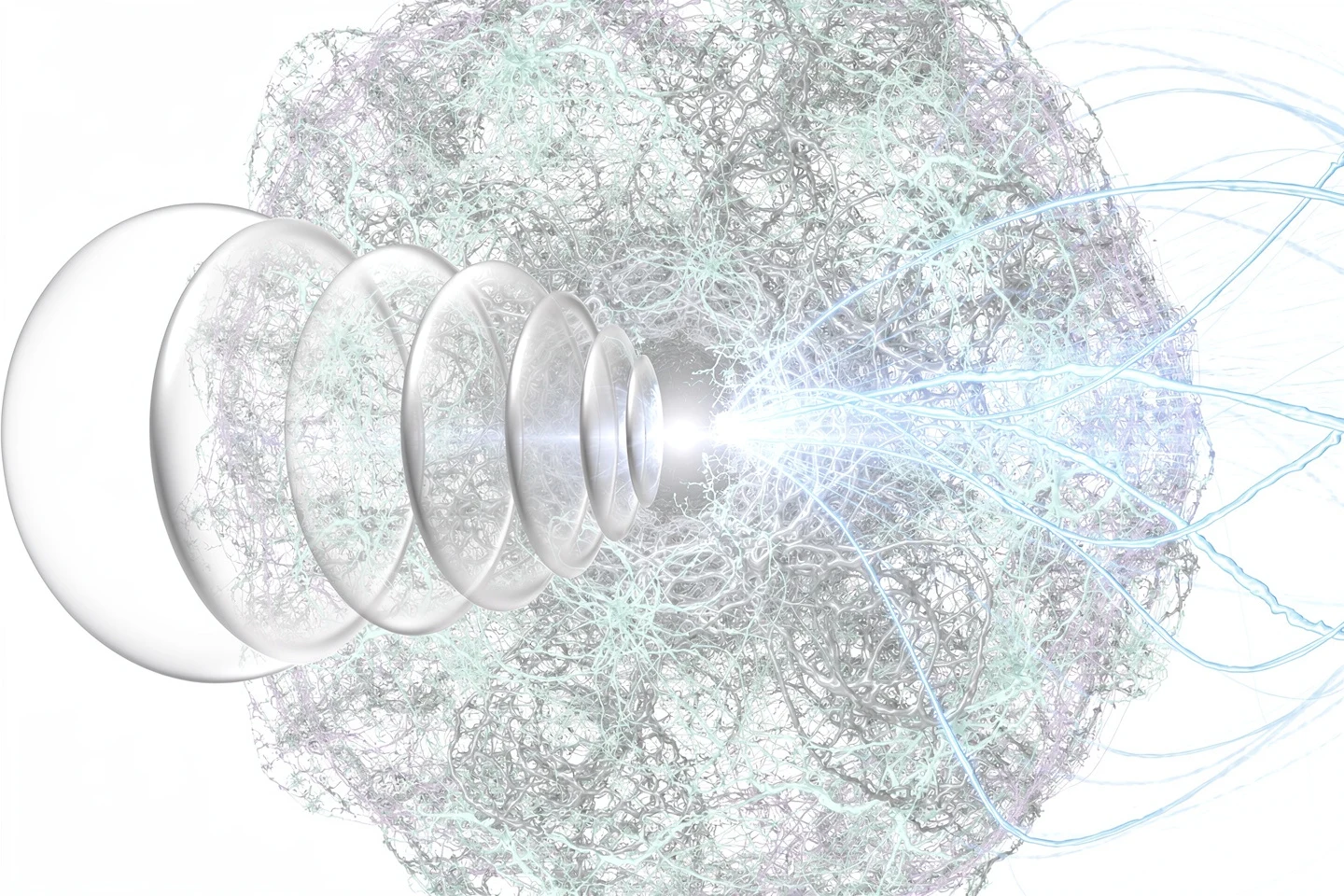
Fast radio bursts — millisecond radio pulses arriving from distant galaxies — long remained a puzzle. Their colossal energy, compressed into instants, pointed to cataclysms on neutron stars, perhaps pulsars or magnetars. But understanding exactly where the burst is born and what environment surrounds it was hindered by the lack of direct diagnostics. The new method turns this weakness into a strength: the very chaos introduced by turbulent plasma becomes the key to the mystery.
Imagine an explorer shouting into a mountain gorge. The echo returns, bearing three signatures of the space. First, it is delayed more the narrower the passage and the more numerous the multiple reflections — this is the time delay (scattering) of the pulse. Second, it is blurred, lacking sharpness, because different frequencies interact differently with the walls — analogously to depolarization of radio waves. Third, the tone of the echo changes over time if a variable wind blows through the gorge — this reflects the drift of the Faraday rotation measure under gusts of the magnetic field. The Faraday rotation measure, by the way, works as a subtle spectroscopy of the interstellar medium, revealing the distribution of magnetic fields and electrons. Putting these three factors together, one can calculate the distance to the wall, even if fog hides it from view. This is precisely how astrophysicists now process FRB signals: pulse delay, decline in polarization degree with wavelength, and rate of change of Faraday rotation angle — three distortions from which the distance to the magnetized screen is deduced.
The method does not rely on pre-set models of a nebular environment. It uses only observables: the standard deviation of RM, the scattering time at a given frequency, and the rate of change of RM. The combination yields the angular scattering scale, after which, using the speed of light and an approximate distance to the source, the desired physical size is found — from astronomical units to parsecs. The formula linking all these data resembles a universal key: $D_B$ ~ 0.45 pc × ($σ_{RM}$ / 10 rad/m²) (τ / 1 ms)^{-1/2} (|ΔRM/Δt| / 10 rad/m²/day)^{-1} (v / 100 km/s) √($D_S$ / 100 pc). The numbers inside the brackets normalize everything to characteristic values, allowing recalculation for specific bursts.
Applying this magnetic echo acoustics to six active repeaters, scientists obtained a striking picture. For FRB 20180916B and 20201124A, the distance to the screen ranged from 1 to 100 astronomical units — the scale of our planetary system. Such tight cocoons are expected in binary systems, where a compact neutron star — a pulsar, first discovered by Jocelyn Bell Burnell — orbits an ordinary companion star, whipping plasma in a dance. Conversely, FRB 20190303A, 20190417A, and 20190520B reside in vast cavities from tenths to whole parsecs in size — a legacy of supernovae, whose nature as stellar explosions was definitively established by Fritz Zwicky. Here, the radio burst pierces through the expanding remnants of a dead star, rich in hydrogen and helium — elements whose cosmic abundance was first calculated by Cecilia Payne-Gaposchkin.
This tool shifts the debate about the origin of magnetoactive screens from the realm of speculation to the domain of measurable physics. Now we can, like from three notes of a chord, distinguish tight binaries from grand remnants. But more importantly, the method opens a path to an evolutionary chronicle: as data accumulate from broadband facilities like CHORD and DSA, we will see how these plasma caves inflate or contract. Perhaps we will capture the moment when a pulsar emerges from the shell of its progenitor — that very transition no one has yet observed. And from there, it's not far to unraveling the generation mechanism of the radio scream itself — one of the sharpest questions in neutron star physics.
The most famous repeater FRB 20121102A resides in a dwarf galaxy with extreme star formation, and its rotation measure reaches a record 10⁵ rad/m² — hundreds of times higher than other sources.
Science fiction writers have sometimes imagined FRBs as messages from other civilizations, but the real physics, where the signal is born in the magnetic grip of neutron stars, turns out to be no less mesmerizing.