Casey Law

5 articles · 30 co-authors · latest: 2026-08-21
145 citations · h-index 4 · 22 papersData: Semantic Scholar

We have retold 5 papers by this author. 3 of them with a full read. most often about: solar corona, fast radio burst, electromagnetic radiation. 30 co-authors across our retellings.

Links in the knowledge graph
Stellar2025-09-193 minarXiv:2509.16453
Fireflies in a Solar Cloud
On the night of March 9–10, 2024, a cloud of plasma ejected by the Sun raced away from the star. It had already passed a distance of five solar radii when a ground-based array of 352 antennas in California's Owens Valley caught a brief radio signal from it.
Stellar2026-02-101 minarXiv:2602.09819express
The Solar Corona: A New Way to Measure Its Density
The solar corona, the Sun's outer atmosphere, stretches millions of kilometers, yet it's visible only during a total eclipse or with specialized instruments. Typically, we gauge the corona's density by how it scatters white light, but that method relies on simplifications that can skew the results.
The Universe's Radio Concert: How 30 Seconds of Silence Are Changing Physics
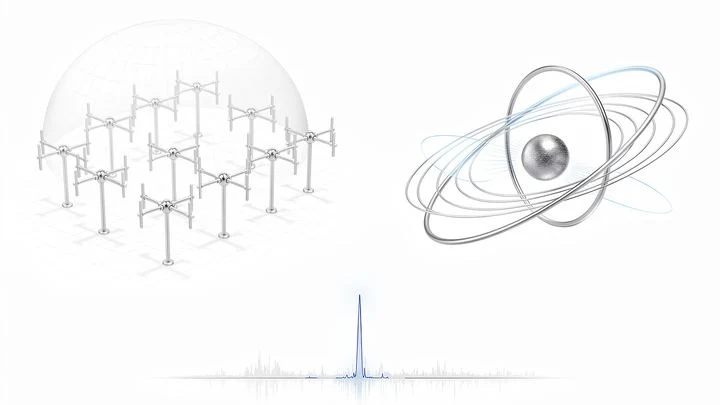
Listening to the cosmos requires patience and a finely tuned ear. Astronomers chose the most sensitive low-frequency instrument for this: the OVRO–LWA antenna array — 352 dipole antennas scattered across two and a half kilometers of California desert.
The Spotlight That Turned Away: The Mystery of Transient AT 2019ijn
The cosmos is full of screams we can't hear. Every time a black hole tears a star apart, a blinding flash is born, and often — a narrow relativistic jet, shooting out thousands of light-years. But if that searchlight is aimed away from Earth, we see only a faint afterglow — a radio echo arriving with a delay.
High Energy2026-08-212 minarXiv:2608.21320express
A Radio Signal That Refuses to Fade
Radio telescopes listen to the sky like sensitive ears: they catch the whispers of distant explosions, the hum of galaxies, the crackle of pulsars. But sometimes they pick up a sound that isn't in the catalogs. In 2003, such a sound emerged in the constellation Aquila — a spot in the sky that had been quiet until it suddenly began to speak.