Lightning over a black hole: the first Neupert effect beyond our Galaxy ✛ ✦
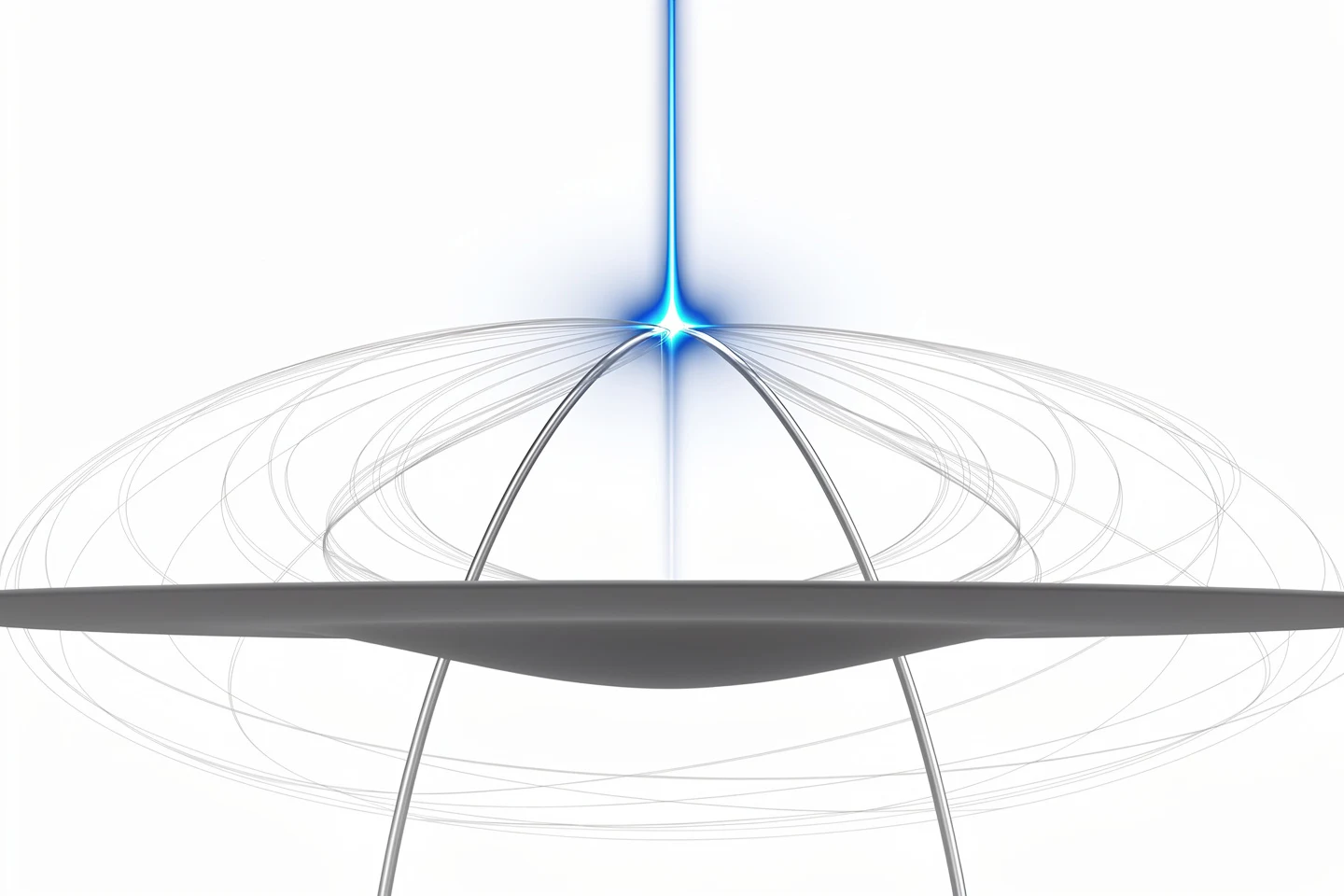
Active galactic nuclei (AGN) are the universe’s powerhouses: their X-ray coronae blaze millions of times hotter than stellar atmospheres. But what strikes the spark? A ten-day X-ray campaign by the XRISM and XMM-Newton satellites, aimed at NGC 3783, provided the answer: it’s actual thunderstorms. A flare, spotted in July 2024, exhibited the Neupert effect: that very signature of magnetic reconnection that has unmistakably revealed solar coronal heating since 1968.
In the turbulent magnetosphere of the accretion disk encircling the supermassive black hole, field lines twist into bundles, storing up monstrous energy. When they reconnect, like a titanic lightning bolt tearing through the darkness, an avalanche of relativistic electrons is born. An instant flash of hard radiation. Then, some 30,000 seconds later, the heated plasma responds with a soft X-ray rumble: that very “thunder” that gave away the nature of the process. It is precisely this proportionality of the hard curve to the derivative of the soft one, the Neupert effect, that has now been recorded for the first time in an active galactic nucleus.
Simultaneously, high-resolution X-ray spectrographs detected an ultra-fast outflow — a jet of matter hurtling away at 0.2 times the speed of light. This extragalactic counterpart of a coronal mass ejection confirms that reconnection not only bakes the corona but also hurls material into intergalactic space. Using the kinetic energy of this outflow and treating reconnection as the engine, astronomers calculated a lower limit for the magnetic field: at least 13,000 gauss, and likely up to 40,000 at the epicenter. For scale: Earth’s magnetic field at the surface is about 0.5 gauss. And all this ferocious energy plays out on a stage less than 30 gravitational radii across — roughly 0.1 astronomical units from the event horizon of a 20-million-solar-mass black hole.
Such lightning bolts are key to the mechanics of accretion flows. The ideas of Rashid Sunyaev on Comptonization allow us to probe the vicinity of the horizon through X-ray spectra, while the Neupert effect provides direct access to measuring magnetic fields in that region. Predictions by Kip Thorne about ergospheric vortex fields, and the mechanisms of spin energy extraction outlined by Roger Penrose, are gaining tangible observational grounding. In the future, continuous monitoring by XRISM, upcoming telescopes like Athena and LEM, and simultaneous radio observations will make hunting cosmic thunderstorms routine. Step by step, a magnetic map of supermassive black holes will emerge. Because each such flare is not just a firework at the edge of the abyss. It’s a window into the processes that govern the growth of galaxies and the very fate of the universe.
The Neupert effect was derived from solar observations in 1968, and astronomers long thought it was merely a local peculiarity of our star. Now it’s becoming a universal metric for cosmic magnetic storms — from the Sun to the event horizon.
This mechanism breathes life into the idea of a black hole’s “magnetic engine,” which Kip Thorne embedded into the scientific backbone of "Interstellar," modeling magnetic fields near the event horizon.