Planet Candidate around Alpha Centauri A: First Image in the Habitable Zone ✛
Context
Alpha Centauri A is the nearest Sun-like star, and its habitable zone extends over angular scales that the MIRI mid-infrared coronagraph can resolve. This provides a chance to directly image a planet in the habitable zone of a Sun-like star for the first time and to sensitively constrain exozodiacal dust. The work sits alongside studies of exoplanets and dust disks around nearby stars: JWST has already pulled an invisible planet out of a disk, ELT/ANDES is tuning in to exoplanet atmospheres, and VLT/NEAR previously reported a candidate C1 around Alpha Centauri A. This work is the first attempt to confirm or refute C1 using JWST/MIRI and simultaneously achieve record sensitivity to warm dust.
Methods
Observations were conducted with the MIRI/4QPM coronagraph at a wavelength of 15.5 μm over three epochs: August 2024, February 2025, and April 2025. Because Alpha Centauri A is bright (about −1.5 magnitude in F1550C), direct pointing is impossible, so blind offset from a Gaia reference star was used with an accuracy of 10 mas. The secondary component, Alpha Centauri B, is only 7–9 arcseconds away and creates bright speckles, so the star ε Muscae was placed at its position as a reference point source. Processing included subtraction of reference images using principal component analysis (KLIP algorithm), construction of sensitivity maps, and injection of model exozodiacal disks to estimate detection limits.
Results
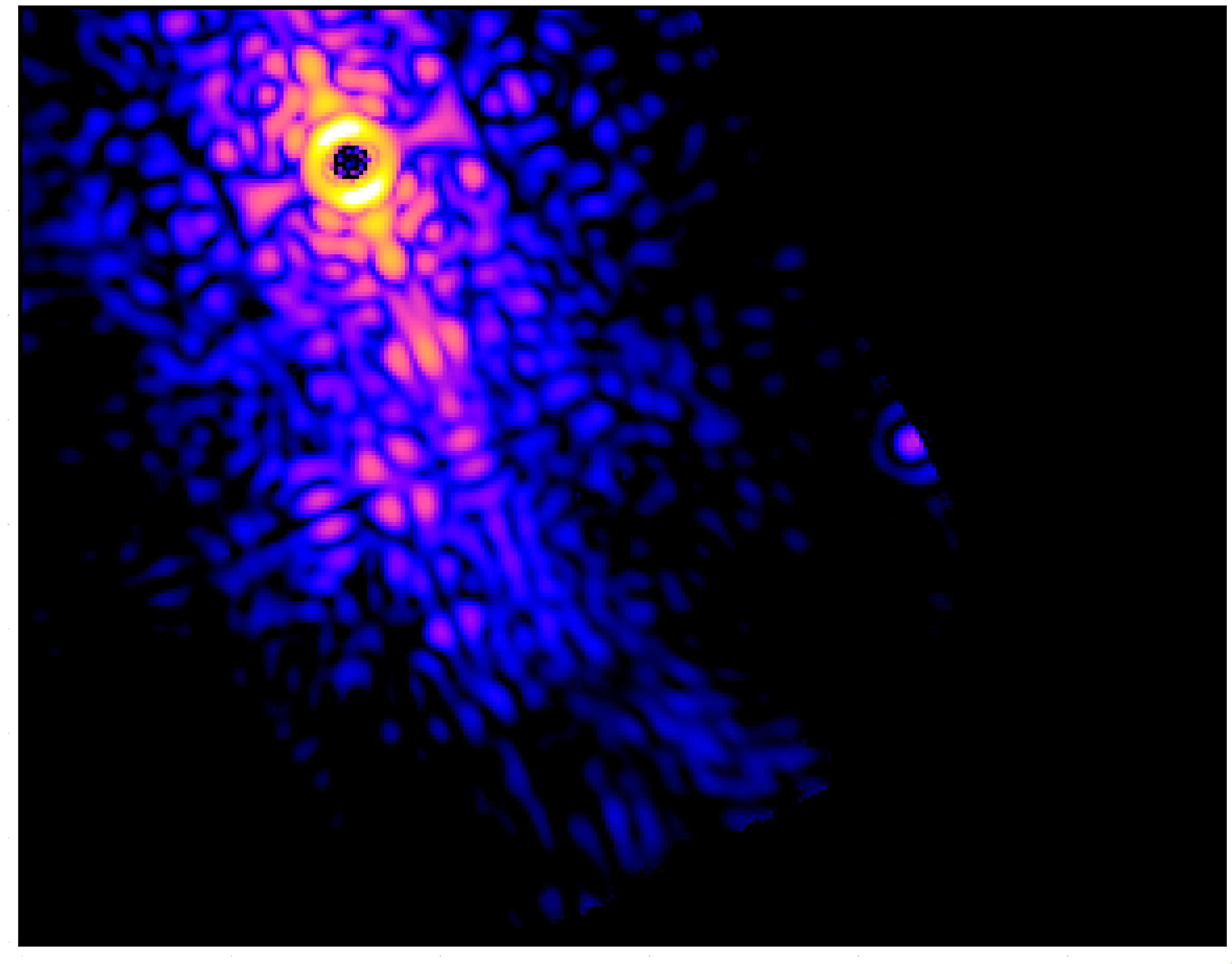
In August 2024, a point source S1 was detected at 1.5″ east of Alpha Centauri A, with a flux of 3.5 ± 1.0 mJy and a contrast of 5.5×10⁻⁵. The statistical significance was 4–6 sigma. The source did not appear in February or April 2025, ruling out a stationary background object. Analysis of archival Spitzer, 2MASS, and VLT/NACO data revealed no counterparts at the position of S1, and the probability of chance coincidence with an extragalactic object is less than 4×10⁻⁴. If S1 is the same object as the candidate C1 from VLT/NEAR, then 52% of dynamically stable orbits consistent with both points predict that the planet could have been missed in both subsequent epochs due to orbital motion. Stable orbits fall into four families: with semi-major axes around 1.6 or 2.1 AU, eccentricity around 0.4, and mutual inclination around 50° (prograde) or 130° (retrograde) to the binary orbital plane. The equilibrium temperature of the candidate is around 225 K. Atmospheric models ATMO2020++ and PICASO allow a radius of 1.1–1.15 Jupiter radii and a mass of 90–150 Earth masses, consistent with radial velocity upper limits. Alternatively, a smaller planet with a radius of about 1 Jupiter radius and an optically thick ring with a cross-sectional area twice that of Saturn's rings also explains the photometry. The limit on exozodiacal dust was less than 5–8 levels of brightness of the Solar System's zodiacal cloud, 5–10 times more sensitive than for any other stellar system.
Implications
This work differs from neighboring studies in that it applies JWST/MIRI coronagraphy to the nearest Sun-like star for the first time, aiming at direct detection of a planet in the habitable zone and achieving a record limit on exozodiacal dust. If the candidate is confirmed, it would be the closest (1.33 pc), coldest (~225 K), oldest (~5 billion years), and least massive (≤200 Earth masses) planet directly imaged around a Sun-like star. The dust limit of 5–8 zodiacal levels is an order of magnitude better than previous achievements in photometry and interferometry.
Future development
The key task is to re-detect S1. Calculations show that August 2026 provides an excellent window: the planet will be at a separation of more than 1″ from the star and away from the coronagraph quadrant boundaries. Urgency is added by the close approach of Alpha Centauri A to the background star KS5 in 2027–2028, which could interfere with observations. Further characterization is possible with NIRCam to test atmospheric models, the Roman Space Telescope coronagraph for reflected light, METIS on E-ELT for spectroscopy and exomoon searches, as well as ALMA and future missions Toliman and SHERA for direct mass measurement.
Impact
Confirmation of the planet would affect theories of planet formation in close binary systems and strategies for searching for life around nearby stars. The exozodiacal dust limit is important for planning future missions to search for Earth-like planets, such as the Habitable Worlds Observatory.
Next steps
Conduct JWST/MIRI observations in August 2026 to re-detect S1. In parallel, continue radial velocity and astrometry monitoring to refine the mass and orbit of the candidate.
Key open problems
For exoplanet astrophysics, the open question remains how often gas giants exist in the habitable zone of Sun-like stars and how their presence affects the possibility of Earth-like planets. This work directly tests the dynamical stability of the inner regions around Alpha Centauri A and provides the first observational constraints on exozodiacal dust in this system.
The knowledge machine's view
This section is addressed to the author of the paper and their colleagues. Neighbouring works were found by meaning-based search across our archive, not by word overlap. We do not review: we show the field around the work.
What the work does
The study reports observations of Alpha Centauri A with the MIRI coronagraph on JWST across three epochs, detecting a point source S1 in August 2024 and its absence in subsequent epochs. A joint analysis with the VLT/NEAR candidate C1 yielded families of dynamically stable orbits and constraints on exozodiacal dust.
Where its strength is
The work achieves record sensitivity to warm dust in the habitable zone of the nearest Sun-like star, and the joint analysis of two independent candidates provides concrete orbital solutions that can be tested by future observations.
Where it could go next
- It might be interesting to compare the observation strategy and candidate analysis with the work on the invisible planet in the disk, where JWST was also used to confirm an object through indirect evidence.based on: Stellar Nurseries in the Jet's Shadow: JWST Explores Centaurus A arXiv:2607.04942v1
- A related study is the JWST investigation of LHS 1140b's atmosphere; if the candidate around Alpha Centauri A is confirmed, its low equilibrium temperature makes it an interesting target for similar spectroscopic study.based on: The Planet Still: LHS 1140b's Helium Exhale arXiv:2607.14326
- A possible direction is to compare with the work on a sub-Saturn around a cool star, which discusses formation mechanisms of giant planets; this could help interpret the candidate's possible mass and radius.based on: The Universe's Recipe: A Sub-Saturn Around a Cool Star Reveals a Standard Method for Making Giants arXiv:2606.23774
Worth trying
- Test the search methodology on archives of other instruments (for example, archival HST data) to find additional epochs that could cover the predicted positions of the candidate on stable orbits.
- Model the observability of the candidate for future JWST epochs using the derived orbit families to optimize observation scheduling.
- Assess the possibility of detecting rings around the candidate from excess flux in the mid-infrared during future confirmation observations.
Why this may matter
Confirming a planet in the habitable zone of Alpha Centauri A would mark the first direct image of a potentially habitable planet around a Sun-like star and would open a new era in the study of nearby planetary systems.
Nearby works in our archive
- Stellar Nurseries in the Jet's Shadow: JWST Explores Centaurus Asimilarity 0.53
- Two Planets Around a Dim Neighborsimilarity 0.53
- Weighing a Stellar Giant Babysimilarity 0.51
- How a baby planet drinks gas: a new discoverysimilarity 0.51
- A Warm World Around a Quiet Starsimilarity 0.51
- The Heart of the Galaxy in Detailsimilarity 0.51
- The Universe's Recipe: A Sub-Saturn Around a Cool Star Reveals a Standard Method for Making Giantssimilarity 0.50
- The Planet Still: LHS 1140b's Helium Exhalesimilarity 0.50
The archive is sparse around this work: the closest review is only 0.53, against a usual 0.64. It looks like few have drilled nearby.
If the candidate S1+C1 is real, its orbit is inclined to the binary plane by about 50° or 130°, meaning the planet moves almost perpendicular to the orbit of Alpha Centauri A and B. Such a configuration is naturally explained by the Kozai–Lidov mechanism, where the gravity of a distant companion periodically changes the eccentricity and inclination of the inner orbit.
The idea of a planet around Alpha Centauri A echoes the world of Pandora from the movie Avatar, with the gas giant Polyphemus in the habitable zone of the star Alpha Centauri A, orbited by a habitable moon. Although candidate S1 likely does not have a habitable moon, its existence would show that giants in such systems are possible.
Key numbers
- distance to Alpha Centauri A: 1.33 pc
- flux of source S1: 3.5 mJy at 15.5 μm
- contrast of S1 to star: 5.5×10⁻⁵
- equilibrium temperature of candidate: ≈225 K
- mass of candidate: 90–150 Earth masses
- limit on exozodiacal dust: 5–8 levels of zodiacal cloud