A Beacon Near Our Nearest Sun: First Glimpse of a Planet around Alpha Centauri A ✛
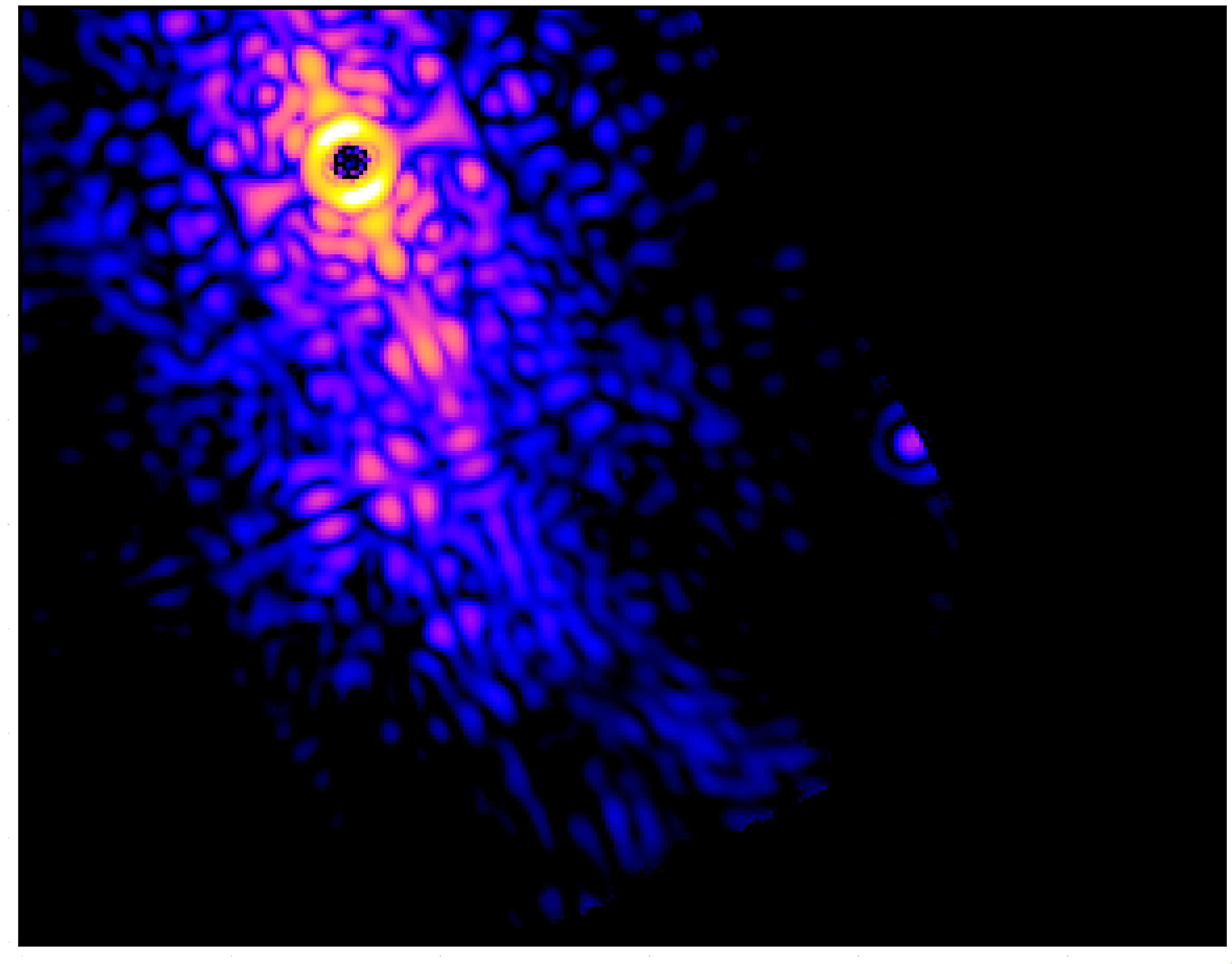
In August 2024, the MIRI coronagraph on the James Webb Space Telescope stared at Alpha Centauri A, the nearest Sun-like star to our Sun. At 1.5 arcseconds from the star, a point source, S1, blinked into view. Flux: 3.5 mJy, contrast: 5.5×10⁻⁵. Four to six sigma. A lighthouse flashing in the fog.
But in February and April 2025, the source did not return. Twice the coronagraph returned to the star, and twice it saw only emptiness. If S1 is a planet, its orbit must have carried the signal beyond the instrument's sensitivity. A joint analysis with candidate C1 from VLT/NEAR 2019 yields a family of stable orbits: semi-major axes of 1.6 or 2.1 AU, eccentricity about 0.4, and inclination of 50° or 130° to the binary plane. The orbital period is two to three years. The planet dives toward the star, then retreats into the cold. A dance easy to miss.
Physical models allow for a gas giant with a radius of 1–1.1 Jupiter radii and a mass of 90–150 Earth masses. Its equilibrium temperature is about 225 K, colder than any body in the Solar System beyond the orbit of Mars. An alternative: a smaller planet with an optically thick ring, whose cross-sectional area is half that of Saturn's rings. The ring reflects light, making the planet appear brighter. It is not yet clear what exactly we saw.
But one thing is clear: there is almost no exozodiacal dust in the system. The upper limit is 5–8 levels of brightness of our zodiacal cloud, 5–10 times more sensitive than for any other star. This is good news for future missions hunting Earth-like planets: less dust, less interference. And it adds a new puzzle. If the planet is confirmed, it would be the closest (1.33 pc), coldest (~225 K), oldest (~5 billion years), and least massive (≤200 Earth masses) planet directly imaged around a Sun-like star. A beacon in the fog that needs to be caught again.
The next window is August 2026. The planet will be more than 1″ from the star and away from the coronagraph quadrant boundaries. If S1 flashes again, we will map it. If not, the fog remains fog, and the search continues.
If the S1+C1 candidate is real, its orbit is inclined to the binary plane by roughly 50° or 130°—the planet moves almost perpendicular to the orbit of Alpha Centauri A and B. Such a configuration is naturally explained by the Kozai–Lidov mechanism: the gravity of a distant companion periodically changes the eccentricity and inclination of the inner orbit.
The idea of a planet around Alpha Centauri A echoes the world of Pandora from the movie Avatar—a gas giant, Polyphemus, in the habitable zone of Alpha Centauri A, orbited by a habitable moon. Although candidate S1 likely lacks a habitable moon, its existence would show that giants in such systems are possible.