The Universe's Foundry: Kilonova Dust and the Birth of Gold ✛ ✦
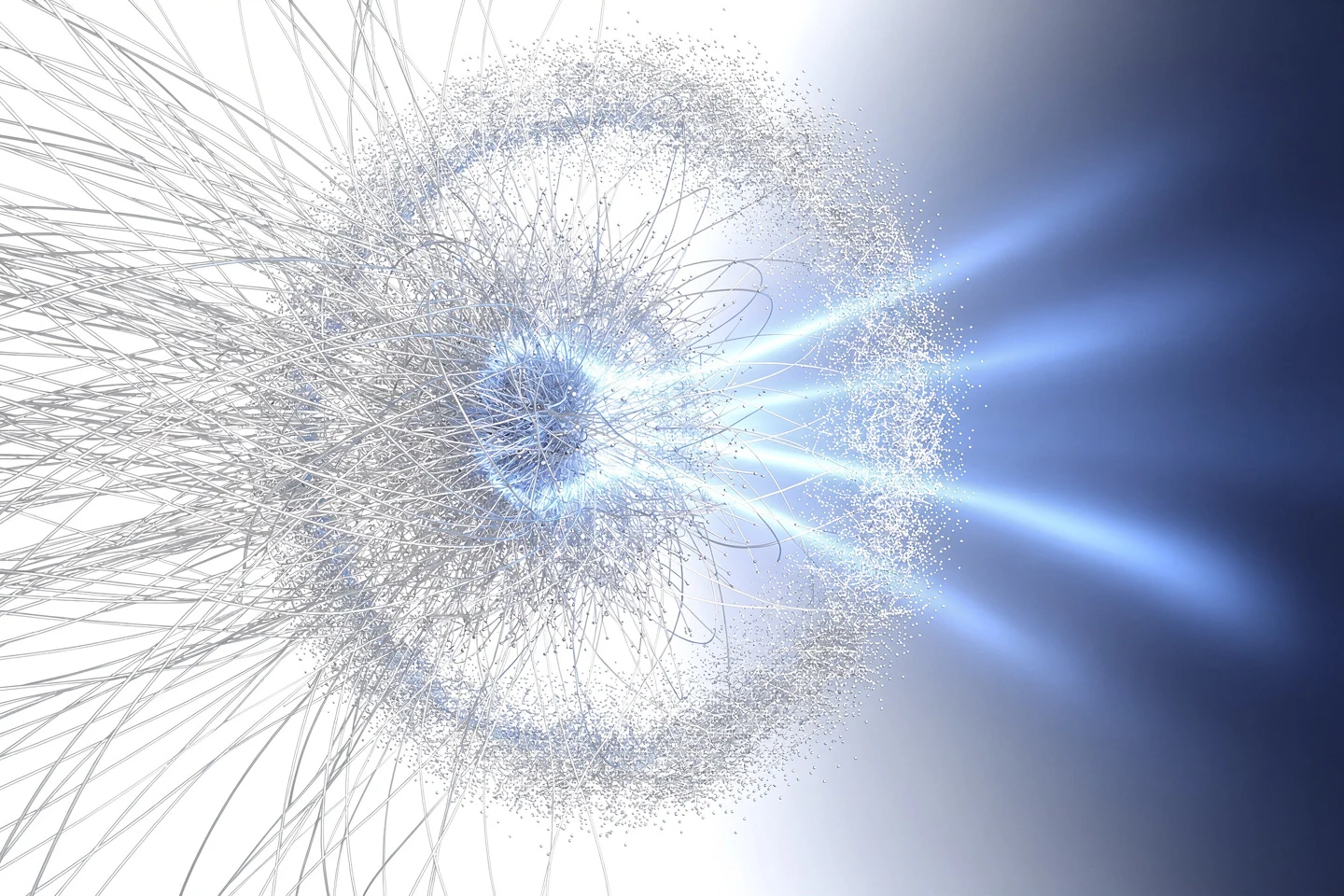
When two neutron stars, the ultra-dense cores of dead stars, collide, a kilonova is born: an explosion a thousand times brighter than a typical nova. This is the universe's true smelting works. In the scorching cloud racing outward at near-light speeds, a furious flux of neutrons transmutes atomic nuclei into gold, platinum, osmium. But the late stage of such events long remained a mystery. A month after the outburst, James Webb spectrographs picked up a smooth infrared continuum, resembling the radiation of a perfect blackbody at 660 K — instead of the expected comb of atomic lines. The solution came with the discovery: dust condenses directly out of the heavy elements.
The secret lies in the refractory nature of many r-process products. Imagine: over the mouth of a blast furnace, metallic vapor churns; as it cools, it turns into a fine suspension. Similarly, in the expanding ejecta, when the temperature drops below 1800 K, atoms of tungsten and osmium stick together into clusters. The process avalanches — already 20 days after the merger, a good half of the heavy nuclei have turned into dust. But the key to understanding is in the geometry of the explosion: condensation occurs only in the slow inner layers, where the expansion speed doesn't exceed 0.1 the speed of light and the density is still high enough for atoms to meet. The outer, fast-moving shells remain transparent and give only a faint dotted line of spectral lines. A simple estimate of the optical depth, \[ \tau_d \approx 1 \,\left(\frac{M_d}{10^{-3}\,M_\odot}\right) \left(\frac{v_{\rm ej}}{0.1c}\right)^{-2} \left(\frac{t}{29\,\rm day}\right)^{-2},\] shows that a minuscule mass of dust, about a thousandth of a solar mass, is enough to completely wrap the cloud in a cloak opaque to infrared light after a month. It's this thick dusty blanket that produces the blackbody spectrum, which brilliantly matches spectroscopy data for kilonova AT2023vfi.
This discovery turns late-time infrared spectroscopy of kilonovae into a powerful diagnostic tool. By analyzing the shape and brightness of the dust continuum, we can recover the mass and chemical composition of the ejecta — essentially peering into the heart of the cosmic forge. Thus, we get a direct way to weigh the gold, platinum, and other precious metals born in mergers of neutron stars — the very events increasingly caught by gravitational wave detectors, developed with contributions from Rainer Weiss. This is invaluable for distant kilonovae too faint for detailed optical analysis. Incidentally, similar dust formation mechanisms may operate in supernovae, whose ejecta are enriched with carbon and lighter elements, but kilonovae offer a unique chance to study the “pure” r-process. The classical theory of nucleosynthesis, laid down by Margaret Burbidge and her colleagues, gains a new experimental foundation.
The discovery of dust emission lifts the curtain on the future. Next-generation telescopes will be able to register this “infrared code” from ever more distant mergers, all the way back to the era of the first stars. Refining models that account for multi-component alloys and reverse shock waves will let us read the detailed history of each explosion in the dust. Perhaps we'll learn to distinguish types of ejecta, from heavily “dusted” to nearly transparent, and reconstruct the diversity of parent neutron star systems, predicted almost half a century ago after Jocelyn Bell Burnell's discovery of pulsars. So the cosmic foundry reveals its secrets, and tiny dust grains become a chronicle of the origin of heavy elements. And think, for a moment: every gold ring on your finger is the light of a distant kilonova, captured in metal.
Imagine a dust grain the size of a thousand tungsten atoms: it's a million times smaller than a grain of sand, yet thanks to its enormous density (about 20 g/cm³), it can absorb all infrared radiation within the ejecta. And if such dust formed in a kilonova in our Galaxy, its thermal glow would be visible even through an amateur telescope!