Thermal conductivity prediction refers to computational and machine-learning methods for estimating or discovering materials with desiredheat-transport properties, such as ultra-low or ultra-high thermal conductivity. This is crucial for applications like thermoelectric energy conversion, thermal barrier coatings, and heat management in electronics. The challenge lies in the fact that thermal conductivity depends on complex atomic-scale interactions — phonon scattering, crystal structure, defects, and composition — making it difficult to predict from simple rules.
History
The field emerged from early empirical correlations in the 20th century, but the modern era began in the 2000s with high-throughput computational screening. The use of deep learning for thermal conductivity, as exemplified by models like KappaFormer, is a development of the 2020s, driven by the availability of large materials databases and advances in graph neural networks.
How it works
Modern approaches combine first-principles calculations (like density functional theory) with machine learning models trained on large databases of known materials. For example, neural networks can learn to map atomic structures and compositions to thermal conductivity values, then screen millions of candidate compounds in silico. Key physical insights, such as the role of anharmonicity, phonon group velocity, and scattering rates, are encoded in the features used by these models. The best predictions often come from hybrid methods that use physics-based descriptors alongside data-driven regression.
In practice
These methods are used to discover new thermoelectric materials for waste-heat recovery, identify efficient thermal insulators for aerospace, and optimize heat spreaders for microelectronics.
Fun fact
Machine learning models have predicted materials with thermal conductivity lower than that of air, which could revolutionize insulation if synthesized.
Old treasure maps were drawn from hearsay: someone found gold by a river, someone else in the mountains, and each person dug in their own spot. High-temperature superconductors went the same way: cuprates were found in some compounds, iron pnictides in others, nickelates in yet others, and there was no common map.
A conventional computer computes by shuttling electric charges along wires. But can you compute with heat? A network of pipes carrying hot and cold water can perform simple logic operations if the pipes are connected in the right order.
The river splits in two. One branch is wide and fast, with water flowing smoothly, but as temperature rises, the flow slows: eddies and waves appear. The second branch is narrow, with rapids, where water leaps from rock to rock. This flow, on the contrary, becomes more lively with warming.
Radio signals in a room act just like sound in a concert hall: bouncing off walls and objects, they create a unique pattern — a silent melody for every location. Your phone, like a keen ear, catches this melody amid noise and distortion. It remembers which chord matches the corner of the couch, and which one fits the doorway.
A search party combs a foggy field. At first, people spread out wide: a high 'temperature' of search means a great variety of attempts. Upon finding a trace, they close in. But the speed of convergence is critical — narrow the circle too early, and the best find stays aside. The coordinator assesses the spread of searchers and commands when to speed up or slow down.
DFTB is a high-speed train in the world of quantum chemistry: hundreds of times faster than classical DFT, yet still on electronic rails. But its engine — iterative self-consistency of charges — sometimes resembles an orchestra where each instrument starts from an arbitrary note.
Imagine an audition for a symphony orchestra, where out of hundreds of hopefuls, only those whose instruments sound pure and withstand the furious crescendo remain. In the world of materials, computers have learned to generate 'atomic scores'—thousands of virtual crystals that promise to become the foundation for quantum chips or superconductors.
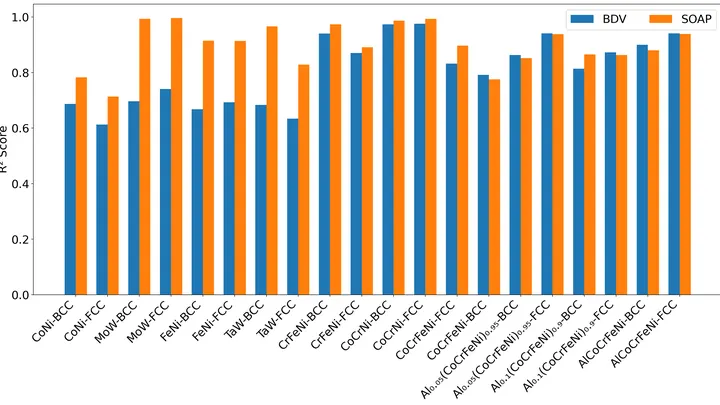
Creating an alloy from several metals is like cooking a soup from mysterious ingredients: guessing the final texture without trial and error is nearly impossible. Conventional models often get it wrong when there are more than three different kinds of atoms.
Heat flows through matter like water through pipes: sometimes fast, sometimes barely. Engineers seek materials that almost don't let heat pass — like clogged pipes. Such insulators are vital for energy saving and devices that turn heat into electricity. The neural network KappaFormer quickly evaluates the "throughput" of an atomic structure.
In a cold cloud of atoms chilled to near absolute zero, energies can behave like threads that weave into braids. These braids are not just a pretty image: their pattern is tied to topology, the branch of mathematics that studies properties preserved under continuous deformations.
A piece of aluminum alloy is heated, and it quietly tells you about its strength. You just need to listen to that story in how the metal absorbs heat.
The usual way to find out how strong an alloy is — pull it until it breaks. That takes time and destroys the sample.
A film of a shattered cup played backward looks absurd: shards don't spontaneously reassemble. This intuitive sense of irreversibility is tied to the increase of entropy — a measure of disorder in a system. The second law of thermodynamics states that the entropy of an isolated system never decreases, setting time's direction from past to future.
A chunk of nuclear fuel inside a reactor is not just a solid. When heated, the uranium atoms in it start to 'wiggle' their magnetic moments, and this motion changes thermal conductivity and other properties.
Certain materials, near absolute zero, superconduct: electricity flows without loss. The critical temperature starts this. John Bardeen and colleagues explained that atomic vibrations glue electrons into Cooper pairs.
A metal alloy is like a cocktail: mix a few elements and you get a material with new properties. But while a bartender tastes the drink, engineers need to know in advance how an alloy will behave in service.