Steam from Scorching Rocks: Silicon Gas in the Atmosphere of TWA5B ✛ ✦
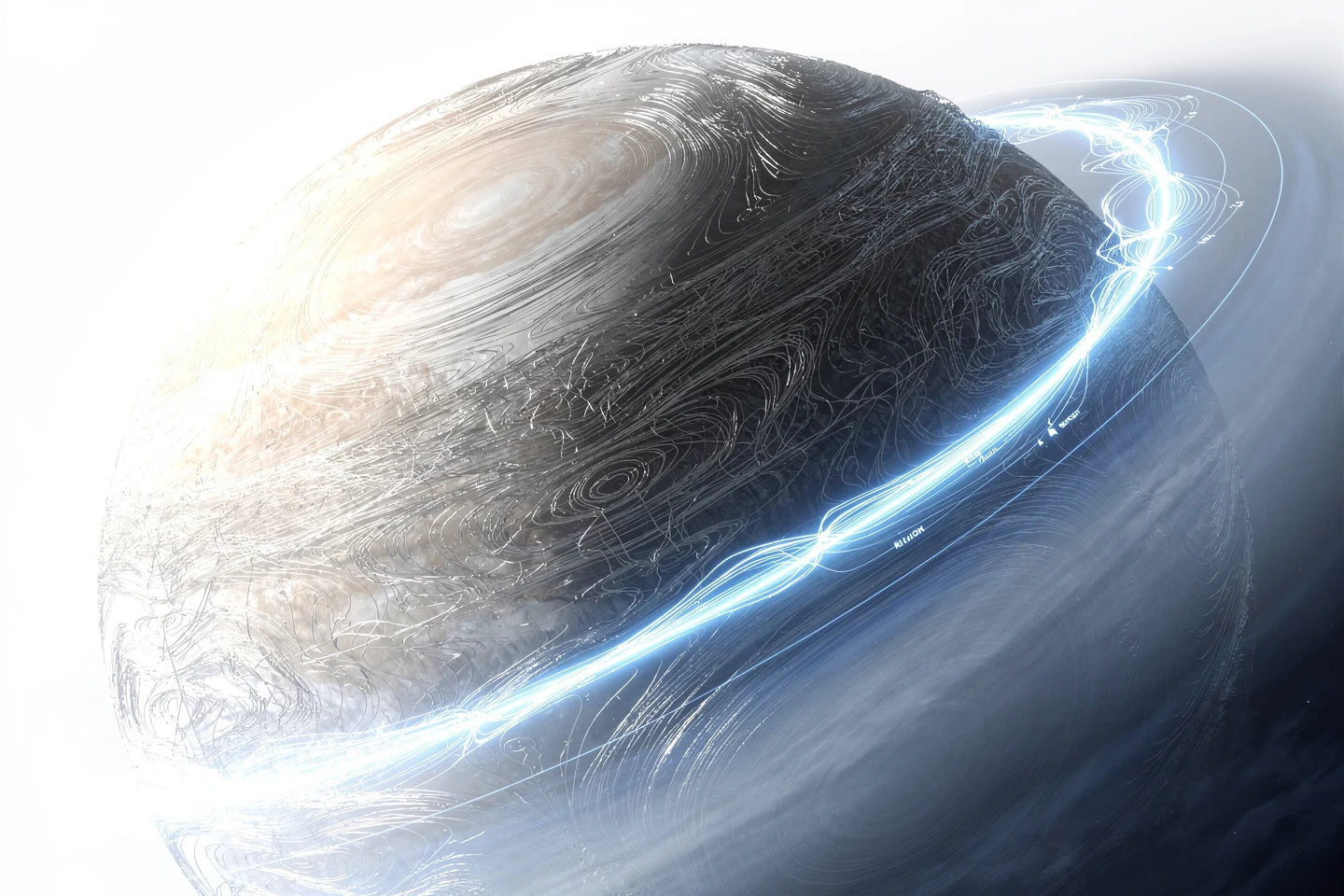
The young super-Jupiter TWA5B, a scorching ball 25 times Jupiter's mass, floats just fifty light-years away. Its faint infrared glow long hid its chemical makeup. Now, high-resolution spectroscopy with CRIRES+ has registered the ghostly trace of SiO — silicon monoxide. This gas is the main messenger of solid material in scorching atmospheres: it is born from vaporized rock and stays volatile until the temperature drops below the condensation threshold of silicates. To tease out the weak signal, the model accounted for collision-induced absorption by H2–He: it acts like a haze that mutes spectral lines.
The metaphor of a cosmic forge becomes tangible. The protoplanetary disk around TW Hydrae acted like a giant furnace: dust and ice fused into rocky embryos, while water and carbon monoxide shrouded them in vapor. As the planet heated up, it began to boil off the material it had absorbed, and now we see this chemical smoke. By detecting CO and H2O alongside SiO, astronomers deciphered the recipe: the high silicon abundance (Si/H 25 times solar) tells us that the giant ingested an anomalously large amount of silicates. And the low C/O≈0.26 ratio indicates: carbon was frozen into CO ices, meaning the planet formed far from the star, beyond the carbon monoxide snow line.
The practical value of this work lies in cloud diagnostics. Silicate clouds made of tiny grains of forsterite, enstatite, or quartz are the bane of observational astrophysics: they shroud the lower layers and distort the spectrum. But when the spectrograph catches strong SiO lines, it means the cloud blanket is absent, and we see the gas directly. Knowing the condensation threshold, we can map cloud types: as cooling proceeds, corundum and perovskite settle first, followed by magnesium-silicate varieties, and finally water clouds. We've caught TWA5B in its youth, when even the most stubborn minerals remain airborne. In essence, we see the vaporized rocky skeleton of the planet — a unique chance to peer into its geological record before clouds hide the truth.
Next-generation telescopes, JWST and the upcoming ELT with its METIS instrument, will enable us to track how nucleation kicks in as the planet ages and cools, and how a dusty veil is born from gaseous silicon. Meanwhile, we are learning to read chemical signatures in the light of distant suns, step by step approaching the key question: how typical is the rocky heart of our own Jupiter?
Silicon monoxide (SiO) is a remarkable molecule: in the gas phase, it appears not only in the atmospheres of hot exoplanets but also in the interstellar medium, born in supernova shock waves. Yet on Earth, SiO instantly polymerizes into solid silicates, the very sand that makes up beaches and concrete.