Francesco D'Eugenio

8 articles · 30 co-authors · latest: 2026-07-28

We have retold 8 papers by this author. 5 of them with a full read. most often about: Accretion disk, quasar, broad_line_region. 30 co-authors across our retellings.

Links in the knowledge graph
Galaxies2025-07-283 minarXiv:2507.20684
Galaxies2026-01-131 minarXiv:2601.08693express
Galaxies2026-03-191 minarXiv:2603.18775express
Galaxy Lit Up Just 330 Million Years After the Big Bang
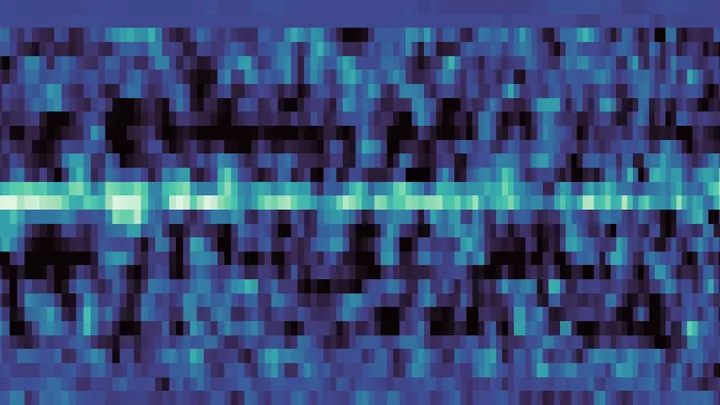
Light from a distant galaxy traveled to us for 13.4 billion years. The James Webb Space Telescope caught it and split it into colors. The spectrum shows a bright hydrogen line, like a fingerprint saying that galaxy GS-z13-1-LA is actively forming stars. Young hot stars inside the galaxy act like floodlights.
Galaxies2026-03-201 minarXiv:2603.20362express
Galaxies2026-06-043 minarXiv:2606.06620
Roots of the Cosmic Banyan: How Black Holes Feed
Cosmic black holes at the centers of galaxies are like giant banyan trees: their aerial root‑filaments stretch for kiloparsecs to harvest nourishing matter. For decades astronomers have debated: how does cooling gas from cluster atmospheres fall into the sphere of influence of a supermassive hole?
Galaxies2026-07-242 minarXiv:2607.22835
Archipelago in the Ocean of Data: Red Points Without Color Boundaries
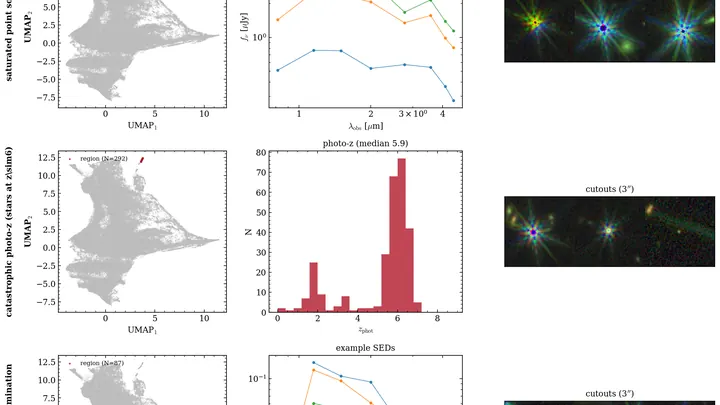
Two hundred forty-two thousand three hundred twenty-seven galaxies — like grains of sand on a beach. But astronomers turned this chaos into a map: the UMAP algorithm (a machine learning method) took from each galaxy eleven parameters — seven colors from optical to mid-infrared (that's photometry), magnitude…
Galaxies2026-07-253 minarXiv:2607.22966
A Chick in a Dust Shell: How a Red Quasar Emerges
In the deep field of JWST, among thousands of galaxies, astronomers zoomed in on the source JADES-GS 209777 – and saw a cosmic chick. Its "shell" is a thick cocoon of gas and cosmic dust that long hid the growing black hole at its center. But at a redshift of 3,711 (1,8 billion years after the Big Bang), the shell began to crack.
Galaxies2026-07-283 minarXiv:2607.26177
Black Hole Infants: A Handicap Race in the Early Universe
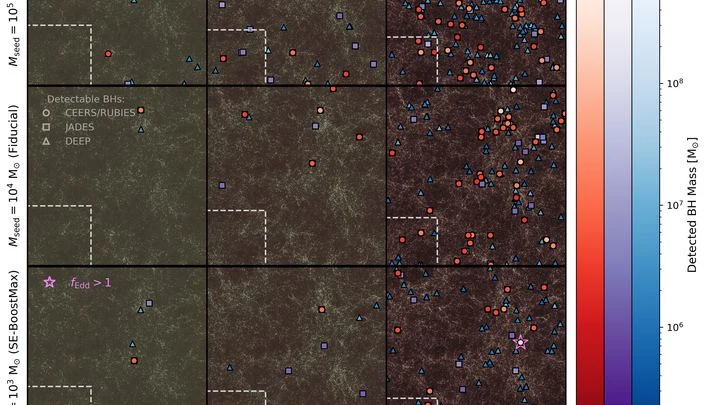
A marathon lasting 13 billion years started with different weights. A hundred solar masses — lighter than some gas clouds. A hundred thousand — gravitational dominance, comparable to an elephant among kittens. That's what black hole seeds looked like, ones that by our time should have turned into supermassive giants.