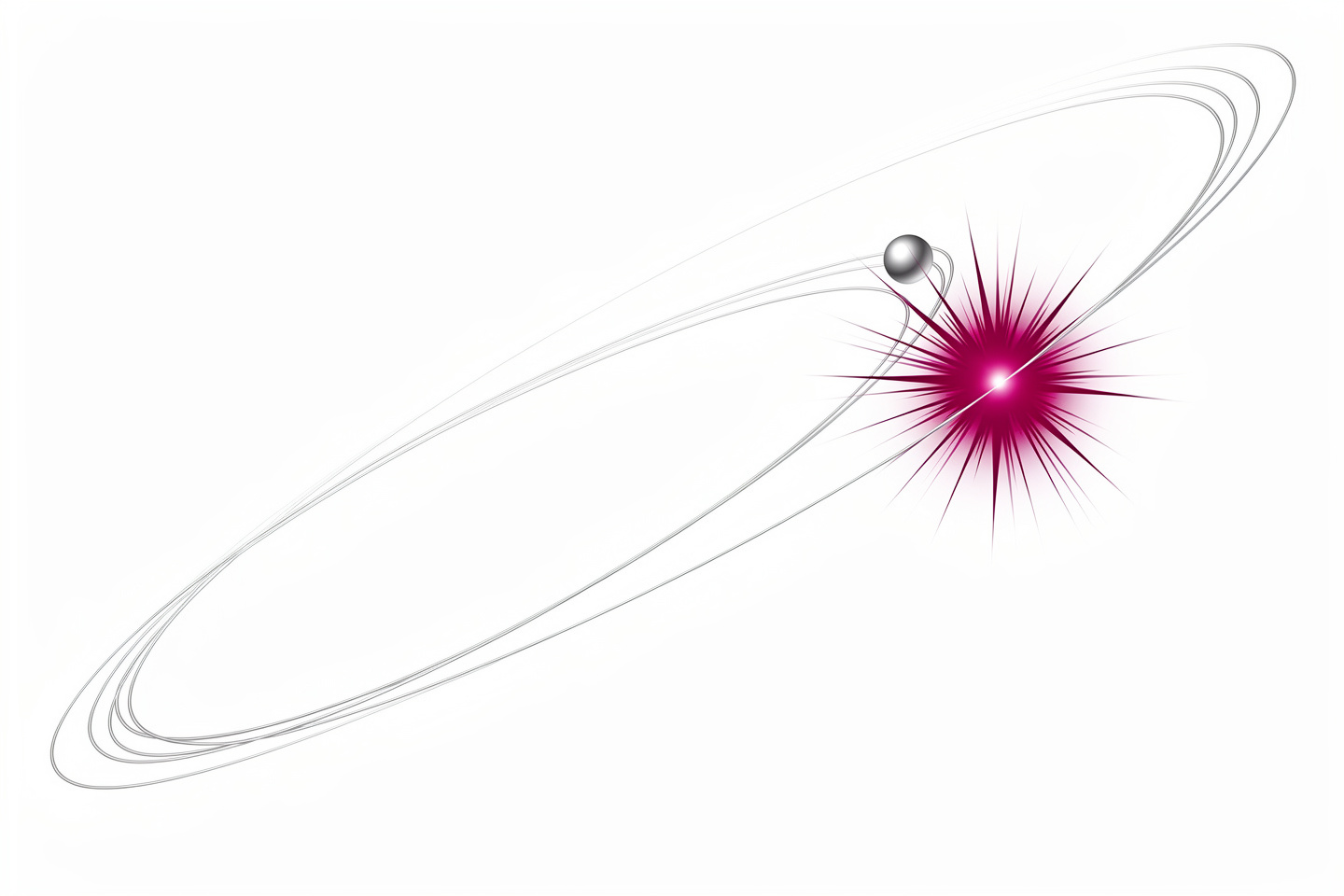
A rocket's fuel tank is like a wallet: if you spend at low speed, you lose bills; at high speed, you lose coins, but you accelerate the same. The Oberth effect is the advantage of firing the engine at high speed.
In practice: Orbital maneuvers of spacecraft: firing the engine at pericenter (the point closest to the planet) yields the maximum energy gain, saving fuel when reaching high orbits and interplanetary transfers.
The idea was first clearly described by Hermann Oberth in his 1923 book, although hints also appeared in Tsiolkovsky's work. The law works due to the nonlinear dependence of kinetic energy on speed. Imagine you push a cart. If it is barely moving, your push adds almost no energy to it — most of the energy turns into heat in your shoes. If the cart is racing, you push off the ground, transferring momentum while remaining nearly in place, and almost all the work turns into its acceleration. In space, the planet's gravitational field plays the role of the ground, and the rocket exhaust provides the 'push.' The faster the rocket relative to the planet, the greater the percentage of fuel energy converted into motion.
How it works
A space probe approaching Jupiter fires its engine at the point of closest approach. There, its speed is maximal, and the same fuel impulse changes the trajectory more. Thus, using the Oberth effect, one can reach the outer planets with less cost.
💡 Oberth first proposed using an 'orbital refueling system' — refueling at high speed, which could allow reaching high velocities without enormous single-use rockets.
The Oberth effect explains why a rocket accelerates more efficiently when it is already moving fast. Kinetic energy depends on speed squared: to double the speed, you need four times the energy. When a rocket burns fuel and ejects gases backward, it gets an extra push. But some energy goes into accelerating the gases themselves. When the rocket's speed is low, the gases carry away a lot of energy; when high, the gases in the planet's reference frame are almost stationary, and almost all the chemical energy of the fuel becomes useful kinetic energy of the spacecraft. A simple analogy: jumping onto a moving train from a standstill is harder than jumping off a moving train — the former requires more effort.
How it works
A space probe approaching Jupiter fires its engine at the point of closest approach. There, its speed is maximal, and the same fuel impulse changes the trajectory more. Thus, using the Oberth effect, one can reach the outer planets with less cost.
💡 Estimates show that without using the Oberth effect, the Cassini mission to Saturn would have required 30% more fuel, making it practically unfeasible.
The Oberth effect is a consequence of the law of conservation of energy for rocket motion in a gravitational field. When the engine fires, the rocket ejects propellant with relative speed u (exhaust velocity). If the current rocket speed in the inertial frame is v, the kinetic energy gained by the rocket over time dt is dK = m v dv + (1/2) dm v² (to first order). For a short impulse (Δv << v), the increase in kinetic energy is ΔK ≈ m v Δv. Burning the same amount of fuel (Δm), the rocket gains more energy the greater its speed v. In the rocket's reference frame, the energy of the exhaust gases is constant, but in the planetocentric frame their kinetic energy depends on v, and at high v it can even be negative relative to the initial state. Thus, an engine firing at the pericenter of an orbit maximally converts chemical energy into orbital mechanical energy.
Discovery
Hermann Oberth, one of the pioneers of astronautics, formulated the effect in 1923 in his work 'The Rocket into Interplanetary Space.' He showed that it is most advantageous to fire the engine at the moment of maximum speed relative to the center of attraction, which later became a standard technique in celestial mechanics. Oberth's ideas were developed by Konstantin Tsiolkovsky and Robert Goddard, but the clear energetic justification was given by Oberth. Later, in the space age, the effect began to be actively used for maneuvers near giant planets, especially in the Voyager and Cassini programs.
How it works
The Oberth effect is fundamental to Hohmann transfers and powered gravity assists. For example, to leave low Earth orbit and head to the Moon, it is advantageous to fire an impulse at perigee. The reverse situation: braking to enter orbit around another planet is most efficient at the pericenter of the approach hyperbola. Limits of applicability: the effect is noticeable when the exhaust velocity is comparable to the current orbital velocity, and it is negligible for low-speed vehicles like atmospheric drones.
Caveats
For low-thrust engines (electric propulsion), long-duration firings smear out the effect, and the optimal point shifts; The effect assumes an impulsive approximation — real engine burn time reduces the gain; In multi-body systems, complex gravitational dynamics can alter the optimal conditions
\Delta K \approx m v \Delta v
ΔK is the increase in the rocket's kinetic energy; m is the rocket mass at the moment of the impulse; v is the current rocket speed; Δv is the speed increment due to the engine firing (Δv << v)
Extra dimensions have long evaded detection due to electromagnetic noise. The protocol of quantum-induced entanglement of masses turns two microscopic bodies in superposition into gravitational tuning forks, accumulating a phase shift exquisitely sensitive to deviations from Newton's law. Analysis o
Scientists have calculated the gravitational radiation from a stellar-mass black hole radially falling into a thin-shell wormhole. The signal resembles rhythmic beats: a burst as the black hole approaches the throat from our side, and a deep silence as it plunges into another universe. Calculations
The event horizon of a black hole conceals not a point of infinite curvature, but a zone of quantum transformation, where time itself changes roles. New research in quantum gravity shows: the singularity vanishes thanks to relational dynamics — one of the metric variables serves as a clock, and the
New research reveals a subtle mechanism: polarization doesn't just illuminate a black hole's shadow — it deforms it. The effect, predicted for rotating holes, is vanishingly small but fundamental: polarimetry transforms from a passive spectator into an active probe of extreme gravity. In a static sc
Analog gravity doesn’t freeze in weak perturbations. When gas roars onto a black hole, it gives birth to a living acoustic spacetime—a horizon that oscillates and shifts. Using an equation of state for ultrahot plasma with a variable adiabatic index, the authors showed that the horizon radius dances
Schwinger pair production in gauge fields reveals the unexpected depth of the vacuum: instead of simple entanglement, nonlocal magic arises—correlations that cannot be described without a full-fledged quantum computer. Holographic duality links this magic to the geometry of strings and black holes,
For the first time, nonlinear simulations of black hole flybys in modified gravity have been performed — test shots on the cosmic range. Comparing the scattering angles with analytics hit nearly the bullseye: the difference stayed within one degree. This paves the way for rapid gravitational wave te
Numerical simulations revealed how plasma gets stuck in the throat of a rotating wormhole, painting a thin luminous rim on its shadow and making it flicker with a period set by mass and spin. These signatures, observable by the Event Horizon Telescope at 230 GHz, turn active galactic nuclei into nat
Matter interferometry creates a Schrödinger's cat for macroscopic masses, opening the path to quantum gravity. A mass in superposition generates two clouds of coherent gravitons — gravitational shadows. Their contrast drops exponentially with increasing mass, signaling the growing entanglement betwe
Quantum cosmology has long faced a paradox: the elegant idea of a universe born from 'nothing' relentlessly favored dreary microscopic worlds. New research shows that swapping the familiar sphere for a three-dimensional torus rewrites the script. Summing over all possible smooth fillings of the toru
Using Cosmicflows-4++, scientists directly estimated relativistic corrections and found that curvature contributes about 10% to the expansion dynamics on scales up to 300 Mpc/h, while kinematic backreaction is negligible. This challenges the globality of ΛCDM and threatens systematic errors in cosmo
In quantum cosmology, the Big Bang singularity turns out to be a mirage. Using relational time emerging from entanglement between subsystems of the universe, physicists have shown: the probability of zero volume is strictly zero. The Page-Wootters formalism transforms a static wave function into an
The hybrid Schrödinger–Newton equation for the first time analytically disentangled two faces of gravity: self-interaction and mutual attraction. It turns out that self-gravity does not alter the Schmidt spectrum, and hence the measure of quantum entanglement; however, the pairwise potential activel
According to classical theory, the collapse of a massive star ends in a black hole with a singularity, where the curtain of physical laws falls. Roger Penrose proved the inevitability of singularities, and Stephen Hawking showed that quantum effects create the information paradox. New work proposes
A new study proposes a simple observational test: any binary system with a negative-mass component must either produce an anomalous signal with a falling frequency or instantly fly apart. Not a single such 'note' has been found in the LIGO, Virgo, and KAGRA archives. The silence shuts down an entire
At the heart of a dying star lies an algebraic cipher that translates the language of matter into the language of black hole geometry. Physicists have found a precise two-way map: given a density profile, you can recover the exterior metric—and vice versa—without solving complex differential equatio
By numerically investigating the scattering of scalar waves on a rotating traversable wormhole, scientists discovered Breit-Wigner resonances. They sharply intensify under fast rotation and for counter-rotating modes, creating a spectral fingerprint radically different from that of black holes—a sig
A new theoretical work unites quantum mechanics and general relativity, showing that two parallel atomic lasers, unperturbed in the classical world, begin to diverge under the influence of quantum fluctuations of spacetime. Vacuum tremors of the metric give rise to an irreducible spread of trajector
Mass currents have now been introduced into the Diósi–Penrose wave function collapse model for the first time, adding post-Newtonian corrections from general relativity. It turns out that moving mass generates gravitomagnetic noise, causing angular momentum decoherence. The most dramatic effects app
The weak equivalence principle has been tested with fantastic precision, but always with grounded samples — as if one string of the gravitational violin is deliberately muted. The κ parameter quantifies whether acceleration depends on electric charge: it is the ratio of the difference in acceleratio
Astrophysicists have proposed a new method for hunting dark matter — not searching for the black holes themselves, but listening to the quantum echo of gravity. In regions of ionized hydrogen, tidal forces from primordial black holes split the atomic level 2P₃/₂, turning a single 9.9 GHz absorption
The diagnostic parameter \(\tilde{\alpha}\) reveals that in galaxies and clusters, the post-Newtonian approximation loses reliability due to accumulated nonlocal gravitational correlations. Its value skyrockets precisely where dark matter is traditionally invoked—and this finding could overturn our
Cosmology allows for a terrifying scenario of phantom dark energy, where the universe's expansion accelerates so violently that it tears apart galaxies, stars, and atoms. Deep-space detectors can't spot a sudden shift to this state: light from distant supernovae has traveled billions of years. So Ro
The no-go theorem dashes hopes of circumventing the wormhole paradox: no interaction with dark energy can shield against the geometric demand for 'negative pressure.' The work shows that even the most cunning models with energy transfer between matter and vacuum shatter against the relentlessness of
The main obstacle for a graviton laser is that gravitational waves cannot be reflected: they pass through any substance. The solution lies in the Gertsenshtein effect. Under a powerful magnetic field, gravity particles temporarily become photons, which are easily reflected by ordinary mirrors. The r
New research shows: wormholes with a precisely tuned throat length can cast a shadow indistinguishable from that of a Schwarzschild black hole. But numerical simulations expose a critical flaw in the disguise—the wormhole's accretion disk emits far more energetic radiation thanks to Doppler boosting
Quantum gravity eludes experiments due to the Planck scale. But the 2026 Gravity Research Foundation award-winning work points to a natural super-amplifier: superradiant axion clouds around rotating black holes. This cosmic mechanism generates squeezed states with up to 10⁷ correlated gravitons, cre
In a new cosmological model, the source of accelerated expansion is not a mysterious cosmological constant but the process of absorbing other universes. The merger intensity is set by a single constant g, calibrated by the local value of the Hubble constant. The computed evolution of the dark energy
The new model intertwines cyclic cosmology and inflation into a single dance: two scalar fields, like blacksmith’s bellows and a valve, alternately compress and inflate the Universe. This approach not only lifts the curse of the singularity but also explains the mysterious smoothness of the cosmos,
When a white dwarf tears apart a passing asteroid, we expect a dust cloud. But new analysis flips the picture: particle cohesion — those very van der Waals forces that hold sand grains in your palm — erects a kilometer barrier. Fragments smaller than hundreds of meters simply cannot be born during t
These objects are one of the biggest mysteries and a possible key to dark matter. New modeling has revealed a rare but spectacular scenario with two outcomes for capture by a binary system. Without an accretion disk, the star fades unnoticed; with a disk, it is torn apart by relativistic jets in min
Neptune's third-largest moon, Nereid, was long counted among the icy intruders from the Kuiper Belt. But its unique infrared spectrum, captured by the James Webb Space Telescope, is unlike any other: crystalline water ice with a reddish tint and traces of carbon dioxide hint at a birth near the plan
Spectral lines of erythrulose (C₄H₈O₄), caught by the Yebes 40m and IRAM 30m radio telescopes, betrayed the presence of this sugar in the cloud G+0.693. For the first time, we see how, in the interstellar medium, on the surface of icy dust grains, components of nucleic acids are born from glycolalde
Analysis of the fireball that blazed on April 1, 2026 over the South Atlantic showed its heliocentric velocity was 51.73 km/s. That's 9.59 km/s above the threshold at which an object forever leaves the Solar System. Scientists accounted for gravitational acceleration, recalculated coordinates, and r
Carbonaceous chondrites that fall to Earth carry a double isotopic signature. Measurements of silicon, iron, magnesium, and chromium tell us that the stuff of Jupiter and Saturn came from two reservoirs, with a late addition of comet dust making up more than a third. Even more surprising, CI chondri
About 800 million years ago, in the main asteroid belt, the parent body of the Eulalia family — a giant chunk of primitive carbonaceous chondrites — broke apart. Nearly three-quarters of the fragments, caught by Jupiter's gravitational resonance, rushed into the inner Solar System, causing a true im
Since 2017, only three interstellar bodies have been discovered — Oumuamua, Borisov, and ATLAS. New research reveals: rapid sky motion renders most such objects invisible. Analytical models and simulations show that faint visitors streak by faster than survey cameras can capture. This explains the p
The bright flash of a bolide is just the first act. After an asteroid or comet fades, dark flight begins: the invisible drift of fragments to the ground. That's when wind sows chaos, shifting the impact point by hundreds of meters. The team of Devillepoix and Cupák deployed the WRF model to calculat
Astronomers took advantage of the visit of the interstellar object 3I/ATLAS to conduct a unique radio reconnaissance. Using the 500-meter FAST telescope and the method of canonical polyadic decomposition, they analyzed the data, trying to extract periodic signals against the background of terrestria
310 light-years from Earth, astronomers have found a remarkable system: a 15 million-year-old star surrounded by two transiting gas giants with record-long orbits of 225 and 314 days. Observations with TESS, CHEOPS, and ground-based telescopes measured their radii and set upper limits on their masse
How does a primordial black hole, a dark matter candidate, alter the fate of a planetary system? Simulations of the TOI-2796 system revealed three dramatic outcomes: planet ejection, formation of a stable triple system, and capture of the planet into an eternal journey with the black hole. The rare
The discovery of 1I/‘Oumuamua made us wonder: could some interstellar wanderers actually be our own comets, ejected from the Oort cloud and returning millions of years later? Simulations show that such ‘quasi-interstellar objects’ are indeed possible, but they have unique characteristics: extremely
A new study has, for the first time, self-consistently incorporated the recipe of double diffusion into an evolutionary code of planets and traced the fate of Jupiter and Saturn from the moment of formation. It turns out that even a thousandfold enhancement of mixing does not lead to significant sme