Levitating Graphite Snags Lunar Gravity ✛ ✦
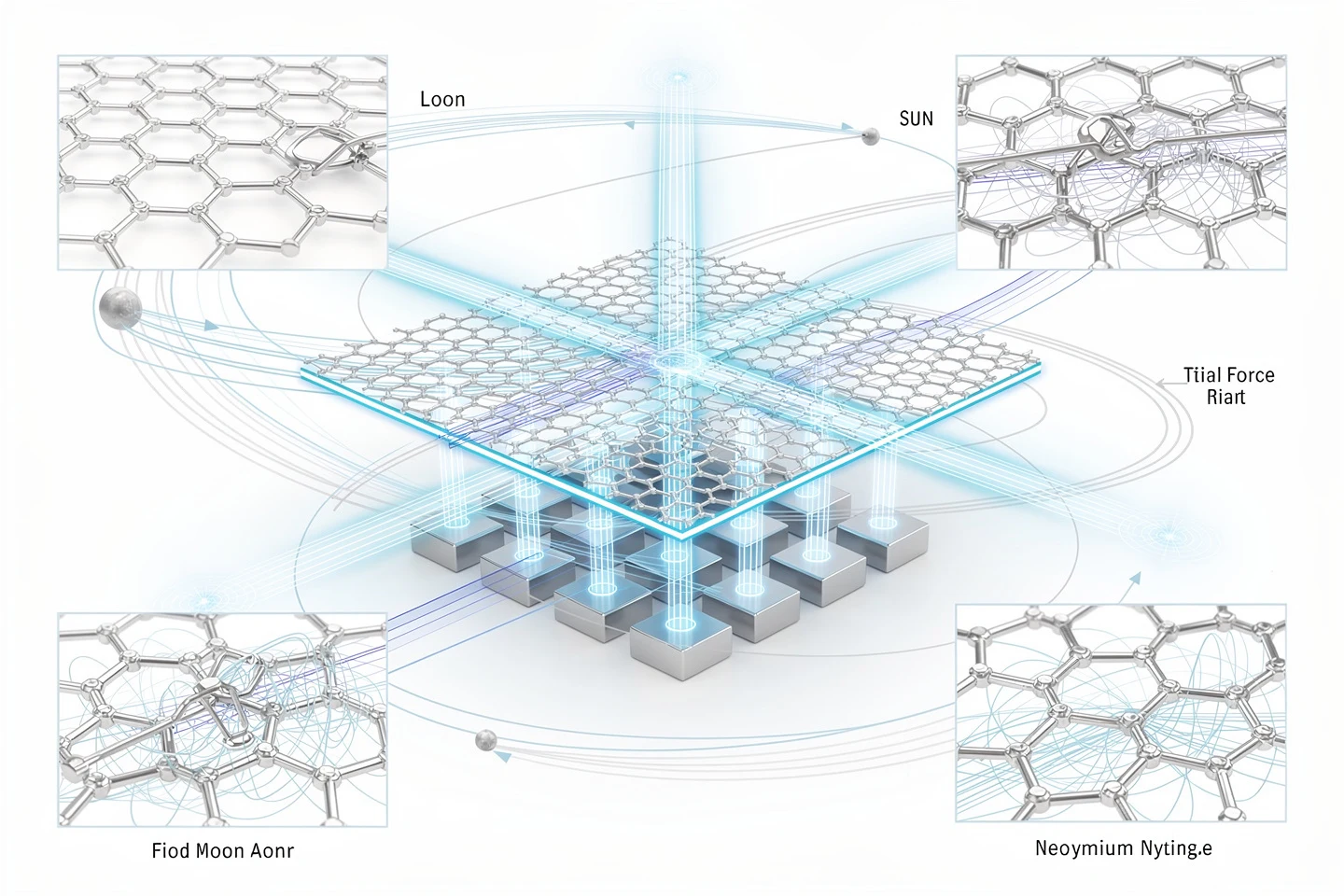
A graphite plate levitates above permanent magnets thanks to diamagnetism — the ability to repel a magnetic field, discovered by Maxwell and Faraday.
This ultra-soft spring captures the tidal forces of the Moon and Sun — the instrument recorded gravity fluctuations with lunar (12.4 h) and solar (24 h) periods. Under these forces, the solid Earth rises and falls by tens of centimeters, but we don't notice. Previously, such sensitivity could only be achieved by giant detectors like LIGO for gravitational waves. Now, thanks to the work of Weiss, the technology has become tabletop.
A network of such instruments could find underground water, predict eruptions, and in science, offer a chance to detect dark matter. An analysis similar to spectroscopy (a method where light is broken down into colors) can extract the "shades" of gravity. In the future — a cosmic array to register gravitational waves from black holes, supernovae, the echo of the Big Bang, and to test Einstein's spacetime curvature, further developed by Thorne.
A graphite plate floats without support thanks to diamagnetism, discovered by Faraday. Its magnetic suspension is 50 times softer than a spiderweb, so it senses how the Earth "breathes" with lunar tides, even when the Moon is below the horizon.
In Arthur C. Clarke's novel "A Fall of Moondust", tourists use such a device to search for underground voids — now this idea has been realized.