Levitating Graphite Catches Lunar Embraces: A New Miniature Gravimeter ✛ ✦
Context
Gravity is the invisible hand shaping the Universe. According to general relativity, massive bodies curve spacetime, and even slight fluctuations in this curvature carry information about mass distribution. Just as giant observatories like LIGO catch ripples of gravitational waves from merging black holes, geophysical gravimeters map Earth's gravitational field, hunting for underground reservoirs, magma chambers, or traces of mining. Yet modern instruments remain bulky, expensive, and energy-hungry, limiting their widespread use. The need for compact, precise, and affordable gravity sensors spurred the creation of a fundamentally new device that uses levitation.
Methods
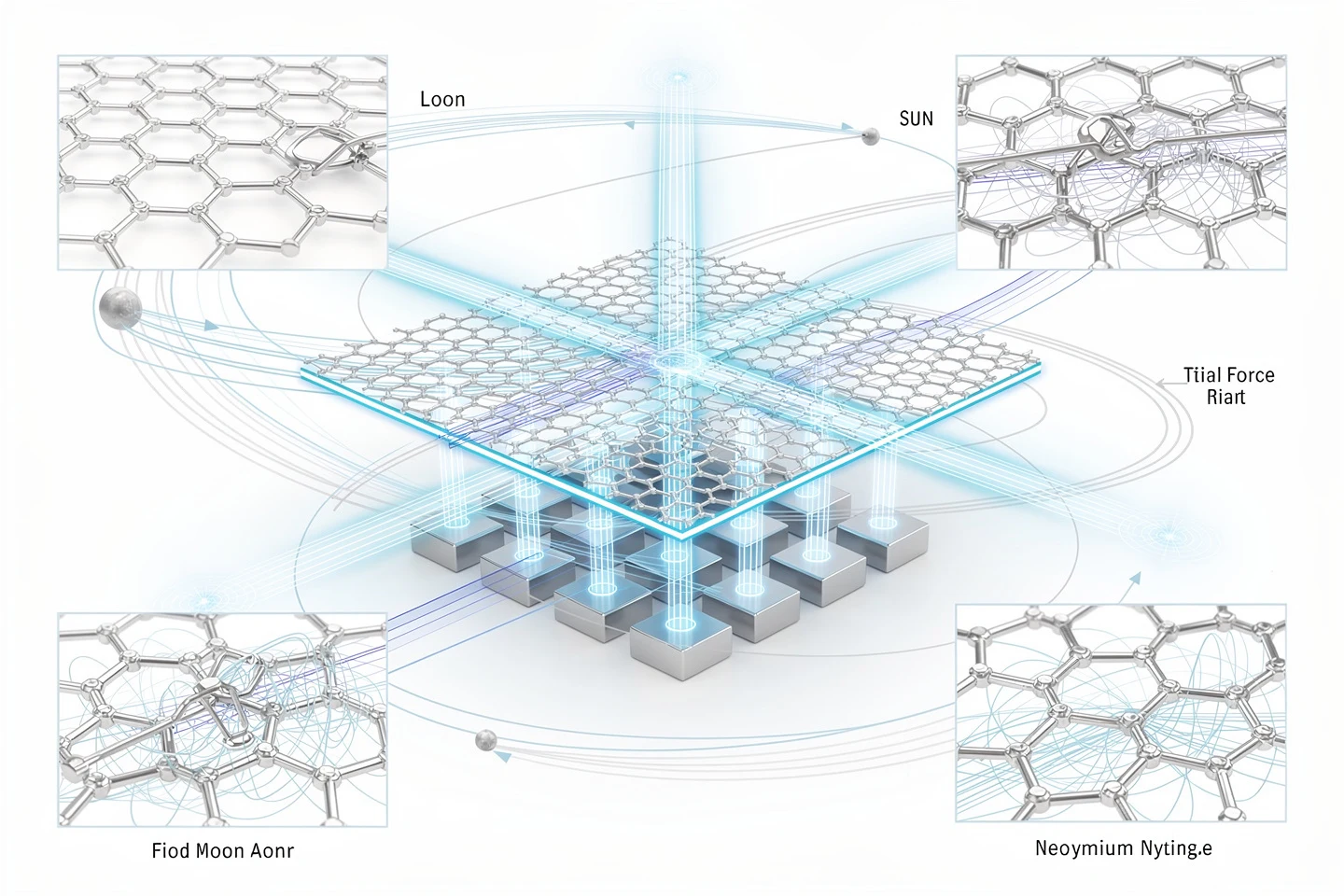
The sensor's core idea is familiar to anyone who has played with magnets: diamagnetic graphite repels a magnetic field and can hover in the air. The experimenters placed a thin flake of highly oriented pyrolytic graphite with a tiny mirror above an array of permanent magnets in a special Halbach configuration. This creates an ultra-soft spring with a resonant frequency of only 0.81 Hz: the slightest change in gravity is enough to shift the graphite 'flying carpet.' To detect nanometer displacements, a quadrature Michelson interferometer is used, cleverly turning light polarization into a precise ruler. Signal analysis resembles spectroscopy: tidal components are extracted by narrowband filters in the frequency domain, much like spectral lines. This approach was pioneered by interferometry's founding figures, including Maxwell, who developed the theory of electromagnetism, and Weiss, one of the fathers of LIGO.
Results
Over a month of continuous observations in Southampton, the instrument recorded a characteristic tidal signal with a clear spring-neap cycle. Comparison with the theoretical model Tsoft showed that the sensor reliably distinguishes the lunar (M2, period 12.42 h) and solar (S2, 24 h) components. At short timescales (6–20 s), a resolution of 18 microgal (1 Gal = 1 cm/s²) was achieved, and the daily drift does not exceed 100 microgal. This stability is comparable to the timing precision of pulsars — cosmic beacons emitting strictly periodic pulses. The thermal noise at room temperature is only 58.5 nanogal/√Hz, and the readout noise is 194 nanogal/√Hz. Although the instrument does not yet fully separate horizontal and vertical accelerations, it has already demonstrated three-dimensional sensitivity, capturing additional peaks not predicted by the one-dimensional model. This paves the way for a full vector gravimeter.
Implications
The creation of such a sensor turns gravity surveying into a mobile and affordable technology. Drones with lightweight gravimeters could map underground utilities, archaeological sites, or mineral deposits from the air. In volcanology, continuous gravity monitoring could enable eruption prediction by tracking magma rise. Distributed sensor networks will help monitor water redistribution and glacier melt — critical climate change indicators. In fundamental physics, miniature levitated masses could serve as probes for dark matter — clumps of it passing through Earth would cause minuscule but detectable oscillations. Such experiments carry on the work of Thorne and other pioneers of precision measurement.
Future development
The next generation of sensors will use a configuration of four levitating masses for gradiometric measurements, enabling common noise rejection and distance determination to an anomaly source. Switching to stronger magnets (with remanence up to 1.56 T) will boost sensitivity by 22%. Suppressing eddy currents in the graphite using composite materials or perforations will increase the mechanical quality factor. Successful tests in microgravity have already been conducted, making the system promising for space missions. An array of such sensors in orbit could detect gravitational waves in a range inaccessible to ground-based observatories, catching echoes of the Big Bang and signals from supernovae.
Impact
The technology will impact geophysics, climatology, planetary science, and cosmology. Miniature gravimeters will become indispensable for resource exploration on Earth and other planets, and will accelerate the development of quantum sensors for testing fundamental physics, including searches for violations of the equivalence principle.
Next steps
The main efforts will focus on constructing a multi-mass gradiometric system and long-term field tests to bring the drift below 1 microgal per year, as required for geodetic applications.
Key open problems
The nature of dark matter remains one of the greatest mysteries. Highly sensitive, cheap, and easily deployable new gravity sensors could join the global search for dark matter particles or primordial black holes by detecting their gravitational influence as they pass through Earth. Furthermore, testing gravity at short distances using levitated masses could reveal deviations from the inverse-square law and hint at extra dimensions of spacetime.
The knowledge machine's view
This section is addressed to the author of the paper and their colleagues. Neighbouring works were found by meaning-based search across our archive, not by word overlap. We do not review: we show the field around the work.
What the work does
This paper presents a miniature gravimeter based on a diamagnetic graphite levitating in a Halbach magnetic trap. An ultra-soft spring with a resonance of 0.81 Hz and interferometric readout enabled the detection of the M2 and S2 tidal components with a resolution of 18 microgal and a daily drift of less than 100 microgal over a month of observations.
Where its strength is
The strength of the work lies in demonstrating that a compact levitation system can achieve sensitivity comparable to bulky stationary gravimeters, at room temperature and without cryogenic cooling.
Where it could go next
- A related work on cooling a magnetic floater to millikelvin temperatures is nearby—borrowing their thermal solutions might further reduce your sensor's thermal noise and improve long-term stability.based on: Magnetic Float Cooled to Millikelvins arXiv:2605.28479
- The archive contains an analysis of a quantum gravitational wave detector using optical resonators; it might be interesting to see how their readout scheme could enhance your interferometer's resolution.based on: A Quantum Net for Gravitational Waves arXiv:2608.02733v1
- To extend the frequency range and move toward vector measurements, consider the fingertip magnetic sensor—it appears to implement multi-component registration in a compact form.based on: Magnetic Hearing at Your Fingertips arXiv:2608.08544v1
Worth trying
- Consider applying vibration isolation or passive cooling methods from work 2605.28479 to reduce thermal noise.
- Assess whether the optical resonator scheme from 2608.02733v1 could be used to amplify the graphite displacement signal.
- Check whether the Halbach magnet design allows simultaneous measurement of multiple gradient components, as possibly done in 2608.08544v1.
Nearby works in our archive
- Quantum Scales on a Web of Lightsimilarity 0.67
- How a Tiny Black Hole Plays a Cosmic Harpsimilarity 0.65
- Gravity on the Edge of Quantumsimilarity 0.64
- Magnetic Float Cooled to Millikelvinssimilarity 0.64
- Dark matter tugs at satellites like invisible stringssimilarity 0.64
- Gravitational Waves Through the Lens of Alternative Gravitysimilarity 0.63
- A Quantum Net for Gravitational Wavessimilarity 0.62
- Magnetic Hearing at Your Fingertipssimilarity 0.62
The closest work in the archive sits at 0.67 by meaning — the usual level for our corpus.
Original abstract
as written by the authors arXiv:2606.14738v1
The detection of mass distributions and mass transport via gravity mapping is a key geophysical tool for understanding the structure and dynamics of the earth. Changes in mass distribution, driven by natural processes and human activity (e.g., extraction of oil, gas, and minerals), contribute to observable phenomena such as sea-level rise (3 mm per year), increased flooding, landslides, and ice mass loss (hundreds of giga-tons per year). These processes generate gravity variations detectable by gravimeters and gradiometers on ground and in space. Current instruments achieve sensitivities of 10-100 micro-GAL per square root of Hz and enable applications including hydrocarbon exploration, volcanic monitoring, and subsurface detection. They also measure Earth tides (100-300 micro-GAL amplitude), requiring long-term stability over days. However, existing systems are limited by size (more than 8 kg) and cost (more than 100,000 USD), restricting widespread deployment. Here we demonstrate a levitated mechanical sensor (LOMS) with a demonstrated sensitivity of 18 micro-GAL, a large dynamical range, and an integration time of 6 s, with an expected sensitivity of smaller than 200 nano-GAL per square root of Hz in a volume of only a few cubic cm. We resolve earth tide signals, demonstrating stability comparable to state-of-the-art instruments. Unlike conventional accelerometers (micro-g sensitivity, low stability), our device operates as a true gravimeter. Its compact size and low projected cost enable scalable deployment, including drone-based surveys (10-100 m altitude), distributed sensor networks, and multipixel gravity imaging arrays. This platform enables high-resolution, cost-effective gravity mapping with potential for large-scale geophysical monitoring.
The graphite flake above the magnets is an ultra-soft spring: its vertical stiffness is just 31 millinewtons per meter, 50 times weaker than a spider web! This allows it to feel the Moon's 'breath,' even when it's below the horizon.
In Arthur C. Clarke's novel 'A Fall of Moondust,' instruments are described that can detect hidden structures beneath the surface by gravitational anomalies — exactly the capability that LOMS enables.
Key numbers
- Sensitivity (6 s): 18 microgal
- Earth tide amplitude: 100–300 microgal
- Resonant frequency: 0.81 Hz
- Test mass: 1.19 g
- Sensor volume: 50 ml