Levitating Graphite Web Captures the Moon's Embrace ✛ ✦
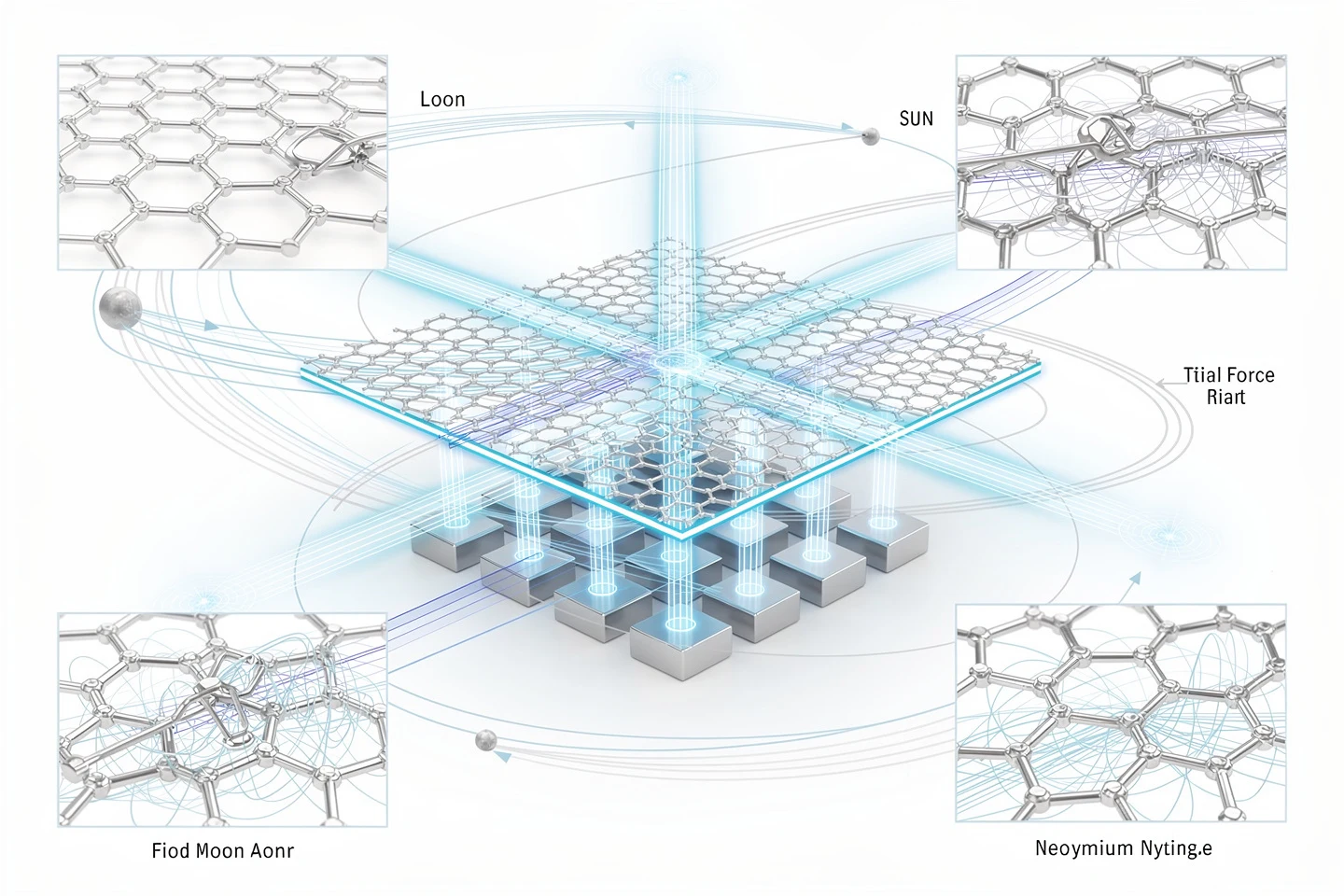
In the quiet of a laboratory, a graphite flake hovers above a magnetic grid. This is not just a demo of diamagnetism's magic — it's listening to the Universe. Like a spider casting its web to catch vibrations from an invisible world, this flake has become a gravitational web. Thread by thread, magnetic field lines stretch it so gently that the faintest breath of lunar gravity makes the web tremble.
The heart of the setup is a Halbach array of permanent magnets, creating an ultrasoft spring. The resonance frequency is just 0.81 hertz: a change in acceleration of billionths of a g is enough to make this graphite 'flying carpet' stir. The detector is a quadrature Michelson interferometer — a tool familiar even to Maxwell and perfected in LIGO under Weiss and Thorne. Signal processing is akin to spectroscopy: tidal components are extracted by narrow-band filters in the frequency domain, like spectral lines from distant stars.
Over a month of continuous observation in Southampton, the web recorded a distinct tidal signal. The spring-neap cycle clearly emerged, and narrow-band analysis separated the lunar (M2) and solar (S2) components. Over short intervals, precision reaches 18 microgals, and daily drift stays within 100 microgals — almost on par with superconducting gravimeters, but without cryogenic complexities. And all at 2 W of power — like a modest nightlight. Stability worthy of pulsars — cosmic clocks.
The miniature gravimeter turns gravimetry into a mobile technology. Drones with such sensors will map underground voids and archaeological layers, networks on volcano slopes will predict eruptions from magma uplift. Global sensor systems will track ice melt and water mass redistribution — indicators of climate change. But the most thrilling prospect is the hunt for dark matter: its clumps, passing through Earth, will make the web shudder. Much like the giant laser antennas of LIGO, which searched for gravitational waves from black holes, this tiny device might catch the echo of the Big Bang.
The next generation of devices will move to multi-mass configurations and stronger magnets, boosting sensitivity by tens of percent. Already tested in microgravity, this approach is ready for space missions. A swarm of such webs in orbit will pick up gravitational waves in a band inaccessible to ground-based observatories — echoes of supernovae and perhaps the primordial ripples of the Big Bang. The graphite web is becoming our new sensory organ, building bridges between the everyday world and the abysses of curved spacetime.
The graphite flake above the magnets is an ultrasoft spring: its vertical stiffness is 31 millinewtons per meter — 50 times weaker than spider silk.
In Arthur C. Clarke’s novel 'A Fall of Moondust', instruments search for hidden structures via gravity anomalies — and LOMS brings that fiction to life.