Astrons: Charged Primordial Giants and Their Cosmological Role ✛ ✎ ✦
Context
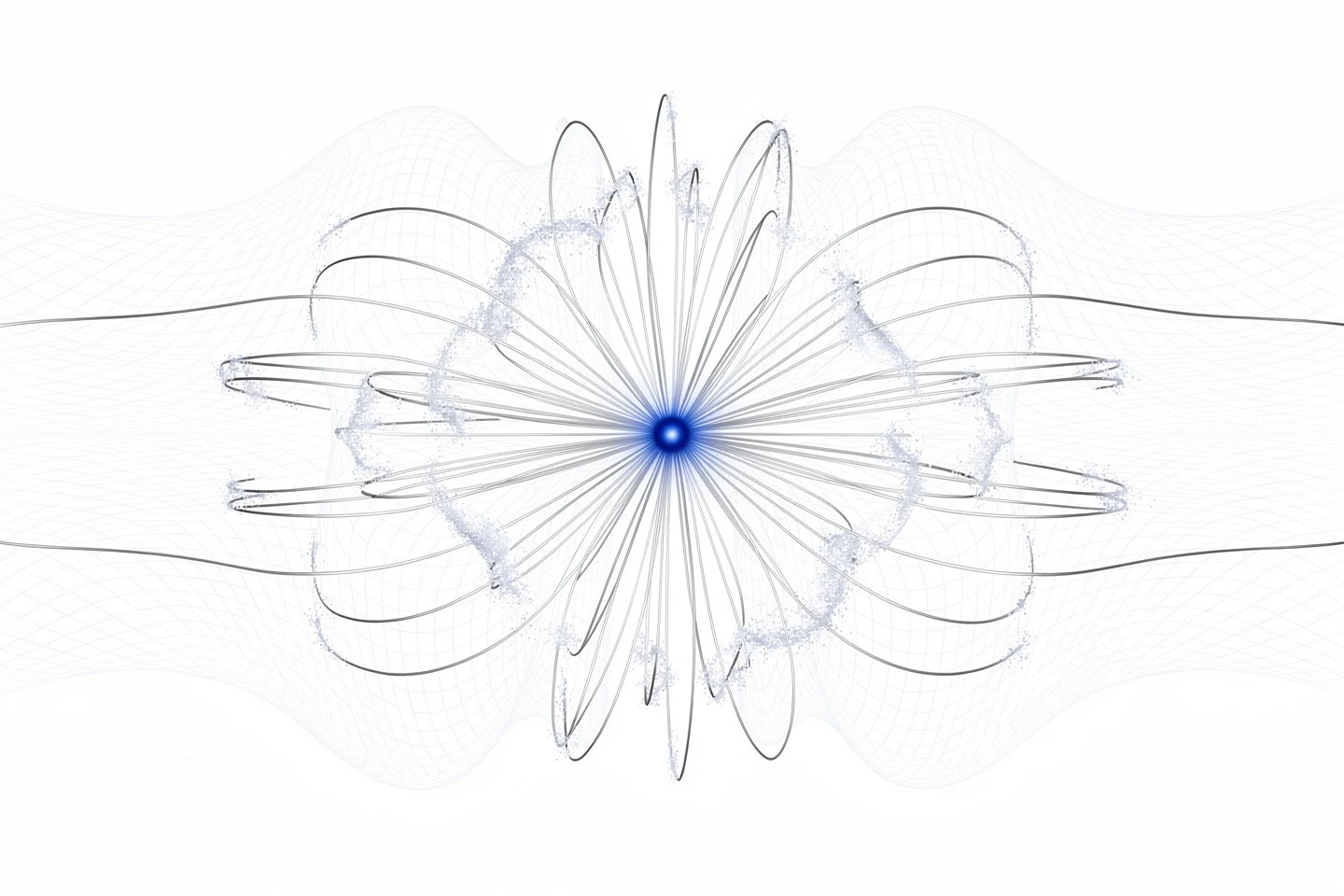
The problem of dark energy driving the accelerated expansion of the Universe, and the mystery of dark matter remain central challenges of modern cosmology. In search of an alternative to the hypothetical cosmological constant, scientists turn to the idea that primordial black holes or other compact objects might carry a macroscopic electric charge. Such objects — astrons — could, through electrostatic repulsion, influence the dynamics of the cosmos. However, to assess the viability of the scenario, one must go through a chain of rigorous physical tests.
Methods
The authors combined several theoretical strands. First, they considered how charge can accumulate during accretion of matter and what the natural saturation point is. Then they analyzed plasma screening in the intergalactic medium — a key factor that can suppress long-range interactions. The geometry of curved spacetime was described by the Reissner–Nordström solution, which generalizes the Schwarzschild metric to the charged case within the framework of Maxwell electrodynamics. The cosmological part included an analysis of the homogeneous Friedmann–Lemaître–Robertson–Walker model and the conclusion that inhomogeneous backreaction must be taken into account.
Results
It turned out that with ordinary accretion, the charge saturates at a level giving the dimensionless parameter Ξ = $k_e$ $Q^2$/(G $M^2$) much less than unity, whereas the phenomenologically interesting scale requires Ξ ≈ 5.4. This pushes the exterior geometry into a super-extreme regime: for Ξ > 1 the event horizon disappears, and for Ξ > 9/8 — the photon sphere as well, drastically altering gravitational lensing. The plasma environment can screen the field on scales smaller than the distance between objects, eliminating collective effects. In a homogeneous cosmological description, the Coulomb energy density behaves as $a^{-4}$, i.e., like radiation, rather than as dark energy. Finally, if astrons have a mass of ~$10^{12}$ M_⊙ and are spaced at 1 Mpc, their abundance in rest mass Ω_A ≈ 7.9 exceeds the critical density, so the real population would have to be even sparser.
Implications
Thus, astrons cannot be directly modeled as a homogeneous fluid replacing the cosmological constant. Any acceleration of expansion must be the result of the backreaction of the inhomogeneous spacetime structure on large-scale dynamics. This shifts the problem from phenomenology to precise calculations within the framework of the Einstein–Maxwell equations.
Future development
Further development of the topic will require the use of numerical simulations for nonlinear plasma processes near supercharged objects and for solving the averaging problem in an inhomogeneous Universe. Of particular interest is the search for observational signatures of super-extreme compact bodies in JWST data and with future telescopes.
Impact
The results are important for several areas: dark matter physics, early-Universe cosmology, plasma astrophysics, and studies of strong gravitational fields.
Next steps
Immediate next steps include a detailed kinetic analysis of plasma screening and the first full-fledged calculations of backreaction in a discrete system of charged sources.
Key open problems
The astron scenario touches upon unresolved questions in physics: the nature of dark energy, the possibility of naked singularities (violating cosmic censorship), the horizon problem, and the connection between quantum gravity and classical singularities.
The knowledge machine's view
This section is addressed to the author of the paper and their colleagues. Neighbouring works were found by meaning-based search across our archive, not by word overlap. We do not review: we show the field around the work.
What the work does
The paper examines astron objects—primordial supermassive charged compact objects—as possible sources of dark energy and dark matter. The authors analyze charge accumulation during accretion, plasma screening, Reissner–Nordström geometry, and cosmological implications. They show that the charge saturates at a level Ξ << 1, whereas influencing expansion requires Ξ ≈ 5.4, which pushes the objects into a super-extreme regime without a horizon; in the homogeneous approximation, their contribution behaves like radiation, not dark energy.
Where its strength is
The strong point is the consistent application of a chain of physical constraints (accretion, plasma, GR) to an exotic scenario, which moves the discussion from speculation to rigorous calculations and reveals nontrivial consequences, such as the possible role of astrons as seeds for early galaxies.
Where it could go next
- It might be interesting to see how our archive treats alternative mechanisms for generating dark energy that do not require a cosmological constant—for instance, via friction.based on: How Friction Gives Birth to Dark Energy arXiv:2607.03272
- Nearby there is a paper on dark stars as sources of the first supermassive black holes; perhaps comparing them with astrons as 'seeds' for early galaxies could yield new constraints.based on: Dark Stars: Cradle of Giant Black Holes arXiv:2511.08578
- The archive contains an analysis specifically devoted to giant charged objects and their failure as dark energy; comparing approaches and conclusions might help refine the limits of applicability.based on: Giant Charged Objects: A Dead End for Dark Energy? arXiv:2605.18186
Worth trying
- Assess whether astrons with mass ~10^12 M⊙ and charge corresponding to Ξ < 1 could serve as seed perturbations for structure formation in the early universe, using the cosmological perturbation formalism.
- Test how a non-uniform distribution of astrons affects local acceleration of expansion, for example, within a 'Swiss cheese' model with Reissner–Nordström metric.
- Consider the possibility of observational manifestation of astrons through gravitational lensing in the super-extreme regime (Ξ > 9/8), where the photon sphere is absent.
Why this may matter
If astrons do exist, they could provide a natural explanation for the early supermassive black holes observed by the Webb telescope, linking fundamental physics with observational cosmology.
Nearby works in our archive
- How Friction Gives Birth to Dark Energysimilarity 0.69
- Dark Secrets: When Energy Changes Signsimilarity 0.67
- Dark Stars: First Light from Invisible Mattersimilarity 0.66
- Dark Energy from the Depths of the Atomic Nucleussimilarity 0.65
- Dark Stars: Cradle of Giant Black Holessimilarity 0.65
- Dark Matter Decays, the Universe Smooths Outsimilarity 0.65
- Giant Charged Objects: A Dead End for Dark Energy?similarity 0.65
The closest work in the archive sits at 0.69 by meaning — the usual level for our corpus.
If an astron with Ξ=5.4 were nearby, we wouldn't see the typical “shadow” of a black hole — it lacks a photon sphere, and light would just be weakly deflected by its mass.
Key numbers
- mass of astron: ~1012 M_⊙
- charge of astron: ~4×1032 C
- parameter Ξ: ≈5.4
- typical distance between astrons: on the order of several Mpc
- abundance at 1 Mpc spacing: Ω_A ≈ 7.9