Axion Receiver: Binary Stars Guarding Dark Matter ✛ ✦
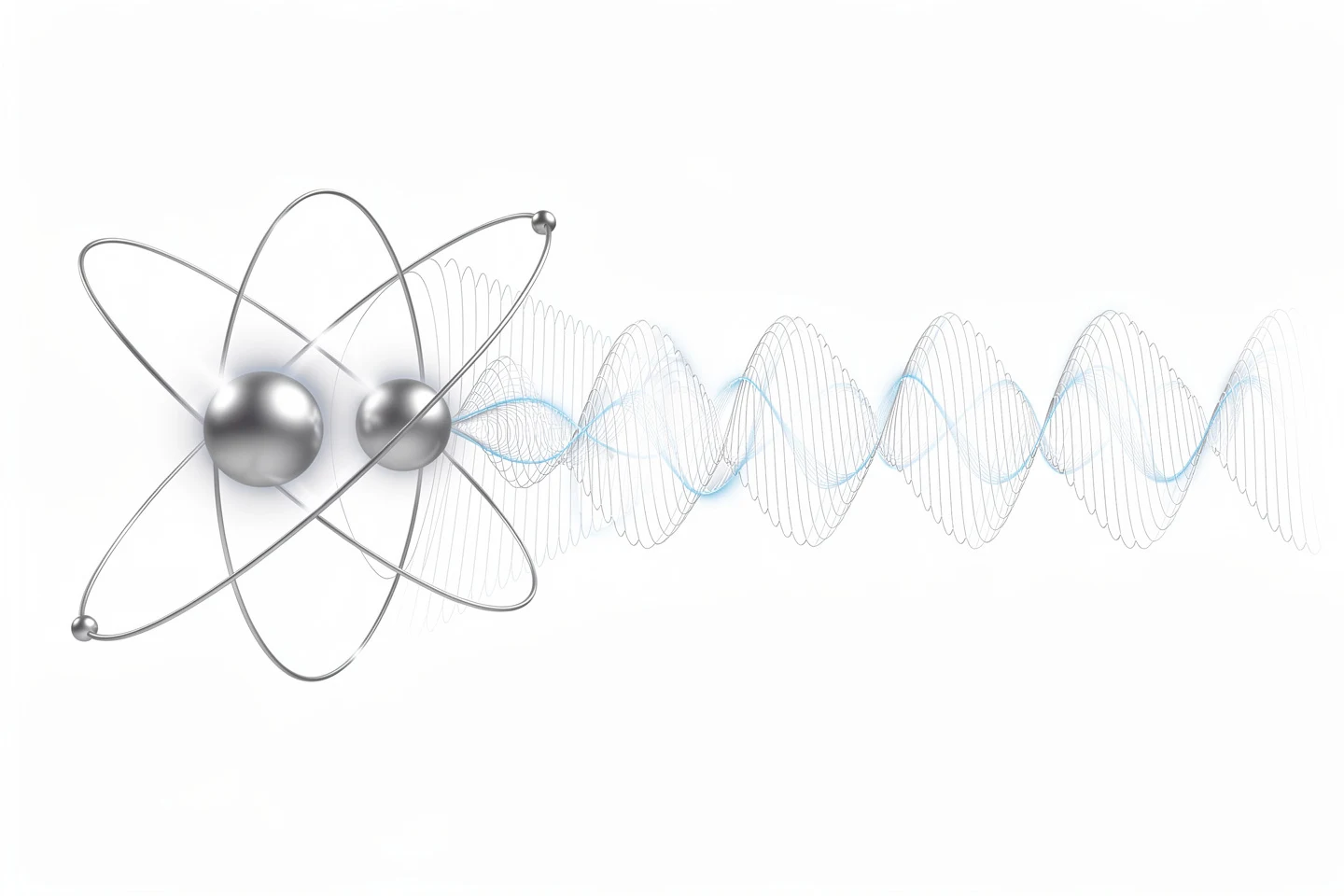
The nature of dark matter has been puzzling physicists for decades. Among the candidates, axions hold a special place — ultralight particles that could simultaneously solve the strong CP problem. If they exist, they barely interact with light, rotating its polarization plane. This effect, birefringence, is sought in the most precise experiments, but so far without success. A new method turns its gaze to the stars.
Imagine a radio receiver tuned to a distant station. The signal is clean, but if a weak transmitter appears at a nearby frequency, whistles arise in the speakers: side frequencies. Close binary systems work in a similar way. One star illuminates its companion, and its light reflects off the companion's atmosphere, acquiring a strict polarization whose phase is tightly synchronized with orbital motion. These are ideal “polarimetric clocks”: the orbital period sets the rhythm, the harmonics — the notes. The axion field that permeates the cosmos acts like a faint echo, shifting these notes and creating sidebands — an acoustic imprint of the invisible. The axion wave itself is coherent on galactic scales; that means we are listening to the same note, trembling in the light of different stars — the Universe seems to hum a monotonous melody.
Astrophysicists decompose the polarization variability into a Fourier series, singling out frequencies nΩ — harmonics of the orbital frequency Ω, which is determined by Kepler’s third law. The presence of an axion adds a rotation at the particle’s mass frequency μ, superimposing on the orbital harmonics and generating satellites nΩ ± μ. The maximum likelihood method, applied to 30-day observations of a μ¹ Sco–type system with a single-shot precision of 10 ppm, yields sensitivity to the coupling constant $g_{aγ}$ of 2.4×10⁻¹² GeV⁻¹ for a mass of 10⁻²⁰ eV. By combining 14 suitable systems and pushing precision to 1 ppm, one can reach 1.3×10⁻¹³ GeV⁻¹ — entering the territory of the best limits from the cosmic microwave background and pulsar timing.
This approach fills the niche of high-cadence optical polarimetry, complementing the CMB, pulsar timing, and observations of protoplanetary disks. It opens a new window in the mass range 10⁻²¹–10⁻¹⁸ eV, where classical methods go blind. Observations of hundreds of close binaries, the development of precise scattering models and stellar evolution (going back to the work of Chandrasekhar), along with numerical simulations and machine learning, promise to turn telescopes into true dark matter detectors. Future polarimetric surveys on large telescopes will either detect axions Peccei–Quinn, or squeeze the allowed parameter space to the limit set by quantum fluctuations. We stand on the threshold of the greatest discovery, or of the most beautiful negative result in modern physics.
In Spica, the polarization of reflected light is only 200 millionths. This used to be beyond imagination, but polarimeters like HIPPI-2 make such measurements routine. And it is in this microscopic jitter that dark matter’s signature might be hiding.