Scientist

Steven Weinberg

1933–2021 · Theoretical physics, Particle physics, Cosmology
American theoretical physicist who unified electromagnetic and weak interactions into electroweak theory — a cornerstone of the Standard Model. Also made contributions to cosmology and quantum field theory.

Biography

Studied at Cornell University, earned his PhD at Princeton. Worked at the University of California, Berkeley, MIT, Harvard, and the University of Texas. Nobel Prize in 1979 (shared with Glashow and Salam). Author of numerous popular science books.

Key discoveries

💡 Weinberg hated string theory and called it 'theology,' but actively participated in public debates about science.
"He thought that the more the universe seems comprehensible, the more it also seems pointless."
Concepts
Phase transition
Scientists
André-Marie AmpèreIlya PrigogineLars OnsagerGustav KirchhoffRobert HermanRudolf ClausiusJosiah Willard GibbsRoy Kerr

Related articles

Optics2026-01-022 minarXiv:2601.00552express
X-ray Without a Camera: How to Film a Spinning Engine
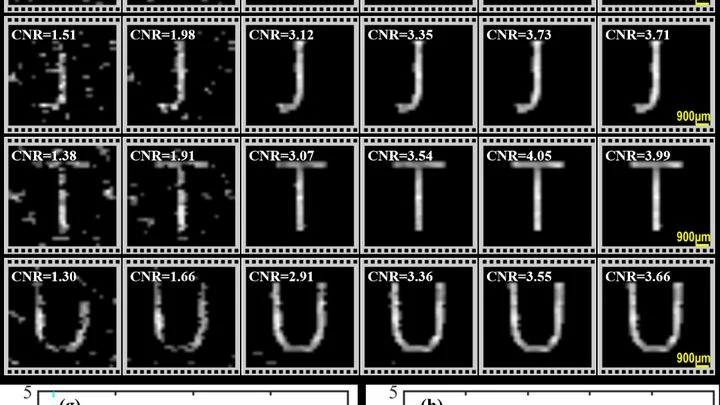
An X-ray image is like a photograph taken in the dark with a very short flash: anything that moves comes out blurred. Conventional X-ray detectors are large arrays of millions of pixels, and by the time they read out one frame, the next is already missed. For a spinning turbine or a beating heart, such sluggishness is a death sentence. A team of researchers sidestepped this problem by ditching the array altogether.
Instrumentation2026-01-261 minarXiv:2601.18311express
X-ray Light from the Lab
An X-ray telescope captures light from hot gas around stars, but that light arrives 'blurred'—like a voice over a bad phone line. To make out the words, you need a dictionary of the exact frequencies at which atoms glow. Such a dictionary is written not only with calculations but also with direct experiments.
Instrumentation2026-01-271 minarXiv:2601.19188express
A Mirror for X-rays: How to Catch a Beam from Space
You can't catch X-rays from stars with an ordinary mirror: they pass through glass like light through a window pane. To reflect them, you need a mirror almost parallel to the beam: then the X-rays skim along the surface like a flat stone skipping on water, only slightly changing direction.
Medical Physics2026-01-292 minarXiv:2602.07003express
Seeing Inside a Cell
In winter, puddles freeze, and ice cracks the asphalt. Inside a living cell, freezing does something similar: ice crystals tear its membrane. To prevent this, the cell is soaked in a special solution, like antifreeze for a car. But precision is key: too little solution and ice still forms; too much and the solution itself poisons the cell.
A Detector That Hears Heat
An X-ray beam strikes a piece of superconductor, and the material warms up ever so slightly. That heating, by billionths of a degree, is the only trace the light leaves behind. The new detector catches exactly that, like a sensitive thermometer pressed against cold metal.
Instrumentation2026-02-121 minarXiv:2602.11728express
A Detector That Hears X-ray Light
An X-ray photon hits the detector like a pebble dropping into still water. The water is a thin film of aluminum and manganese, cooled to near absolute zero. The impact sends a heat wave rippling across the film, and by measuring its height, you can tell how much energy the photon carried.
Optics2026-02-121 minarXiv:2602.12255express
X-ray Snapshot of a Crystal Without Guesswork
When an X-ray beam reflects off a crystal, it paints a pattern of spots and streaks on a detector. If the crystal is perfect, the pattern is simple. But inside a real material, atoms are often shifted — compressed in some places, stretched in others. The pattern then looks like ripples from a stone thrown into water, and deciphering it by hand is nearly impossible.
Optics2026-02-201 minarXiv:2602.18343express
X-ray microscope sees twice as clearly
An X-ray image of a battery looks like a photo taken through frosted glass: fine details blur into a gray smudge. The culprit is the detector itself, which cannot distinguish features smaller than its pixel size. Engineers proposed getting around this barrier by illuminating the sample not with a uniform beam but with a striped pattern.
X-Ray from Your Pocket: Raspberry Pi Sees Through Objects
An X-ray image usually brings to mind a bulky machine in a hospital. But such a picture can be taken by a device the size of a palm, assembled from hobbyist electronics. The authors took a Raspberry Pi mini-computer, a 12.3-megapixel camera, and a screen that glows under X-rays.
Medical Physics2026-03-072 minarXiv:2603.07103express
The Radiation Scalpel Gets Sharper
Radiation therapy is like shooting at a small target with a very large-caliber rifle: even a precise shot hits a large area around it. The thickness of the 'trace'—called the penumbra — is 2–3 millimeters in standard machines. For a tumor in the lung, that's not a big deal, but next to a nerve or a blood vessel, those millimeters decide whether a person stays healthy.
Optics2026-03-151 minarXiv:2603.14391express
X-ray captures metal melting at 25,000 frames per second
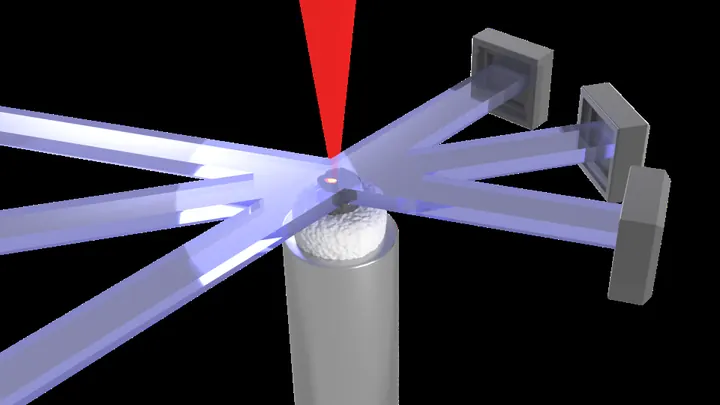
A laser melts metal powder layer by layer, and inside the boiling pool, vapor bubbles appear and collapse within milliseconds. Seeing this kitchen in action was previously impossible: the X-ray tomograph that takes 3D images is too slow. The sample has to rotate, and by the time it does, the melt has already changed a hundred times.
Medical Physics2026-03-191 minarXiv:2603.18983express
Light Through Skin Reveals Bone Fragility
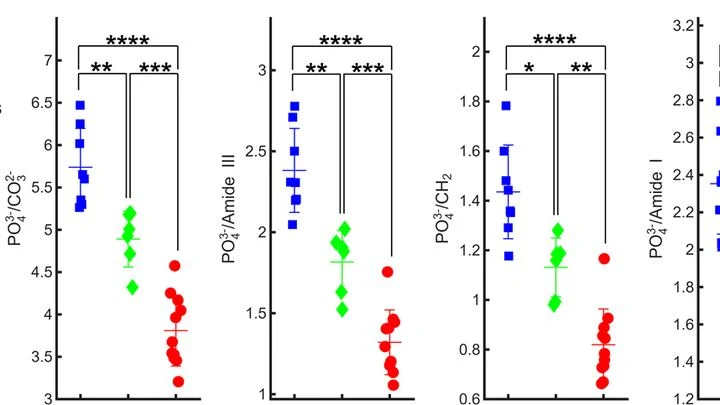
A finger is illuminated with a laser beam, and some of the light returns after traveling inside. That's how Raman spectroscopy works: molecules in bone and skin alter the color of the reflected beam differently, leaving their chemical fingerprints. But skin, muscle, and fat are noisy: their signal drowns out the bone's, like a crowd's chatter overpowering a single singer.
Medical Physics2026-03-201 minarXiv:2603.19651express
A Snapshot at Minimal Dose: What Can You See?
An X-ray image is like a photo taken in the dark: the less light, the harder it is to see details. Doctors wanted to know how much you can dim the "light" in computed tomography (CT) and still not miss a disease. To do this, they took 50 pairs of chest images: one with a full radiation dose, the other with a low dose.
Liquid Xenon Instead of Crystals: A Tomograph That Sees Three Times Sharper
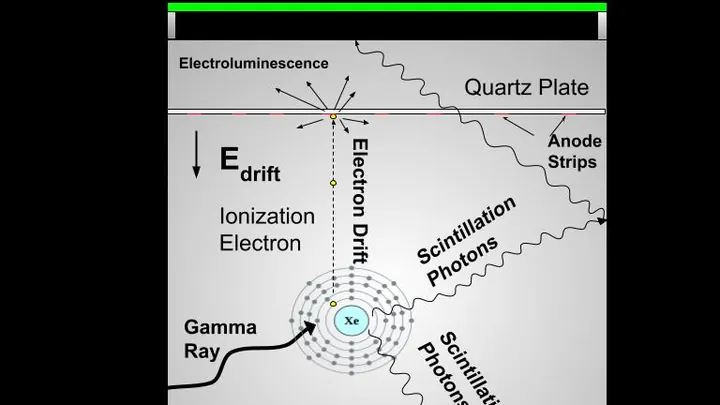
The camera that hunts for tumors works like a highly sensitive camera: it catches the faint glow from a substance that accumulates in diseased cells. In conventional machines, the light is born in a crystal — a solid piece that resembles glass. But a crystal doesn't always convey exactly where the light flashed, so the image comes out slightly blurry.
X-rays Teach Atoms to Dance
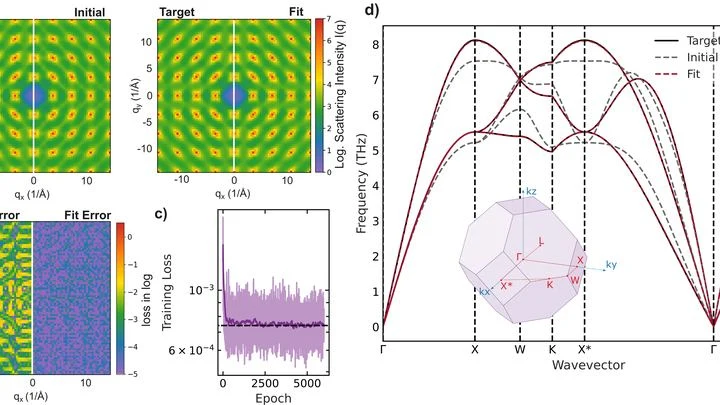
Heat a crystal, and its atoms start to jiggle like plucked strings. An X-ray beam passing through the crystal scatters off these vibrations, painting on the detector not only sharp spots but also faint, smeared patterns. These patterns are like fingerprints: from them, you can reconstruct how strongly atoms pull and push on each other.
HEP Phenomenology2026-04-072 minarXiv:2604.05935express
How X-rays See Hot Matter
When matter is compressed to pressures of millions of atmospheres and heated to thousands of degrees, it is neither solid nor gas. This warm dense state is like the interiors of giant planets or the moment of a meteorite impact. You can't look inside directly, but you can shine X-rays and see how they scatter off electrons.
How Not to Fry a Detector in a Particle Beam
A silicon wafer as thin as half a human hair catches a passing particle the way a palm catches a raindrop. But if that drop is a proton accelerated to enormous energy, the palm can get burned. Inside the detector, an avalanche of charge is born, and sometimes it's enough to burn a microscopic hole. This is called single-event burnout.
Instrumentation2026-04-232 minarXiv:2604.21846express
A Sensitive Thermometer for X-rays
An X-ray beam is a stream of tiny packets of energy, photons. Ordinary detectors count them but don't distinguish shades: two photons with close energies look the same to them. The new device works like a sensitive thermometer: it catches each photon and measures how much it warms a thin film. From the warming, you can tell exactly how much energy the photon brought.
Plasma Physics2026-04-262 minarXiv:2604.23687express
An X-ray Flashlight for Invisible States of Matter
When matter is heated to millions of degrees, it turns into plasma — a mix of free electrons and ions, like a boiling soup of charged particles. You can't measure the temperature of such a 'soup' with an ordinary thermometer, but you can shine X-rays through it.
Medical Physics2026-05-022 minarXiv:2605.01265express
X-ray imaging without interference, like a photo without glare
An X-ray machine with gratings takes not one but three pictures at once: a regular image, a map of beam deflections invisible to the eye, and an image of tiny structures that scatter light. Together, they help spot, for example, emphysema or pulmonary fibrosis. But there's a catch: to separate these three layers, you need a clever mathematical trick.
Optics2026-05-162 minarXiv:2605.17006express
Light in a Crystal Marches in Formation
A flashlight beam aimed through frosted glass turns into a blurry spot with every extra millimeter of thickness. Scintillators, materials that convert X-rays into visible light, behave much the same way. They underpin medical imaging, baggage screening, and detectors at particle accelerators.
Medical Physics2026-05-241 minarXiv:2605.25139express
Seeing Through Bone Without X-Rays
Ultrasound isn't just for baby pictures on a screen. It can scan muscles and tendons, but there's a catch: bones. To sound waves, they act like mirrors to light. The reflection is so strong that nothing behind them is visible.
Biological Physics2026-06-221 minarXiv:2606.23396express
Viruses Under the X-Ray Beam
An ordinary microscope is powerless when you need to examine a single virus in detail. It's too small. But there's a tool that fires flashes billions of times brighter than sunlight — an X-ray free-electron laser. It's designed to 'photograph' a particle before the beam vaporizes it.
Seeing Through Shipping Containers
A shipping container is a steel safe the size of a room, packed with goods. X-rays struggle to see through it: thick walls and dense cargo block the rays. Enter muons — particles born high in the sky that constantly rain down on Earth. They can pass through even lead, but they veer slightly off course when they encounter something heavy.
Plasma Physics2026-08-191 minarXiv:2608.19382express
Warm Dense Matter: How Lasers Squeeze Material to 25 Grams per Cubic Centimeter
A laser beam strikes a thin target hidden inside layers of another material. Within billionths of a second, the material is compressed to a density of 25 grams per cubic centimeter, as if a piece of lead became more than twice as heavy without moving an inch.
Stellar2026-08-272 minarXiv:2608.27344
X-ray passports for habitable worlds
Twelve stars have received X-ray passports. Now, for each of them, we know the exact radiation dose received by a planet in the habitable zone, the region where liquid water is possible.