Wilks' theorem is a cornerstone of statistical inference, stating that under certain regularity conditions, twice the log of the likelihood ratio between two nested models converges to a chi-squared distribution as the sample size grows. The number of degrees of freedom equals the difference in the number of free parameters between the models. This theorem turns a complex likelihood comparison into a simple significance test, making it indispensable in fields where data are expensive and hypotheses are precise, like particle physics.
History
The theorem was proved by Samuel S. Wilks in 1938, in a paper titled 'The Large-Sample Distribution of the Likelihood Ratio for Testing Composite Hypotheses'.
How it works
The theorem relies on the fact that, near the true parameter values, the log-likelihood surface is approximately quadratic (a parabolic bowl). For nested models, the difference in their maximum log-likelihoods then behaves like the sum of squares of independent standard normal variables, which is exactly a chi-squared distribution. This approximation improves with more data, so in practice it works well for large samples, though it can fail near parameter boundaries or when the true parameters are at the edge of the allowed space.
In practice
It is used to compute significance levels for new particle discoveries at the Large Hadron Collider, where the 'local p-value' is derived from a chi-squared distribution via Wilks' theorem.
A magnet is slowly heated. At low temperatures, all its microscopic arrow-like spins point in the same direction: that's order. At high temperatures, they dart about chaotically. But there is a special point, the critical point, where order is just about to vanish and the system freezes in indecision.
Two observers, Alice and Bob, sit at opposite ends of the same lab. Between them is a source that fires off two pulses in turn. Each pulse gives birth to a wave packet flying toward its own detector. So far, this looks like an ordinary experiment with quantum particles.
In 1998, mathematician David Boyd noticed something strange. He was studying the Mahler measure of polynomials, a quantity that gauges the "complexity" of their roots, and found that for a family of curves, it always equals a special rational number times the derivative of an L-function.
4 610 universes — that's exactly how many cosmological models astrophysicists needed to show that the familiar Gaussian mask no longer works for next-generation data. Future sky surveys, such as the Euclid mission and the Vera C.
In the infinite river of integers, where whirlpools of primes swirl, mathematicians have been sifting sand for centuries in search of golden nuggets — the zeros of L‑functions. These enigmatic objects, discovered by Riemann in 1859, act like an invisible hand governing the distribution of primes.
Biological complexity has long eluded us: you can count genes, cells too, but how do you grasp the organization of the proteome itself — a multi-thousand ensemble of proteins woven from carbon, oxygen, and hydrogen?
A long chain of atoms, each a tiny magnet. They talk to each other and to a common field, like musicians in an orchestra who hear both the conductor and their neighbors. When the external field changes, the orchestra either plays out of sync or all instruments come in together: that's a quantum phase transition.
Two ultra-thin sheets, each just one atom thick, are placed on top of each other and slightly rotated. Like two sheets of colored tracing paper: while they lie flat, the picture is one thing, but give them a twist and a moiré pattern appears. Here, though, the pattern isn't visible to the eye, but it completely changes how the material handles light.
Two particles behave like a pair of unusual dice: thrown at opposite ends of the universe, they always land on the same face. Physicist John Stewart Bell calculated: if the dice had hidden rules, the frequency of matches would have a strict limit.
Toss a dozen coins on a table. The number of heads-and-tails combinations is just over a thousand. For two dozen coins, it's already a million. The number grows as 2 to the power of the number of coins, and that's fast. But quantum systems are far richer.
Each particle here is not a coin with two sides but an arrow that can point in any direction.
The heart doesn't push blood in a steady stream but in pulses. Each beat sends a wave racing through the arteries, like ripples along a taut garden hose. For a long time, it was thought that an animal's metabolic rate depended only on how vessels branch, like pipes in a house. But new work flips that view: what matters isn't the shape of the pipes but the pulse itself.
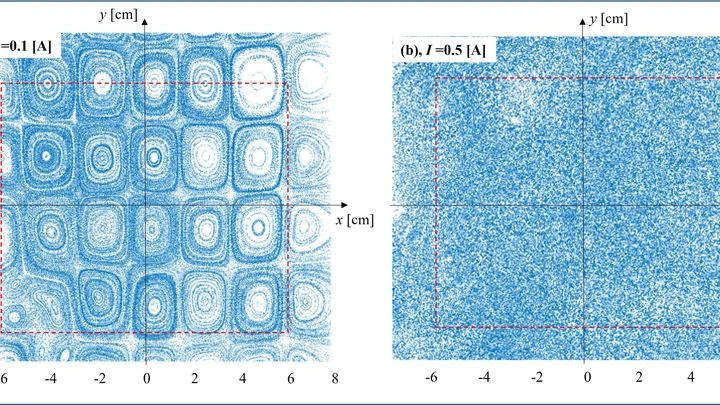
Water in a puddle after rain swirls differently than in a deep lake. A thin layer of fluid feels the bottom, and that changes the nature of its vortices. Scientists created such a layer in the lab: they poured in an electrolyte, ran a current and a magnetic field, and the fluid began to move.