The Poisson distribution is a probability distribution that describes the number of events occurring in a fixed interval of time or space, given that these events happen independently and at a constant average rate. In optics and quantum physics, it is the natural statistical model for counting photons: when a coherent light source, such as a laser, illuminates a detector, the number of photons detected in a given time follows a Poisson distribution. This is a cornerstone of quantum optics, where the particle-like nature of light is observed through such counting statistics.
History
The distribution was introduced by Siméon Denis Poisson in 1837 in his work on the probability of court rulings, though it was later applied to many other fields, including physics.
How it works
The distribution is characterized by a single parameter, λ, which is the average number of events in the interval. The probability of observing exactly k events is given by P(k) = (λ^k · e^(−λ)) / k!. For photons, λ is proportional to the light intensity and the detection time. The key property is that the variance equals the mean, which distinguishes Poissonian light from other types, such as thermal light, which has a broader distribution.
In practice
Poisson statistics are used in photon counting detectors for quantum cryptography, in analyzing cosmic ray showers, and in calibrating photodetectors in astronomy and medical imaging.
Fun fact
The Poisson distribution emerges naturally from the quantum theory of coherent states, which are the closest quantum analog to a classical electromagnetic wave.
Imagine a cookbook that gets rewritten from generation to generation. One day, the borscht recipe receives a secret ingredient from a pastry chef, and from that moment, the taste remembers not only ancestors but also a neighbor. In the Standard Model of evolution, genes behave the same way.
The cells of an organism are like twin chefs sharing a kitchen. They have the same cookbook (DNA), but when copying the recipe to a cheat sheet and assembling the dish, random errors occur. This unpredictability, entropy, means that in identical cells, protein levels are sometimes high, sometimes low.
Gravitational microlensing is a fascinating cosmic effect predicted by Einstein and developed by Zwicky. A massive body passing between us and a distant star bends its light like a lens, creating characteristic magnifications and distortions.
If you stick two identical thermometers into a pot of hot water, they'll both read the same, and we relax, thinking the temperature is measured correctly. But in a rarefied gas heated to millions of degrees, this trick stops working.
A glass chip, threaded with 128 optical waveguides, has been turned into a kind of quantum pinball machine. The role of balls is played by photons — quanta of light, and instead of mechanical flippers, microheaters control the routes, instantly altering the optical paths.
An ordinary rain gauge collects water in a bucket and shows the total volume of precipitation. But the new device is like a sensitive palm that feels every falling drop and keeps count, even when the drops number in the thousands.
That's exactly what physicists have built.
Light in a particle detector behaves like a voice in the mountains. One shout, and the echo repeats several times, growing fainter with each reflection. So it is in a silicon detector: a real flash from a particle gives rise to false ones that confuse measurements.
The lighthouse in the Crab Nebula blinks thirty times per second. It's a pulsar — a dead star that, as it spins, shoots out narrow beams of light, and Earth sweeps through them like a ship crossing a lighthouse beam. This lighthouse has two beams: the main pulse and the interpulse.
When a neutron or proton enters an atomic nucleus, it behaves like a ball hitting a rough wall: it can bounce off in different ways, depending on where it hits.
In quantum communication, a secret key is transmitted using single photons. Eavesdropping on such a channel is supposedly impossible: any interception attempt disturbs the particle and leaves a trace. But the idea has a weak spot — the real hardware, which sometimes behaves differently than theory dictates.
The proton is not a solid ball. Its charge, mass, and other properties are distributed differently in space, and each property has its own radius. Physicists have long been able to measure where the proton's charge is concentrated and where its mass lies.
In collisions of heavy nuclei, a fireball of thousands of particles is born. Among them are pions and kaons, two kinds of light particles that look very much alike. To understand what happens in this fireball, physicists need to know exactly how many of each particle flew out.
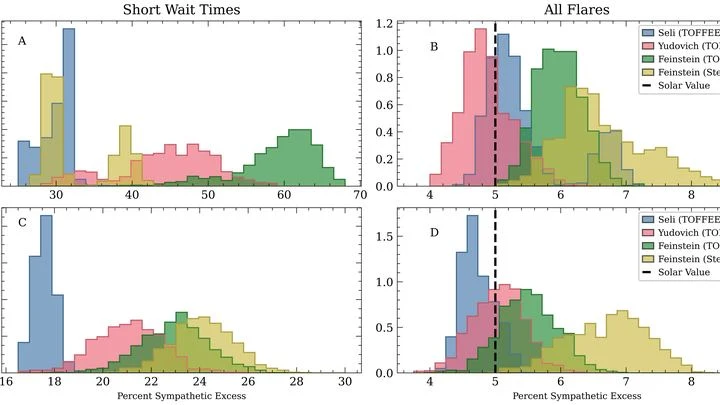
The Sun occasionally produces flares — powerful bursts of energy that last from minutes to hours. Most are random, like raindrops hitting a roof. But sometimes one flare seems to ignite another: the second begins almost immediately after the first, even though they occur in different locations. Astronomers call these sympathetic flares.
A conventional thermal camera is like a thermometer that slowly heats up and cools down. It shows where heat is well, but it can't keep up with fast motion. The new sensor works differently: it counts individual quanta of heat, like a droplet counter during rain.
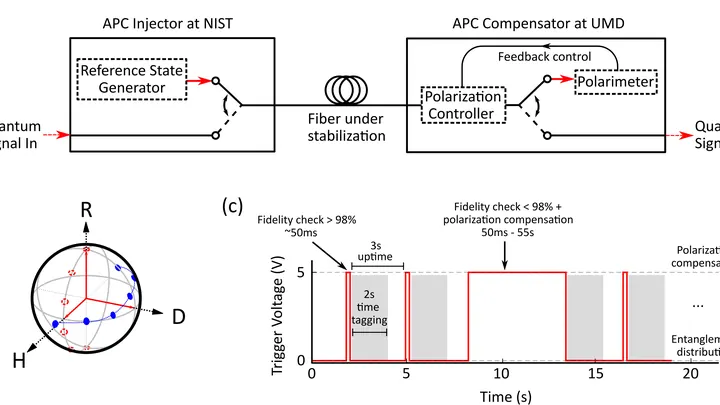
Two photons, like two halves of the same coin, fly tens of kilometers apart but remain linked: measure one, and you instantly know the state of the other. This property is called entanglement, and it underpins quantum communication.
Inside protons accelerated to nearly the speed of light, a particle heavier than a gold atom is sometimes born — the top quark. It lives for tiny fractions of a second and decays, leaving a trace in the ATLAS detector. Physicists collected such traces for four years to understand how often the top quark and its mirror twin, the antiquark, appear.
The Wigner function is a kind of topographic map of probabilities: hills correspond to regions where a particle is most likely to be found, and valleys to where its appearance is practically ruled out.