Scientist

Gerard 't Hooft

1946- · quantum field theory, quantum gravity, elementary particle physics
Dutch theoretical physicist, one of the founders of modern quantum field theory. Made fundamental contributions to the proof of renormalizability of gauge theories, which laid the foundation for the Standard Model. Developed the holographic principle in quantum gravity, proposing a connection between quantum field theory and gravity.

Biography

Born in Den Helder. Studied at Utrecht University, where he obtained his doctorate under Martinus Veltman. Worked in Utrecht, then professor there. Winner of the Nobel Prize in Physics (1999) jointly with Veltman. Also known for work on instantons, magnetic monopoles, and quantum black holes.

Key discoveries

💡 In his youth, he was interested not only in physics but also in music, playing the saxophone. He is also known for his hobby of collecting scientific errors and misconceptions.
"He believed that the final theory must be beautiful and natural."
Concepts
spacetime curvatureentropy
Laws
holographic principle
Scientists
Jacob BekensteinKarl SchwarzschildJoseph WeberEmmy NoetherWilhelm WienLudwig BoltzmannKip ThorneCharles Bennett

Related articles

Earth as an Antenna: Hunting the Dark Photon
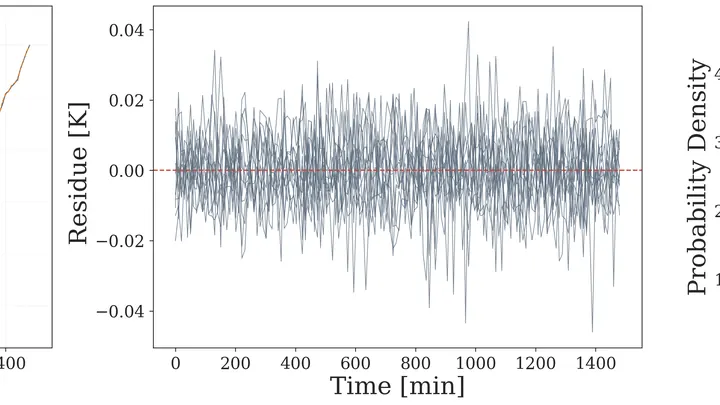
A century ago, magnetic observatories recorded only the slow breathing of Earth's core. Today, their data have become hunting grounds for particle physics. At the Eskdalemuir Observatory in northern England, fluctuations of the magnetic field are recorded every hundredth of a second.
Instrumentation2025-10-191 minarXiv:2510.17907express
Earth's Shadow Hunts for Alien Probes
Back in the 18th century, William Herschel was searching for life on Mars. Today, astronomers are targeting not planets but artifacts — for example, alien probes lurking in the Solar System. The problem is that spotting a tiny object next to the blinding Sun is nearly impossible.
HEP Theory2025-11-251 minarXiv:2511.20747express
Tiny Universes: Why Their Secrets Are Elusive
According to one physical hypothesis, our voluminous world might be a projection from a flat surface. From such a Universe, tiny closed bubbles — baby universes — sometimes pinch off. For a long time, they were thought to be empty, devoid of internal diversity. It turned out that the information inside them is scattered, like shards of a broken mirror.
HEP Phenomenology2026-01-131 minarXiv:2601.08567express
Ghost Particle: How Scientists Caught a Hint of a New Force
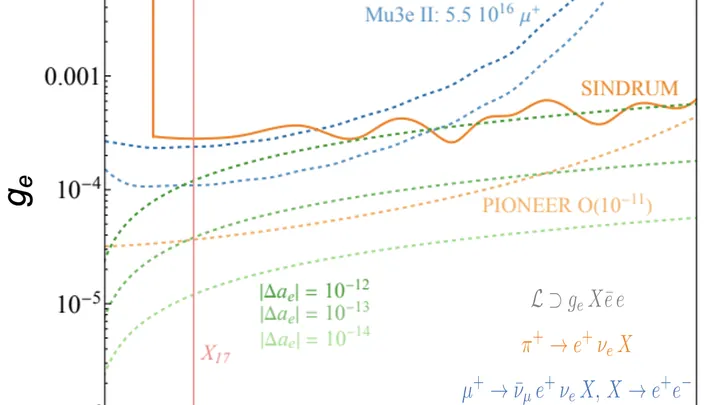
At Hungary's Institute for Nuclear Research, ATOMKI, physicists noticed something odd: in the decays of excited atomic nuclei, pairs of electrons and positrons sometimes fly apart at an unusual angle. It's as if an invisible mediator particle briefly appears and disappears between them.
Cosmology2026-01-251 minarXiv:2601.17938express
Lack of Information Accelerates the Universe
The visible edge of the universe is a holographic screen that, like a black hole, obeys laws discovered by Bekenstein and Hawking. Normally, information is preserved on it, but calculations show that if a few bits are lost, energy is released that accelerates expansion.
Quantum Physics2026-01-311 minarXiv:2602.00633express
Light That Comes in Pairs
Light from an ordinary bulb is a stream of individual photons, like drops from a faucet. But there is also light where photons come in pairs, like twins walking together. Such grouped light has long been desired for measuring distances and imaging objects hidden around corners. But sources of this light were either too dim, or their flashes too short for ordinary detectors to catch.
HEP Phenomenology2026-02-111 minarXiv:2602.10562express
How LHC can hear dark matter
Hidden in the heart of the Alps is the Large Hadron Collider. From time to time its detectors register sudden bursts — scientists call them UFOs (Unidentified Falling Objects). According to one theory, these are not equipment malfunctions at all, but traces of dark matter.
HEP Phenomenology2026-02-192 minarXiv:2602.17620express
A 17 MeV Ghost Particle
In nuclear transitions of beryllium-8, helium-4, and carbon-12, physicists from the ATOMKI collaboration have been seeing extra events since 2020—as if, when an excited nucleus decays, something else is sometimes born besides the usual photons. The energy of this "something" is always the same: about 17 million electron-volts.
Cosmology2026-02-201 minarXiv:2602.18218express
Hunting Dark Photons with a Mirror Telescope
The universe is held together by an invisible scaffolding of dark matter. Part of it could be dark photons, ghostly copies of light that pass right through matter. The Dandelion experiment turned a spherical mirror into a super-sensitive ear: it gathers dark photons and translates them into the language of radio waves.
Nuclear Experiment2026-02-212 minarXiv:2602.18675express
How Light Reveals the Secrets of Proton Resonances
A proton can't be seen as a simple ball. If you hit it with a photon, it can absorb energy and jump into an excited state, like a bell that starts ringing at a certain frequency after being struck. These states are called nucleon resonances, and they live very briefly before decaying into other particles.
HEP Phenomenology2026-02-221 minarXiv:2602.19267express
Seeing the Unseen: The Proton Without Formulas
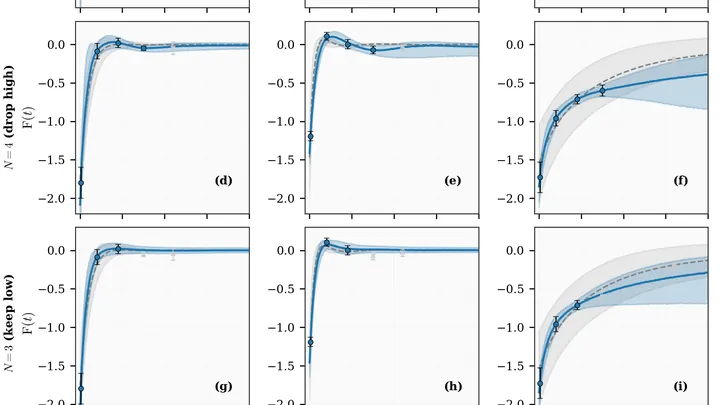
The proton is not a smooth ball but a tangle of quarks and gluons in constant motion, exchanging energy. Finding out exactly how energy, pressure, and spin are distributed inside it is impossible to do directly: measurements yield only sparse, noisy points. It's like trying to guess a face from a few blurry photos taken from different angles.
HEP Experiment2026-03-212 minarXiv:2603.20837express
The Invisible Caught in a Trap of Light
At the Large Hadron Collider, protons collide at nearly the speed of light. Sometimes they don't smash apart but exchange photons — particles of light. These photons can produce a pair: one particle the detector sees, and another that flies off unnoticed.
How to Tell Dark Matter from Noise
Underground, in a former gold mine, sits a tank of liquid xenon. If a dark matter particle flies through it, the xenon flashes. But it also flashes from ordinary particles, like neutrinos or leftover radioactivity. The task is to tell which flash comes from dark matter and which from noise.
Quantum Physics2026-04-091 minarXiv:2604.07782express
Picture from Nothing: Silence Paints Ghosts
A drummer stays silent, but from the pauses you can tell where he didn’t hit. Similarly, physicists built an image by catching not light, but moments of absolute darkness. The picture emerged from silence. In the experiment, they shone light from an ordinary lamp onto the object.
Gravity from Heat: How Entropy Rewrites the Equations of the Universe
The event horizon of a black hole behaves like a thermostat: it has a temperature and an entropy. In 1995, physicist Ted Jacobson showed that if you apply the ordinary rule of heat transfer to this thermostat, Einstein's equations of gravity follow from it on their own.
HEP Theory2026-05-051 minarXiv:2605.04032express
How Gravity Dictates Patterns in the Quantum World
A stone thrown into a pond leaves ripples spreading across the water. In quantum physics, the role of such ripples is played by equations that relate the properties of particles. Recently, mathematicians proposed a set of such equations for a world without gravity but with a large number of 'degrees of freedom'—roughly like the complex ripples on water.
Mesoscale2026-05-102 minarXiv:2605.09488express
Dark Excitons: A Quantum Trickle in a Chip
In a thin sandwich of semiconductors, light creates pairs, an electron and a positive hole, that stick together like a ball on a rubber band. Normally, such pairs, called excitons, quickly emit light and vanish. But there are others, dark ones, that live hundreds of times longer because their internal structure forbids them from easily giving off energy.
HEP Theory2026-05-151 minarXiv:2605.15776express
The Perfect Mirror: Quantum Fields on a Donut and the Geometry Within
On a donut-shaped ring, the theory lives on the surface, while inside hides a curved space — like a saddle widening toward the edge. According to the holographic principle of Juan Maldacena, everything happening inside can be described by data on the boundary.
General Relativity2026-05-211 minarXiv:2605.22172express
How to Measure the Chaos of Spacetime Itself
Spacetime isn't a flat sheet, but a crumpled fabric: stars and planets leave creases on it. Information is written into every crease, and to erase it, heat would have to be released — that's how Landauer's principle works. Thus, the 'crumpledness' of space can be measured through entropy — the universal measure of disorder.
Quantum Physics2026-06-162 minarXiv:2606.17983express
The Universe as a Hologram Woven from Quantum Threads
Our universe is expanding, and its future, according to cosmologists, is empty, cold de Sitter space. Understanding its quantum nature is like trying to read a book by looking only at its cover. The holographic principle suggests that all information about what happens inside a volume can be encoded on its boundary, like a picture on a film.
Fractional Holographic Dark Energy: The Nonlocal Conductor of Cosmic Acceleration
Einstein’s cosmological constant — a blunder or a boomerang insight? The universe’s acceleration caught physicists off guard: ΛCDM works, but why is the vacuum energy so absurdly tiny? Imagine an ocean heaving with quantum fluctuations, yet on the surface only a microscopic ripple.
Ghostly Duet: Neutrino Decay of a Superluminal Photon
In 2021, the LHAASO observatory registered gamma quanta with energies above a petaelectronvolt from sources like the Crab Nebula — a supernova remnant with a pulsating neutron star at its heart.
Cosmology2026-07-162 minarXiv:2607.15020
The Cosmic Score is Silent: Dark Matter and Neutrinos Don't Play a Duet
Light from distant quasars, breaking through billions of years, leaves a pattern of dark absorption lines on the cosmic film — the spectroscopic Lyman-alpha forest. Each line is like a note in a grand score, written by the hydrogen of the intergalactic medium.
General Relativity2026-07-302 minarXiv:2607.28249express
Mosaic on the Surface of a Black Hole
A black hole devours everything, even light. Yet it obeys the laws of physics: it possesses entropy — a measure of the hidden information an object 'remembers.' In the 1970s, Jacob Bekenstein and Stephen Hawking discovered a strange pattern: a black hole's entropy grows not with its volume, but…
HEP Phenomenology2026-07-311 minarXiv:2607.29682express
Dark Photons from a Wobbling Field
In the first moments after the Big Bang, the universe expanded at an incredible rate — a phase known as inflation. Even the vacuum was restless back then: quantum jitters shook the fields like wind rustling through a wheat field.
HEP Theory2026-08-042 minarXiv:2608.03459express
Three-Dimensional Gravity Seeks Its Reflection in the Mirror
The holographic principle is often compared to a hologram: all the information about a volume is encoded on a flat surface. In physics, this means that three-dimensional spacetime with gravity could be equivalent to a two-dimensional theory without gravity — a so-called conformal field theory (CFT).
HEP Phenomenology2026-08-051 minarXiv:2608.05284express
Dark Matter Reveals Itself in a Pair of Muons
Buried in Antarctic ice, there's a detector the size of a cubic kilometer. It doesn't catch light but ghostly particles — neutrinos. Yet sometimes, a different beast might flash through: a pair of muons born together and flying apart in a wide fan. No known particle of ordinary matter can paint that pattern.
A Crystal Trap for Light Dark Matter
No one has ever seen dark matter, but it should pass through detectors like wind through leaves. Sometimes, very rarely, a dark matter particle bumps into an atomic nucleus, and then the detector must catch that jolt. The trouble is that light dark matter particles can hardly move heavy nuclei: it's like trying to knock down a bowling pin by throwing a feather at it.
Higgsino: An Invisible Guest in Liquid Xenon
In a tank holding three tons of liquid xenon, buried deep underground, something stirred one day. Not the xenon itself, but one of its atomic nuclei: it received a kick with an energy of 248 thousand electronvolts and recoiled like a billiard ball struck by an invisible cue ball.
Dark Matter as an Invisible Conductor: Explaining a Rare Signal in the LZ Detector
In an underground laboratory in South Dakota, the LUX-ZEPLIN detector, filled with liquid xenon, waits for rare collisions. Usually, dark matter particles pass through it without a trace, but one day a xenon nucleus was displaced with an energy of 248 keV.
The dark photon stays silent: a new limit from the DALI prototype
Picture yourself listening to a radio in the dead of night, hoping to catch the whisper of some distant station. Instead, all you get is the hiss of the ether. That is roughly how physicists listened for a signal from dark photons: 36 hours of silence, but that silence turned out to be worth more than any amount of noise.
A Nudge or a Break: What a Single LZ Signal Might Be Hiding
Deep inside a former gold mine in South Dakota stands a tank holding ten tonnes of liquid xenon. It looks like a giant thermos, except that it catches not heat but rare nudges from invisible particles. Over two and a half years of observations, the LUX-ZEPLIN detector felt a single solitary hit that does not fit the usual noise.