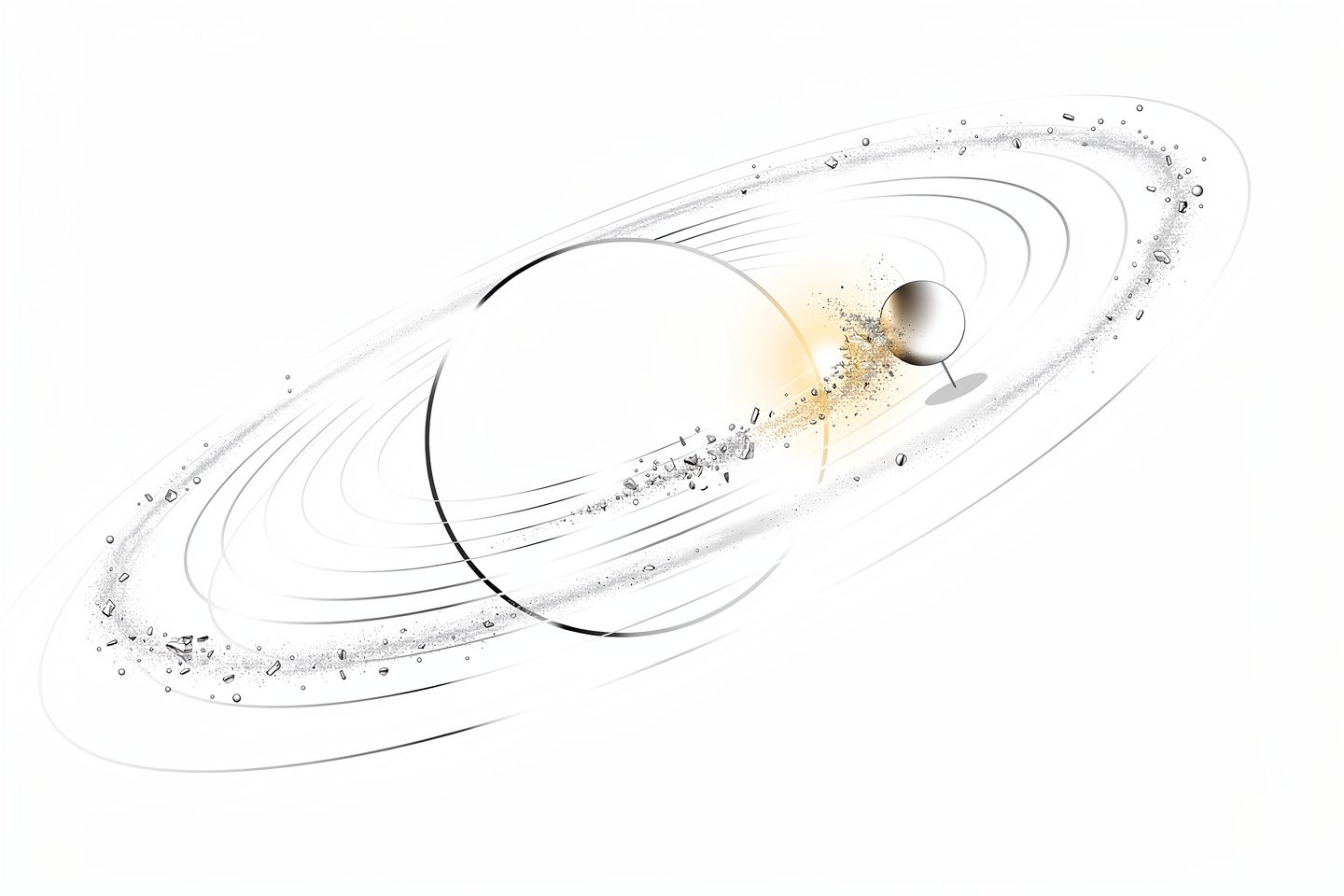
A small moon, flying too close to a planet, breaks into pieces, like a snowball thrown into a fan.
In practice: It helps calculate safe orbits for moons and determines where rings can form around a planet.
French astronomer Édouard Roche first calculated this distance in 1848. The Roche limit is the radius at which tidal forces (the difference in gravitational attraction between the near and far sides of a moon) exceed the moon's own gravity holding it together. A simple analogy: a falling water droplet keeps its shape due to surface tension, but if you blow on it too hard, it tears apart — here, tidal forces play the role of the 'blow'.
How it works
On giant planets like Saturn, rings lie inside the Roche limit: moons once existed there but were torn apart. Comet Shoemaker-Levy 9 broke apart when passing near Jupiter inside its Roche limit.
💡 Saturn's rings may consist not only of destroyed moons but also of material that could never coalesce into a moon because it lay inside the Roche limit.
The Roche limit is the distance from a celestial body (e.g., a planet) at which another celestial body (e.g., a moon) will be torn apart by tidal forces (the difference in gravity from different sides). If a moon comes closer than this distance, the planet's gravity on its near side is much stronger than on the far side, and the moon cannot withstand it.
How it works
On giant planets like Saturn, rings lie inside the Roche limit: moons once existed there but were torn apart. Comet Shoemaker-Levy 9 broke apart when passing near Jupiter inside its Roche limit.
💡 Comet Shoemaker-Levy 9 was torn apart by Jupiter's tidal forces in 1992 into more than 20 fragments, and in 1994 they crashed into the planet.
The Roche limit is the minimum distance from a planet (or other central body) at which a moon held together only by its own gravity can remain intact without being destroyed by tidal forces. For a non-rotating moon on a circular orbit, considered a rigid solid body, the Roche limit d is given by d = R * (2 ρ_M / ρ_m)^(1/3), where R is the radius of the central body, ρ_M and ρ_m are the densities of the central body and the moon, respectively. For a fluid moon (like most large bodies), the coefficient becomes about 2.44.
Discovery
Édouard Roche (1820–1883) first formulated the concept in 1848 while studying the shape of Saturn's moons and rings. Later, James Jeans (1877–1946) refined the theory of tidal stability by introducing the Jeans criterion for gravitational collapse.
How it works
The Roche limit is critically important in astrophysics: it explains the formation of planetary rings (e.g., around Saturn, Uranus, Neptune) and destructive tidal events. It is used in designing orbits of artificial satellites to prevent them from breaking up. It also helps analyze exoplanetary systems and predict possible cataclysmic events in close binary star systems.
Caveats
The formula for a fluid moon depends on its internal structure and rotation speed; For bodies made of loose material (like comets), disruption can occur at a larger distance; Models do not account for the complex dynamics of fragmentation and the possibility of partial self-compaction of debris
d = R \left( \frac{2 \rho_M}{\rho_m} \right)^{1/3}
d is the limiting distance (Roche limit), R is the radius of the central body, ρ_M is the density of the central body, ρ_m is the density of the moon (or small body)
Meticulous 14-year observations of three 'cotton-candy' exoplanets in Kepler-51 yielded an unexpected surprise. The James Webb Space Telescope recorded the outermost known planet crossing the star's disk two hours ahead of schedule. The anomaly was only explained by adding an invisible fourth planet
At Alpha Centauri A, the nearest Sun-like star, Webb briefly picked up a dot called S1 — a planet candidate the size of Jupiter but with a temperature around –20°C. The object hid behind the star — its orbit lasts just 2–3 years, and there’s remarkably little dust around.
Astronomers peeked into planetary cradles and saw: in a third of cases, the disk of gas and dust is tilted relative to its star. That means worlds are born on crooked orbits, not acquiring chaos later. The discovery explains why even our system is slightly lopsided, and promises a whole menagerie of
The search for life has typically focused on planets with liquid water. But hot exoplanets lack it. It turns out that ionic liquids—molten salts that don't evaporate in hellish heat—could substitute for water. Scientists created them in the lab from volcanic acid and organic matter. So, there may be
Analysis of 20 years of NASA antenna operations shows that the most powerful terrestrial radio signals are emitted in the plane of the Solar System. If extraterrestrial civilizations follow the same logic, their transmissions should be sought right there, especially when a planet passes in front of
A baby planet absorbing gas has been discovered around the star AB Aurigae. Light from hydrogen revealed its growth with a unique pattern—astronomers observed this for the first time in a planet embryo. This is direct evidence of how giants like Jupiter grow.
On the dayside of WASP-121b, where rocks vaporize from the heat, Webb’s telescope has spotted clouds of calcium titanate — the same white pigment used in paint. The discovery unveils the alchemy of ultra-hot worlds and how the host star gradually destroys its planet.
A gas giant the size of Jupiter orbits the pulsar PSR J2322-2650b, heated to 1900°C. Its atmosphere is thick soot of carbon chains, not the usual water vapor. Carbon is a hundred times more abundant than oxygen compared to normal, and ten thousand times more than nitrogen. This doesn't fit the 'blac
Scientists have built the first model of sub-Neptune interiors where hydrogen and rock are not separated but mixed. It turns out that in young planets, hydrogen makes up tens of percent of the mass and, as it escapes outward, slows down contraction. This explains why juvenile sub-Neptunes are larger
Webb studied the planet HAT-P-26 b and found water, carbon dioxide, and sulfur dioxide in its air. Previously, SO₂ had only been spotted on scorching hot giants or chilly sub-Neptunes; now it's clear that photochemistry works across a wide temperature range. A trend emerged: the higher the atmospher
Planet TOI-561 b orbits its star in less than a day and surprises with its lightness. Infrared observations revealed: the dayside isn't hot enough for bare rock. This means a thick gas coat holds in the heat, rewriting the rules for worlds around bright stars.
The algorithm, like an artist, reconstructs the polarization picture from sparse strokes. Accounting for the smooth change of light properties from color to color allows it to work in extremely low light—this will improve astronomical observations and material analysis.
Using Webb, astronomers peered into the atmosphere of the brown dwarf Wolf 1130C and found phosphine — a gas familiar from Jupiter. Its abundance is ten times higher than expected, pointing to vigorous mixing of layers, like in a planetary mixer. Now the boundary between giant planets and brown dwar
LTT-9779 b is a planet from the 'hot Neptune desert', a region where worlds usually perish. But it survived thanks to a carbon cocoon: an atmosphere of carbon monoxide and carbon dioxide turned out to be so thick that it doesn't evaporate even at 2000°C. On top of that, this exoplanet reflects 80% o
A cosmic dance of dust and light: the James Webb Space Telescope discovered that Chariklo's inner ring suddenly grew denser, while the outer one almost disappeared. Such adornments are likely short-lived and constantly renew themselves.
Scientists have figured out how rocky planets hold onto lightweight hydrogen: stellar tidal forces heat up their interiors, triggering non-stop eruptions. Volcanoes belch out gases, replenishing the loss. Such a planet gives itself away by an unusually thin hydrogen envelope — which the James Webb S
Astronomers using the James Webb Space Telescope observed the exoplanet WASP-121b—a blazing gas giant circling perilously close to its star. It turns out the planet is losing its atmosphere: helium streams into space in two comet-like tails. One tail outruns the planet and plunges into the star, whi
A swarm of comets around RZ Psc briefly dimmed the star's light as they passed in front of it. The TESS telescope caught these dimmings, allowing astronomers to estimate the sizes of these icy bodies—between one and seven kilometers. The size distribution resembled the belt of icy boulders beyond Ne
Astronomers investigated the possibility of submoons—small moons orbiting other moons. It turns out Earth could host an asteroid-sized submoon, while giant planets might have entire Earth-like worlds. But for life to emerge, a submoon needs about half of Earth's mass, and at that very mass its orbit
Scientists pointed the Japanese probe's navigation camera at alien suns and saw giant planets briefly dimming their light. Even such tiny optics, with clever data processing, can rival space telescopes. This trick promises to find planets that have been hiding for years.
Astronomers tested the idea of using Earth's shadow to detect alien probes. An automated telescope captured brief light flashes near the shadow's edge — objects not listed in any catalog. This could change the approach to the search for extraterrestrial intelligence.
Astronomers analyzed data on the orphan planet WISE 0855 — a dim, cold ball not far away. For 11 hours, Webb watched its light, trying to spot the shadow of a moon. No direct discovery happened, but the method proved its worth. If many rogue planets have Titan-sized moons, we will soon find them.
Astronomers have found many rocky planets wrapped in a thick layer of hydrogen. Experiments with pressures of 600,000 atmospheres and heat above 4000°C have shown for the first time: deep inside, hydrogen pulls oxygen from rust (iron oxides) and turns it into water. This unseen chemical factory can
Simulations show that after a planet is ejected by a supernova explosion, all its moons are left on slightly elongated orbits. This triggers constant internal heating — as if the planet endlessly kneads its moons. In 12–15% of cases, the heat is enough for subsurface oceans, like those on Europa and
By recreating the interiors of sub-Neptune planets, scientists discovered that under high pressure, hydrogen interacts with magma, pulling out oxygen. Water forms, and its fraction can reach tens of percent. So water doesn’t always come from icy outskirts — it’s born right on the spot. This changes
Scientists have figured out that not every star is fit for 'cooking' life. By comparing the ultraviolet balance of different suns, they determined: the ideal recipe is found in yellow G-class stars like the Sun. Only there does the ratio of soft to hard radiation allow molecules to complexify into i
Scientists collected tens of thousands of observations from ground-based and space telescopes to nail down when planets pass across the faces of their stars. It turned out that 45% of the planets needed adjustment. This will help schedule observations on major telescopes like the James Webb. Amateur
Analysis of a single transit with James Webb pointed to a possible moon around exoplanet Kepler-167e. But a slow brightness drift scrambled the clues: it could be a starspot. A new transit in 2027 will settle the case.
Algorithms sift through millions of options, suggesting new ideas to scientists—from medicines to distant planets. Robotic labs then test these hypotheses immediately, making science faster and more accessible.
VHS 1256B is a giant planet, drifting alone in the dark. Its brightness swings by 40% due to global storms of scorching sand. Data from the James Webb telescope and computer models showed that dust clouds blanket the planet entirely, explaining the strange changes in its light and color. This discov
The Comet Interceptor spacecraft will hide in a gravitational 'niche' lying in wait for a comet. Scientists propose using the same tactic for sudden interception of objects arriving from other stars. For the first time, we'll get a look at the material that builds the universe beyond the Solar Syste
Scientists reexamined data from the hunt for planets around other stars and identified objects detectable only through gravity. Six suspicious 'planets' and two cases of light bending might actually be primordial black holes. They don't glow, they don't eclipse stars, but they could be the key to da
Tight binary stars rarely have planets. The reason is gravitational resonance. When two stars draw close, their spin falls into rhythm with a planet’s orbit, like pushes that rock a swing. The orbit stretches, and the planet either flies off into space or crashes into a star. So the very process of
Scientists modeled the thermal evolution of sub-Neptunes and found that 98% of these worlds probably harbor a permanent magma ocean under their hydrogen atmosphere. This explains why the most common planet type in the galaxy stays hot inside, even though they were thought to have solidified long ago
The James Webb telescope is hunting for an atmosphere on TRAPPIST-1 e, but the star's flares get in the way. Scientists found a fix: record the noise using the neighboring airless planet TRAPPIST-1 b, then subtract it from the main signal. Early tests show the method works on quiet days, but a power
Gas giants around alien stars turned out to be more inflated than expected. New modeling shows that heating comes from the surface, not the interior, reshaping our understanding of planetary weather.
Astronomers have found an elegant mechanism: the supernova doesn't destroy the planetary cradle but sends rays that create the necessary radioactive atoms right inside the disk. At a distance of one parsec, it works perfectly. This discovery makes rocky planets common.
The brightest astronomical discoveries involve rare and extreme objects. First contact with aliens will likely also happen thanks to a civilization experiencing a brief but immensely powerful flash — possibly its final one. To be noticed, a civilization must release at least 1% of its total energy.
The study estimates how much longer plant life will persist on Earth as the Sun brightens. It factors in seafloor weathering and random changes in CO₂ emissions. The research is crucial for understanding our biosphere's future and searching for life on other planets.
Free-floating planets, untethered to stars, long remained a mystery: without an exact distance, their mass couldn't be measured. By combining telescopes on Earth and in space, scientists calculated the distance to object KMT-2024-BLG-0792 and found its mass—just 0.22 Jupiter masses. It turned out to
Astronomers spotted lone planet KMT-2024-BLG-0816 when, like a cosmic lens, it amplified the light of a background star. The planet passed so close to the line of sight that it was possible to see how the brightness of different edges of the stellar disk changed. They didn't find a host star nearby,
Astronomers mistook a dip in star brightness for a planet transit, but careful scrutiny revealed an indistinguishable pair of suns. The culprit: a companion star hiding in the glare of the primary. A story of how easy it is to mistake a shadow for reality.
Around dim stars like TRAPPIST-1, photosynthesis barely produces oxygen—visible light is scarce. Infrared bacteria, on the other hand, thrive, gobbling up nearly all the available energy. As a result, an oxygen atmosphere may never form, and complex life never arise.
Around TOI-4495, two planets orbit wrapped in thick gas blankets. Their orbits are almost tuned—two revolutions of the inner planet for one of the outer—but exact synchronization is absent. The elongated path of the inner planet persists for billions of years thanks to the unusual elasticity of its
Astronomers are reimagining the map of nearby stellar pairs. The zone of tight orbits around Sun-like stars was once called the 'brown dwarf desert,' thought to hold few objects heavier than planets but lighter than stars. Fresh Gaia data reveal that many stars are dancing with unseen companions — a
The light of TRAPPIST-1 revealed that standard models were wrong: in its cold atmosphere, molecules collide differently, hiding the chemical composition. Refining the rules will help us better understand the star itself and its planets.
The study showed: at the edges of habitable zones, carbon monoxide accumulates to dangerous levels due to a breakdown in chemistry. And formaldehyde, important for life, forms better around hot stars. This will help select planets for detailed study.
Measurements of 32 celestial bodies revealed that giant planets spin almost at the brink of tearing apart because their gaseous cocoon barely slowed them down in their youth. Brown dwarfs, on the contrary, lost spin due to a denser disk. Moreover, planets don't depend on proximity to a star, while c
A planet on a slightly egg-shaped orbit swings in close to its star, then pulls away. The changing gravitational tug heats its guts, melting rock into a lava ocean. Tidal waves stir it, spawning wandering hot spots. This makes the planet's glow flicker unpredictably—and sometimes the entire world tu
Scientists have figured out how to search for life on other planets by looking for colored traces on the surface. These paints are left by living organisms. The HWO telescope will spot such color signatures even if the air shows no signs of life — for instance, when it’s ancient and doesn’t produce
Gravitational kicks from distant giant planets knock small rocky worlds (super-Earths) near the star out of the system. The ejected planet becomes a lonely wanderer. This same mechanism can shuffle the orbits of the remaining planets and even send them plunging into the star.
Scientists have found: moons around rogue planets can stay warm and wet for billions of years. A dense hydrogen atmosphere traps heat, and tidal forces warm the interior. These conditions are suitable for the emergence of life, including the formation of RNA.
The model divides exoplanets into rocky and water worlds. Water worlds with steam atmospheres nicely account for the size gap, but at three Earth radii, their numbers plummet — like water over a cliff. This points to the inevitable capture of light gases by large planets.
On tidally locked planets, mountains and hills can stave off a permanent ice age. They disrupt air currents, transporting moisture to the dark side, where clouds blanket the surface and trap heat. Even modest relief can transform an ice ball into a world with liquid water.
The study calculates how much energy plants can extract from the light of different stars. Cool red dwarfs lack enough suitable light particles for efficient photosynthesis. This reduces the likelihood of complex life. For Earth, the results match real-world data.
The star GJ 504, similar to the Sun, spins too fast for its age. After devouring a Jupiter-sized planet, it gained extra angular momentum and regained its magnetic youth. A similar case with HD 75332 shows that stellar cannibalism is not uncommon.
In the lab, a mix of carbon dioxide and nitrogen was bombarded with particles, mimicking the young Sun's era. This produced nitrous oxide and glycine. Nitrous oxide, like a lid on a pot, trapped heat—so early Earth didn't freeze. The same mechanism could warm distant exoplanets where stellar heat is
Spectroscopic analysis of comet 3I/ATLAS by Webb revealed an anomalously high deuterium content. This chemical marker suggests the comet was born in the bitter cold of a distant star system.
Researchers applied Earth’s competition models to bacteria on hycean planets—worlds with deep oceans and hydrogen skies. Light-eating microbes grab the surface, like weeds taking over a garden. Viruses can crash the system or boost diversity. On worlds with one side always facing their star, life is
Like friends in a dark theater, signals from aliens can be synchronized to a common cosmic flash. Astronomers tested this method for the first time, using the most powerful gamma-ray burst GRB 221009A and the TESS satellite to observe 58 stars. Two suspicious flickers turned out to be interference,
Analysis of exoplanet surveys showed that their orbits are grouped, not scattered randomly. It's like piano keys: there are preferred positions and gaps in between. The cause is standing waves in the gas-dust disks that dictate the birthplaces of worlds. The discovery changes our view of planetary s
Scientists discovered that hydrogen seeps into molten iron, making it less dense. Under the conditions of the Moon's core, iron absorbs up to 1.2% hydrogen, reducing its density by 9% — exactly the amount needed to explain data about the Moon's oscillations. This finding overturns our understanding
Comparing 1.6 million brightness measurements over five years, astronomers noticed opposite trends: Starlink satellites with sun visors (VisorSat) became 0.6 magnitudes brighter, while OneWeb spacecraft became 0.4 dimmer. Both changes are statistically significant with an error probability below 0.3
Scientists calculated a thousand years of the future across ten scenarios. It turns out civilizations pulse: periods of prosperity alternate with decline, like heartbeats. The active time fraction ranges from 38% to 100%. The main factors are the rate of resource depletion and the resilience of know
The Loeb scale rates the weirdness of an interstellar object on a five-point scale. A ‘candidate’ level isn’t proof, but a green light for intensive observations. Ignoring it is more dangerous than being wrong.
The study examines how radiation from stellar flares affects the air of young planets. Scientists modeled a year of chemical changes and found that moderate flares have a strong impact. Atmospheres with high water vapor content are particularly vulnerable. This discovery is important for correctly i
Usually, life on distant planets is sought by telltale gases in the atmosphere. But their buildup isn’t only from life. A new approach gauges not the concentration but the rate gases stream from the surface — like figuring out if bread is baking not by the smell, but by the waft of heat from the ove
Extra dimensions have long evaded detection due to electromagnetic noise. The protocol of quantum-induced entanglement of masses turns two microscopic bodies in superposition into gravitational tuning forks, accumulating a phase shift exquisitely sensitive to deviations from Newton's law. Analysis o
Scientists have calculated the gravitational radiation from a stellar-mass black hole radially falling into a thin-shell wormhole. The signal resembles rhythmic beats: a burst as the black hole approaches the throat from our side, and a deep silence as it plunges into another universe. Calculations
The event horizon of a black hole conceals not a point of infinite curvature, but a zone of quantum transformation, where time itself changes roles. New research in quantum gravity shows: the singularity vanishes thanks to relational dynamics — one of the metric variables serves as a clock, and the
The search for extraterrestrial life is like an unreliable medical test: a single positive result means nothing if the error rate is unknown. A new approach sidesteps this problem by dividing worlds into groups—much like patients with different risk factors. Statistical comparison dramatically reduc
New research reveals a subtle mechanism: polarization doesn't just illuminate a black hole's shadow — it deforms it. The effect, predicted for rotating holes, is vanishingly small but fundamental: polarimetry transforms from a passive spectator into an active probe of extreme gravity. In a static sc
Analog gravity doesn’t freeze in weak perturbations. When gas roars onto a black hole, it gives birth to a living acoustic spacetime—a horizon that oscillates and shifts. Using an equation of state for ultrahot plasma with a variable adiabatic index, the authors showed that the horizon radius dances
Schwinger pair production in gauge fields reveals the unexpected depth of the vacuum: instead of simple entanglement, nonlocal magic arises—correlations that cannot be described without a full-fledged quantum computer. Holographic duality links this magic to the geometry of strings and black holes,
For the first time, nonlinear simulations of black hole flybys in modified gravity have been performed — test shots on the cosmic range. Comparing the scattering angles with analytics hit nearly the bullseye: the difference stayed within one degree. This paves the way for rapid gravitational wave te
Numerical simulations revealed how plasma gets stuck in the throat of a rotating wormhole, painting a thin luminous rim on its shadow and making it flicker with a period set by mass and spin. These signatures, observable by the Event Horizon Telescope at 230 GHz, turn active galactic nuclei into nat
When a young planet is covered in scorching liquid rock, heavy particles like iron want to sink. But the mantle melts from below, and light droplets float up, churning the ocean. On big Earth, the 'stirring' was strong—no layers formed. Mars is smaller, its rocky soup was shallower and calmer, so ir
Matter interferometry creates a Schrödinger's cat for macroscopic masses, opening the path to quantum gravity. A mass in superposition generates two clouds of coherent gravitons — gravitational shadows. Their contrast drops exponentially with increasing mass, signaling the growing entanglement betwe
Quantum cosmology has long faced a paradox: the elegant idea of a universe born from 'nothing' relentlessly favored dreary microscopic worlds. New research shows that swapping the familiar sphere for a three-dimensional torus rewrites the script. Summing over all possible smooth fillings of the toru
Astronomers used the Green Bank Telescope to search for signals from 70,000 stars. 100 million candidates turned out to be interference from earthly technology. This gives an upper limit: only six out of 100,000 stars within 20,000 light-years might have a transmitter of the required power. 40,000 v
Using Cosmicflows-4++, scientists directly estimated relativistic corrections and found that curvature contributes about 10% to the expansion dynamics on scales up to 300 Mpc/h, while kinematic backreaction is negligible. This challenges the globality of ΛCDM and threatens systematic errors in cosmo
The Fourier Plane Division (FDD) method splits light into several parts, measures them independently, and combines them with an algorithm. An experiment showed a fivefold increase in sharpness in microscopy. Unlike other methods, FDD needs no special illumination, making it applicable for astronomy
In quantum cosmology, the Big Bang singularity turns out to be a mirage. Using relational time emerging from entanglement between subsystems of the universe, physicists have shown: the probability of zero volume is strictly zero. The Page-Wootters formalism transforms a static wave function into an
The hybrid Schrödinger–Newton equation for the first time analytically disentangled two faces of gravity: self-interaction and mutual attraction. It turns out that self-gravity does not alter the Schmidt spectrum, and hence the measure of quantum entanglement; however, the pairwise potential activel
According to classical theory, the collapse of a massive star ends in a black hole with a singularity, where the curtain of physical laws falls. Roger Penrose proved the inevitability of singularities, and Stephen Hawking showed that quantum effects create the information paradox. New work proposes
A new study proposes a simple observational test: any binary system with a negative-mass component must either produce an anomalous signal with a falling frequency or instantly fly apart. Not a single such 'note' has been found in the LIGO, Virgo, and KAGRA archives. The silence shuts down an entire
At the heart of a dying star lies an algebraic cipher that translates the language of matter into the language of black hole geometry. Physicists have found a precise two-way map: given a density profile, you can recover the exterior metric—and vice versa—without solving complex differential equatio
By numerically investigating the scattering of scalar waves on a rotating traversable wormhole, scientists discovered Breit-Wigner resonances. They sharply intensify under fast rotation and for counter-rotating modes, creating a spectral fingerprint radically different from that of black holes—a sig
Traditionally, SETI has searched for narrow radio signals. But Earth's technosphere is humming ever louder, creating a broad radio background. Astronomers have developed a method to detect such a planetary hum around other stars using modern telescopes. This will allow us to find civilizations up to
A new theoretical work unites quantum mechanics and general relativity, showing that two parallel atomic lasers, unperturbed in the classical world, begin to diverge under the influence of quantum fluctuations of spacetime. Vacuum tremors of the metric give rise to an irreducible spread of trajector
Mass currents have now been introduced into the Diósi–Penrose wave function collapse model for the first time, adding post-Newtonian corrections from general relativity. It turns out that moving mass generates gravitomagnetic noise, causing angular momentum decoherence. The most dramatic effects app
The weak equivalence principle has been tested with fantastic precision, but always with grounded samples — as if one string of the gravitational violin is deliberately muted. The κ parameter quantifies whether acceleration depends on electric charge: it is the ratio of the difference in acceleratio
Astrophysicists have proposed a new method for hunting dark matter — not searching for the black holes themselves, but listening to the quantum echo of gravity. In regions of ionized hydrogen, tidal forces from primordial black holes split the atomic level 2P₃/₂, turning a single 9.9 GHz absorption
The diagnostic parameter \(\tilde{\alpha}\) reveals that in galaxies and clusters, the post-Newtonian approximation loses reliability due to accumulated nonlocal gravitational correlations. Its value skyrockets precisely where dark matter is traditionally invoked—and this finding could overturn our
Cosmology allows for a terrifying scenario of phantom dark energy, where the universe's expansion accelerates so violently that it tears apart galaxies, stars, and atoms. Deep-space detectors can't spot a sudden shift to this state: light from distant supernovae has traveled billions of years. So Ro
The no-go theorem dashes hopes of circumventing the wormhole paradox: no interaction with dark energy can shield against the geometric demand for 'negative pressure.' The work shows that even the most cunning models with energy transfer between matter and vacuum shatter against the relentlessness of
The main obstacle for a graviton laser is that gravitational waves cannot be reflected: they pass through any substance. The solution lies in the Gertsenshtein effect. Under a powerful magnetic field, gravity particles temporarily become photons, which are easily reflected by ordinary mirrors. The r
Simulations show that a planet buffeted by a pulsar's wind generates radio waves. This means exoplanets around neutron stars can be detected by their radio glow. The method has been tested on the system PSR J0636+5129 b.
New research shows: wormholes with a precisely tuned throat length can cast a shadow indistinguishable from that of a Schwarzschild black hole. But numerical simulations expose a critical flaw in the disguise—the wormhole's accretion disk emits far more energetic radiation thanks to Doppler boosting
Quantum gravity eludes experiments due to the Planck scale. But the 2026 Gravity Research Foundation award-winning work points to a natural super-amplifier: superradiant axion clouds around rotating black holes. This cosmic mechanism generates squeezed states with up to 10⁷ correlated gravitons, cre
In a new cosmological model, the source of accelerated expansion is not a mysterious cosmological constant but the process of absorbing other universes. The merger intensity is set by a single constant g, calibrated by the local value of the Hubble constant. The computed evolution of the dark energy
The new model intertwines cyclic cosmology and inflation into a single dance: two scalar fields, like blacksmith’s bellows and a valve, alternately compress and inflate the Universe. This approach not only lifts the curse of the singularity but also explains the mysterious smoothness of the cosmos,
In 2011, Comet Lovejoy passed through the solar corona. Almost immediately, instruments recorded a bright flare. Scientists calculated that the comet's energy was 10–1000 times less than needed for such a flare. Probably, comets don't cause explosions themselves, but can trigger ones that are alread
When a white dwarf tears apart a passing asteroid, we expect a dust cloud. But new analysis flips the picture: particle cohesion — those very van der Waals forces that hold sand grains in your palm — erects a kilometer barrier. Fragments smaller than hundreds of meters simply cannot be born during t
These objects are one of the biggest mysteries and a possible key to dark matter. New modeling has revealed a rare but spectacular scenario with two outcomes for capture by a binary system. Without an accretion disk, the star fades unnoticed; with a disk, it is torn apart by relativistic jets in min
Traditionally, astronomers caught planets by waiting for multiple passes across stars. ExoVeil breaks this mold: a transformer neural network learns to predict the star's normal twinkling and spots even a lone shadow. A blind analysis of Kepler data revealed 179 new candidates, and on TESS data with
In the disk of TW Hydrae, resembling the early Solar System, HC5N has been detected — the longest carbon chain in such an object. The ALMA discovery shows that prebiotic compounds are not destroyed in the planetary forge. Models point to an excess of carbon, linking the disk's chemistry with interst
Neptune's third-largest moon, Nereid, was long counted among the icy intruders from the Kuiper Belt. But its unique infrared spectrum, captured by the James Webb Space Telescope, is unlike any other: crystalline water ice with a reddish tint and traces of carbon dioxide hint at a birth near the plan
Spectral lines of erythrulose (C₄H₈O₄), caught by the Yebes 40m and IRAM 30m radio telescopes, betrayed the presence of this sugar in the cloud G+0.693. For the first time, we see how, in the interstellar medium, on the surface of icy dust grains, components of nucleic acids are born from glycolalde
The CRIRES+ spectrograph on the Very Large Telescope captured the faint light of the young super-Jupiter TWA5B and resolved the SiO lines—the main carrier of gaseous silicon. The detection with a signal-to-noise ratio of 7.5 means: silicon almost entirely floats in the gas phase, not locked in silic
What happens to a solar sail at near-light speeds? An analysis of three components of light pressure — incident, specular, and diffuse — revealed a critical threshold. The relativistic Doppler effect weakens the mirror-like thrust, and after v=0.75c, diffuse scattering reverses sign and decelerates
Using the OVRO–LWA array, astronomers conducted an unprecedented survey in the 50–86 MHz band with 10 Hz resolution. The 30-second exposure produced over three million images, setting strict limits on the power of hypothetical transmitters around nearby stars. No extraterrestrial signal was detected
Analysis of the fireball that blazed on April 1, 2026 over the South Atlantic showed its heliocentric velocity was 51.73 km/s. That's 9.59 km/s above the threshold at which an object forever leaves the Solar System. Scientists accounted for gravitational acceleration, recalculated coordinates, and r
Carbonaceous chondrites that fall to Earth carry a double isotopic signature. Measurements of silicon, iron, magnesium, and chromium tell us that the stuff of Jupiter and Saturn came from two reservoirs, with a late addition of comet dust making up more than a third. Even more surprising, CI chondri
About 800 million years ago, in the main asteroid belt, the parent body of the Eulalia family — a giant chunk of primitive carbonaceous chondrites — broke apart. Nearly three-quarters of the fragments, caught by Jupiter's gravitational resonance, rushed into the inner Solar System, causing a true im
Since 2017, only three interstellar bodies have been discovered — Oumuamua, Borisov, and ATLAS. New research reveals: rapid sky motion renders most such objects invisible. Analytical models and simulations show that faint visitors streak by faster than survey cameras can capture. This explains the p
TRAPPIST-1 e is a rocky planet in the habitable zone of a red dwarf, one of astrobiologists' prime targets. But decoding its atmosphere requires a precise ultraviolet 'autograph' of the star. Simulations showed: different UV spectra dramatically alter the chemical portrait, producing deceptive pairs
Predicting rare disasters—market crashes, AI glitches—is nearly impossible. Classical computers demand oceans of data or predefined checklists. A new quantum algorithm flips this: it uses the blurry nature of qubits to amplify the faintest warning signs, offering a safety net for banks, power grids,
Solar flares crank temperatures up to millions of degrees, but iron ions move much faster along magnetic lines than across them. An international team, analyzing nearly 4,600 spectra from the Japanese Hinode satellite, proved for the first time that line broadening is driven not by turbulence but by
Atmospheres of many sub-Neptunes are shrouded in dense organic hazes that hide their true composition. In lab experiments, such hazes were recreated from water vapor, methane, and carbon dioxide, then irradiated with ultraviolet light, mimicking flares from red dwarfs. It turned out that after irrad
Where to look for intelligent brothers? A new parametric filter of seven criteria rejects stars unable to support complex life. From Gaia DR3's 1.74 million stars, it eliminated 55.4%, retaining 777,835 priority targets — mostly G and K dwarfs. Key rejection factors: low metallicity and youth. Notab
In the turbulent disks of active galactic nuclei, blanets form—giant planets of incredible density. Drifting toward the central black hole, they are torn apart by tidal forces, generating brief but dazzling flares in optical and ultraviolet light. Their density allows them to approach the horizon of
The bright flash of a bolide is just the first act. After an asteroid or comet fades, dark flight begins: the invisible drift of fragments to the ground. That's when wind sows chaos, shifting the impact point by hundreds of meters. The team of Devillepoix and Cupák deployed the WRF model to calculat
Ultra-precise photometry of four secondary eclipses of the planet in the red dwarf system GJ 3929 yielded a depth of 118±22 ppm, corresponding to a dayside temperature of about 640 K. Modeling showed that a dense carbon dioxide envelope like Venus's cannot be held, though traces of gases might remai
Planets on the outskirts of star systems prove to be perfect scales for invisible matter. A drifting clump of dark matter nudges their orbit just enough— a shift we can now measure. This method could uncover the primordial invisible structures lingering from the Big Bang and let us chart the dark un
Hundreds of rogue planets lurk on the outskirts of the Solar System. Their close encounters with Earth—even without a collision—cause waves, eruptions, and climate shifts. This explains past mass extinctions.
A new study turns our understanding of Uranus and Neptune upside down. Instead of layers of frozen water and methane, an ocean of magma soaked with hydrogen likely sloshes inside them. This idea explains all the mysteries of these planets and makes them kin to distant worlds around other stars.
Astronomers studied WASP-121 b, a gas giant always facing its star with one side. As the planet transited the star, they detected changes in light absorption: the eastern limb was hotter than the western, which destroys water and leaves carbon monoxide. This opens a method for scanning weather on su
The main enemy here is not heat, but gravity. If the Sun sheds mass fast enough, Earth will retreat to a more distant orbit. Judging by observations of similar stars, we have a pretty good chance.
A third giant planet has been found around Beta Pictoris—not in an image, but through chemical traces in light: methane, water, and carbon monoxide. It is 2–4 times more massive than Jupiter and sits so far out that a year there lasts over a century. Its gravity shapes the inner edge of the dusty di
Calculations show that tiny artificial particles could cross interstellar space and survive in the lunar soil. Sunlight filters out the unsuitable ones, and on the Moon, they don't burn up in an atmosphere. Even a handful of regolith could tell us how often technological civilizations arose in the G
When two would-be planets around other stars collide, the impact strikes a blinding spark. The glow slowly fades over weeks to years. New sky surveys will capture these events, unveiling the secret of world birth.
The Drake Equation estimates the number of extraterrestrial civilizations, but many of its factors are a mystery. A view from the perspective of indigenous traditional knowledge dramatically changes the picture: life becomes ubiquitous, and the Galaxy—densely populated.
Between searching for life and technology, there is a gap: how to notice intelligence without machines? Noosignatures — any ordered traces of a thinking being — fill this void. From a paw print to a signal without a key: a new method expands the chances of finding alien intelligence even where life
Astronomers discovered exoplanet TOI-2195 A b – a hot Neptune with a mass 1.5 times that of Neptune, but a radius almost as large as Jupiter's. Orbital analysis suggests a likely polar orbit. Modeling indicates the planet may have formed as a cold Jupiter, losing up to 90% of its mass during highly
The James Webb Space Telescope has peered into a previously unseen world: the atmosphere of the giant planet WD 1856 b, orbiting a white dwarf. The transit spectrum from 0.5 to 5.0 μm revealed hydrocarbons, including methane with a significance of 17:1 to 30:1, thick aerosols, and thermal glow from
Astronomers took advantage of the visit of the interstellar object 3I/ATLAS to conduct a unique radio reconnaissance. Using the 500-meter FAST telescope and the method of canonical polyadic decomposition, they analyzed the data, trying to extract periodic signals against the background of terrestria
Astrophysicists analyzed ultra-precise spectra of 79 solar twins and concluded: most Sun-like stars acquired their chemical makeup naturally—through Galactic evolution. Only a few candidates show signs of exoplanet ingestion. This confirms that our star is not an exception but a typical product of i
For the first time, a planet has been detected in TESS data using gravitational microlensing. The event Gaia23bra, identified by the Gaia survey as an isolated lens, revealed sharp caustic-crossing peaks in the TESS light curve—an unmistakable sign of a binary system with a planetary companion. Join
Analytical estimates and numerical simulations show that kicks during white dwarf formation directly liberate only ~1% of known exoplanets, but in multi-planet systems they trigger dynamical instability in 40–47% of cases, leading to planet ejections. These free-floating planets are heated to up to
Protoplanetary disks harbor complex architecture, but the narrowest rings elude direct view. By analyzing how brightness varies along the disk's tilt, scientists found a 'double peak' — a telltale signal of optically thick rings in an optically thin background. This method unveils substructures beyo
310 light-years from Earth, astronomers have found a remarkable system: a 15 million-year-old star surrounded by two transiting gas giants with record-long orbits of 225 and 314 days. Observations with TESS, CHEOPS, and ground-based telescopes measured their radii and set upper limits on their masse
Scientists from Blue Marble Space combined geophysics, atmosphere, and rocket dynamics to find the limits of chemical escape from exoplanets. A payload of 1,000 kg — like that of the Voyager probes — was used as a benchmark. It turned out that for a planet more massive than about 11.5 M⊕, the number
How does a primordial black hole, a dark matter candidate, alter the fate of a planetary system? Simulations of the TOI-2796 system revealed three dramatic outcomes: planet ejection, formation of a stable triple system, and capture of the planet into an eternal journey with the black hole. The rare
The discovery of 1I/‘Oumuamua made us wonder: could some interstellar wanderers actually be our own comets, ejected from the Oort cloud and returning millions of years later? Simulations show that such ‘quasi-interstellar objects’ are indeed possible, but they have unique characteristics: extremely
A new study has, for the first time, self-consistently incorporated the recipe of double diffusion into an evolutionary code of planets and traced the fate of Jupiter and Saturn from the moment of formation. It turns out that even a thousandfold enhancement of mixing does not lead to significant sme
Spectrograph NIRSpec aboard the JWST telescope has discerned a complex mosaic of carbon dioxide and carbon monoxide bands on Ariel, Umbriel, Titania, and Oberon. Comparison with laboratory ices at cryogenic temperatures revealed signatures of crystalline CO₂, clathrates, and carbonates. The observed
A model based on exponential technological growth shows: the faster a civilization develops, the shorter the period during which it emits technosignatures we can detect. At rates comparable to Earth's after the emergence of AI, this window could be less than twenty years. Traditional narrowband sear
We've been searching the skies for factory chimney smoke, but we should be looking for blooming gardens. A new approach in astronomy suggests shifting focus from pollution to ecological harmony.