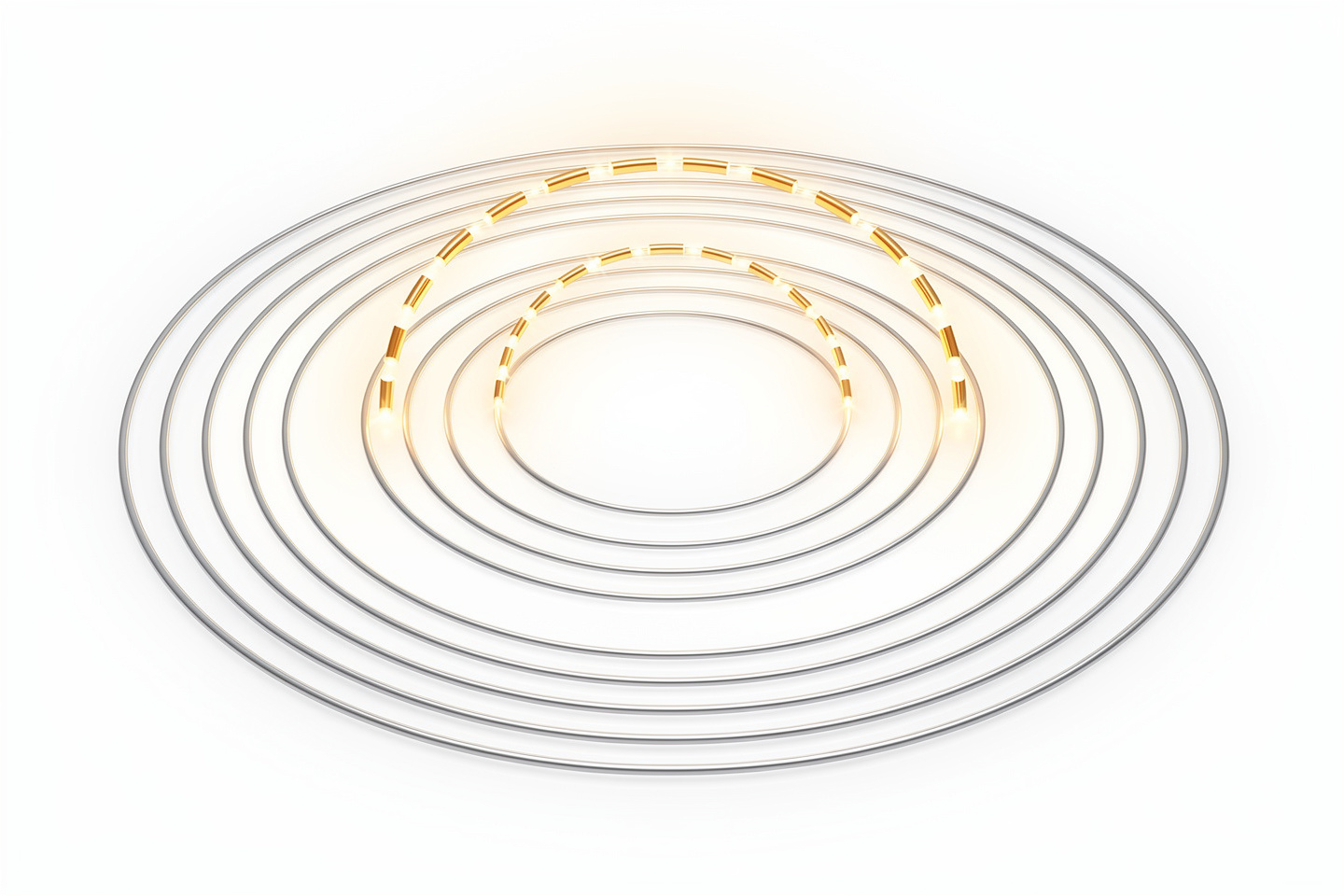
Like notes on a staff, four visible hydrogen lines follow a simple mathematical rhythm.
In practice: Thanks to this formula, one can tell from a star’s spectrum how much hydrogen it contains and how fast it moves.
In 1885, 60-year-old Johann Jakob Balmer (a Swiss mathematician and teacher) noticed numerical harmony in the wavelengths of the hydrogen spectrum. He empirically derived a formula that was later generalized by Johannes Rydberg for all series (Lyman, Paschen, etc.). Balmer's discovery became the empirical foundation for subsequent quantum theories of atomic structure—Niels Bohr in 1913 explained the Balmer formula by postulating quantization of angular momentum.
How it works
Astronomers use this formula (generalized as the Rydberg formula) to identify hydrogen in stars and galaxies. In the lab, it helps calibrate spectrometers and study atomic structure.
💡 Balmer was so fascinated by numerical patterns that he tried to explain the layout of Egyptian pyramids and even the proportions of the human body using simple fractions.
Swiss mathematics teacher Johann Balmer in 1885 found a surprisingly simple formula that accurately predicted the wavelengths of the visible colored lines in the hydrogen spectrum. Before him, these four lines had been measured, but no one knew the pattern. The formula is 1/λ = R (1/4 - 1/n²), with n = 3, 4, 5, 6. It matched measurements perfectly and later helped Niels Bohr build the first quantum model of the atom.
How it works
Astronomers use this formula (generalized as the Rydberg formula) to identify hydrogen in stars and galaxies. In the lab, it helps calibrate spectrometers and study atomic structure.
💡 Balmer's original formula was λ = (3645.6 × 10⁻¹⁰) × n²/(n² - 4), n = 3, 4, 5, 6. He guessed the constant without knowing about the Rydberg constant.
The empirical Balmer formula describes the spectral lines of hydrogen in the visible region: 1/λ = R (1/2² - 1/n²), where n = 3, 4, 5, ... (integers greater than 2). λ is the wavelength in vacuum, R is the Rydberg constant (≈ 1.09678×10⁷ m⁻¹ for hydrogen, with a small correction for the finite nuclear mass). A strict physical interpretation came later: electron transitions between levels with principal quantum numbers n₁=2 (second level) and higher n₂=n. The formula reflects the quantized energy of the atom predicted by the Bohr model.
Discovery
Johann Balmer published 'Notiz über die Spektrallinien des Wasserstoffs' (Note on the Spectral Lines of Hydrogen) in 1885. His formula amazed contemporaries with its predictive accuracy. In 1888, Johannes Rydberg generalized it to other series. Niels Bohr in 1913 derived the formula from his postulates, giving it physical meaning. Arnold Sommerfeld later refined the model by introducing elliptical orbits and the fine-structure constant.
How it works
It is applied in astrophysics to determine the redshift of distant objects and analyze stellar chemical composition. Limitations: it does not account for fine or hyperfine structure; for heavy multi-electron elements the formula is inapplicable—there quantum electrodynamics is needed.
Caveats
It does not explain line intensities (quantum mechanics needed).; In light hydrogen-like ions (He⁺, Li²⁺), the formula works with a replacement of R, but requires relativistic corrections for precise measurements.
\frac{1}{\lambda} = R \left( \frac{1}{2^2} - \frac{1}{n^2} \right)
λ — wavelength of the spectral line in vacuum; R — Rydberg constant, R ≈ 1.09678×10⁷ m⁻¹; n — integer greater than 2 (3, 4, 5, ...), specifying the particular line of the Balmer series: n=3 gives the red line Hα (656.3 nm), n=4 the blue-green Hβ (486.1 nm), etc.
A material with an internal structure of nested patterns of different sizes suppresses several frequencies at once—like a stack of sieves with different mesh sizes. The computer finds the right shapes on its own, and the large details don’t interfere with the small ones. This paves the way for ultra
In a vanadium-based material, electrons interacting with magnetic moments form a heavy liquid. Under pressure that turns graphite into diamond, the liquid freezes and magnetism vanishes—this is a quantum critical transition, opening the door to new states of matter.
In the US, the SoLID detector is being prepared for launch — a device that will peer inside protons and neutrons, creating 3D snapshots of their structure. It will study how the energy gluing particles together gives rise to almost all mass in matter. Additionally, SoLID will hunt for new particles
As the film thickens from 1.6 to 2440 nanometers, heat transfer shifts from free flight to a crowded jostle. At small thicknesses, resistance is constant—limited by defects and edges, while at larger thicknesses, heat packets live longer but collide more often. This discovery is crucial for microchi
Meticulous 14-year observations of three 'cotton-candy' exoplanets in Kepler-51 yielded an unexpected surprise. The James Webb Space Telescope recorded the outermost known planet crossing the star's disk two hours ahead of schedule. The anomaly was only explained by adding an invisible fourth planet
Astronomers have finally found compelling evidence that black holes are indeed born in supernovae. Around the black hole SS 433, a shell of hot gas is visible — like cooling steam from a massive star explosion that thundered 20,000–30,000 years ago.
Magnetic refrigerators cool by changing the magnetic field around a material: it alternately heats up and absorbs heat. Instead of expensive rare metals, an alloy of iron, nickel, and manganese has been proposed—cheap and effective. But when ground into nanopowder, carbon infiltrates the alloy, spoi
Next-generation batteries could last longer, but their energy leaks away like water from a sieve. The solution: weak measurements, which act like a perfect patch, stopping losses without expending energy. The method works for systems of any size and promises stable storage for quantum computers.
Scientists stabilized a pair of micromirrors using a donut-shaped laser beam. The beam’s dark center lands right on the detector, letting the camera capture the glow of single atoms without interference. This will boost the reliability of quantum devices.
Using spectroscopy, like a probe feeling the electron clouds, physicists discovered: at one energy electrons sit on atoms, at another — in between. This means the internal structure of the material is more complex than a simple model, and such knowledge will help create quantum devices.
Astronomers used 1,200 high-speed stars to compute the Sun's motion. By measuring their full 3D velocities, scientists refined the trajectory of our star and the gravity map of the Milky Way. This helped better understand the distribution of invisible dark matter in the outskirts.
Now, instead of running many simple tests, you can use a single cleverly designed sample. When loaded, its bends reveal all the material’s elastic properties. Scientists have developed a computer method to calculate the ideal shape, ensuring accuracy even amidst noise.
Scientists used a precise laser pulse—a delta-kick—to cool molecules almost to a standstill. The molecules' internal vibrations don't mess with their motion, so they stay intact. Supercold molecules will open the door to ultra-precise tests of gravity.
Ordinary optical fiber without processors has learned to recognize handwritten digits with 93% accuracy. Light passed through the glass strand performs computations on its own — like water swirling into vortices changing its pattern. This is a cheap way to create thinking machines.
MatGL is an open-source library for materials researchers. It uses graph neural networks (akin to social media algorithms) to predict properties from atomic structure. It comes with ready-made models, like construction kit parts: pick the one you need and quickly test new materials. The tool acceler
Weak continuous measurement of quantum systems usually causes random walks of their properties. However, new research has shown that these walks are secretly constrained by simple 'rails' — curves with few parameters. This unexpected discovery simplifies control over quantum objects and promises pro
Quantum computers suffer from imprecise signals, like an orchestra without a conductor. The engineering approach iLQR, which lands rockets, now calculates smooth pulses for qubits. This reduces noise and paves the way for practical quantum computing.
A team of scientists used light from carbon ions in a distant galaxy to determine the rotation speed of gas around the central object. A sharp acceleration of the gas toward the center pointed to a black hole with a mass of about 6.3 billion Suns. This is the first dynamical weighing of a black hole
Armed with a quantum magnetometer that reads nuclear spins with incredible precision, scientists hunted for exotic forces that break mirror symmetry. A tandem of rotating lead masses and a cloud of neon atoms improved previous constraints by a thousandfold. The setup works like a miniature gravitati
Quantum tunneling is not just a trick that lets electrons seep through impassable barriers. It’s a window into the deepest mysteries of reality. It turns out that an electron behaves not as a point, but as a distributed entity—something like an octopus squeezing its tentacles through a crack. This v
Quantum sensors based on Rydberg atoms can detect minuscule electromagnetic fields, but optical readout usually destroys almost all signal photons. Physicists from Warsaw went against the grain and deliberately enhanced nonlinear losses through dipole-dipole collisions of excitations. This paradoxic
By combining lithium niobate and gallium arsenide, scientists created a chip. In it, quantum dots interact with microresonator modes, and electro-optic tuning of the feedback phase drives the system to an exceptional point. At this singularity, two modes coalesce, and the spectral density of states
A new method uses light to shine through thin brain slices and deep learning for automatic analysis. The DenseNet121 neural network identifies structural changes with 88% accuracy, speeding up diagnosis and reducing the risk of error. The technology will aid in early detection of tumors and other pa
A computer simulation showed that the compound of cobalt, iron, and germanium is magnetic and at the same time conducts current excellently — a rarity. The secret is that the intrinsic rotation of electrons (spin) aligns in one direction, reducing disorder. This opens the door to spintronics: from u
Typically, light traps lose some photons upon capture. The 'pitch-and-catch' method uses reflected light for a second attempt, catching the pulse without loss. This will improve the accuracy of quantum networks, bringing us closer to reliable quantum internet.
Particle collisions are usually chaotic due to their internal entanglements. But if you remove these entanglements, an elegant symmetry emerges, simplifying the description of the microworld. The discovery builds on ideas from quantum information science.
A new proof shows that the growth of disorder in the universe is caused by erasing information about order. The system forgets its initial state, and it cannot be restored. This discovery links quantum mechanics with everyday phenomena and could help create energy-efficient nanotechnology.
Some materials conduct electricity only along their edges. Laser irradiation causes these edge paths to twist into a quantum Möbius strip—a noise-resistant foundation for future quantum computers.
Vacuum is not emptiness, but an invisible fabric of fleeting particles of light. By placing a material inside a microresonator, we 'wrap' it in this fabric, and its properties change without external influence. This is the path to new electronics and energy technology running on emptiness.
Aluminum fluoride molecules resemble microscopic dumbbells—incredibly sturdy. Until now, traps only captured fragile objects. Now physicists have thrown a lasso of laser light and magnetic field over AlF, cooling them to a near standstill. The leap in measurement precision is akin to the jump from p
Scientists have developed a method to detect ultra-weak signals, bypassing the fundamental noise threshold of the quantum world. Using a special amplifier crystal and analyzing two 'echoes' of the signal, the useful signal becomes louder, but the noise does not. This paves the way for more sensitive
Scientists broke the coherence barrier by teaching detectors to recognize photon frequencies. This allows measuring delays with 10-picosecond precision, even when photons don’t arrive simultaneously. The discovery promises a breakthrough in quantum metrology.
In a closed space, like the surface of a donut, orbital rotation loses its discreteness. Its values become continuous—from fractional to irrational—and the effect persists on the scale of the entire Universe. Scientists suggest searching for its traces in the cosmic microwave background.
Scientists have shown that systems where light pushes a microscopic mirror can serve as memory. Laser pulses change the mirror's state, making it remember past signals. To gauge memory, they devised a simple metric—a number close to one for good memory. The technology is compatible with current chip
Physicists shifted light from visible red to infrared—the color that glides through glass cables—using a cloud of cold rubidium atoms. Achieving 80% efficiency, the method marks a leap toward a quantum internet where signals travel without fading.
Physicists ran two programs on a superconducting chip: an orderly one and a chaotic one. By measuring the distances between energy levels, they found that in chaos, these levels keep a respectful distance, like people in a crowded room forming a circle. On a graph, this looks like a 'donut'—an empty
The idea that light between mirrors behaves like a pair of tuning forks fails for flat systems. A new theory accounts for any shape and accurately predicts how light will bounce around inside. This paves the way for sensitive sensors and more powerful lasers.
In a diamond anvil cell that compresses matter to pressures of the Earth's core, scientists placed diamond dust specks, which lit up under a laser like miniature sensor-bulbs. Analyzing their glow allowed them to build a detailed stress map, revealing dangerous 'hot spots.' The method paves the way
Physicists built a computer out of tunnel diodes that directly converts pictures into voltage patterns. No need to program each 'neuron' — physics does all the work. The chip already reads handwritten digits and tells fruits apart in photos, rivaling graphics cards.
Astronomers using the spectroscope aboard JWST have, for the first time, measured the amount of dust around a distant black hole. Dust, like fog, dims its light, but the main surprise is that the black hole fluoresces, revealing the secrets of its rapid growth.
Scientists have built a laser trap where rapid frequency shifts force the void to spawn photon pairs. An unexpected twist: the stronger the shaking, the harder it is for new particles to appear—space itself seems to resist. This paradox yields light with suppressed noise, perfect for quantum sensors
Quantum processors are isolated in ultra-cold chambers. Their microwave signals were converted into light, which ran through an optical fiber, and back in another chamber—without losing the quantum essence. The first step toward a quantum internet.
Astronomers have searched for decades for the object left behind by supernova 1987A. Webb finally saw it: a neutron star that is accelerating gas and flying sideways. By measuring its displacement, scientists determined its speed — 500 km/s, as if someone gave it a stellar 'kick'.
Inside a mirror trap, light binds two magnetic nanoscale strings into a single quantum object. The pressure of light synchronizes their vibrations, creating entanglement that doesn't break even at a surprisingly high temperature — a few thousandths of a degree above absolute zero. This is an order o
Astrophysicists have proposed a simple mechanism for mysterious fast radio bursts: an electrical charge builds up in the disk around a black hole, then a spark discharge occurs, producing a bright radio flash. The model is backed by observations and explains how some of the most powerful signals in
The James Webb Space Telescope has for the first time captured light from stars consisting solely of hydrogen and helium — exactly what the very first stars after the Big Bang were probably made of. A cosmic magnifying glass helped: a galaxy cluster whose gravity amplified the faint shine of the dis
Astronomers compared data from ripples in space, cosmic flashes, and the chemical makeup of stars. It turned out: neutron star mergers can't saturate the galaxy with gold and platinum. Even counting exotic collisions between black holes and neutron stars, there's still a shortfall. There must be a h
Astronomers peeked into planetary cradles and saw: in a third of cases, the disk of gas and dust is tilted relative to its star. That means worlds are born on crooked orbits, not acquiring chaos later. The discovery explains why even our system is slightly lopsided, and promises a whole menagerie of
Instead of complex setups — just one qubit (an artificial atom) and a resonator. A signal at double the frequency swings the string in two opposite directions at once, like the legendary cat, only mechanical. This simplifies experiments and paves the way for ultra-precise sensors and error-proof qua
By cooling atoms to near absolute zero and arranging them with laser tweezers, scientists created a ruler that directs light into a narrow beam. The more atoms in the row, the sharper the beam. An effect previously known only in crystals made of billions of atoms emerged for the first time in just a
Sunlight is passed through a crystal that splits each photon into two entangled halves. Their invisible link allows imaging where ordinary optics are blind: in fog, under murky water, in near-total darkness. Previously, only lasers could do this—bulky and expensive. Now, daylight can be the source,
Many organic molecules have a built-in charge imbalance that changes upon light absorption. In pairs of such molecules, this opens hidden channels between bright and dark states. The discovered dark states barely respond to thermal noise, promising more efficient carbon-based solar cells.
A diamond plate with 49 DNA sensors catches disease marker molecules. When the target is caught, the magnetic noise quiets, and the sensor gives a signal—fast, with no reagents or bulky equipment.
One reflects, the other swallows. Black holes and black mirrors alter the music of gravitational waves, and future detectors will tell them apart by the rhythm of falling stars.
Researchers have shown that if the heat and cold sources in a quantum maser (microwave amplifier) race along at nearly the speed of light, this engine circumvents the classical efficiency limit. Moreover, it can operate even without a temperature difference—the motion itself serves as fuel.
The device generates pairs of entangled photons at a record rate—45 billion per second—consuming just milliwatts of power. The purity of the quantum connection exceeds 96%. Its tiny size and efficiency bring quantum internet, secure satellite links, and ultra-precise sensors closer to reality.
A chain of tiny magnets, where coupling strength drops sharply with distance, under rhythmic kicks transitions into a discrete time crystal state. Energy accumulates avalanche-like, and sensitivity to rhythm disruptions surpasses all known limits.
Physicists have found a way to entangle two microscopic defects in diamond simply by heating them. Usually heat destroys everything, but here it establishes quantum order instead. The secret is to make the environment behave like a crowd with uneven rules, which synchronizes the defects. This method
The SPHEREx telescope split the light of the interstellar wanderer 3I ATLAS into colors. It revealed that it's actively emitting carbon dioxide, while water ice absorbs some of the rays like tinted glass. All visible glow is a dusty shell, with the solid core inside being hundreds of times smaller.
A new tuning technique made it possible to combine ultra-precise single-qubit and two-qubit operations with high-quality readout. Previously, one harmed the other, but now a balance has been found. This is an important step toward computers that can correct their own errors.
The Vera Rubin Telescope will discover thousands of interstellar visitors. To tell a natural object from a relic of another civilization, scientists have developed a protocol: they’ll study the light 'fingerprints' of these guests.
Gas clumps around black holes move either in predictable orbits or chaotically. Scientists have found a way to distinguish them by analyzing the frequency spectrum of light. Chaotic orbits produce a blurred signal, like noise, while regular ones produce sharp peaks, like a pure note. This method wil
Physicists excited scandium-45 nuclei with an X-ray laser and saw that in a solid crystal, vibrations hinder ideal precision. But the transition's natural purity promises nuclear clocks with an error of less than a second over the age of the universe. This opens the door to ultra-precise measurement
Cheap fullerenes added to plastic emit light strictly in single-photon packets — fast and fail-proof. This simple material opens the door to affordable quantum devices for secure communication and computing.
The white dwarf ZTF J1944+4557 plays hide-and-seek: its light dims by 30% every 4 hours 58 minutes. The dust particles here are no smaller than 0.2 microns and they dim all colors of the spectrum equally. But the strangest twist: the pattern of eclipses changes faster than the orbit, and sometimes a
A baby planet absorbing gas has been discovered around the star AB Aurigae. Light from hydrogen revealed its growth with a unique pattern—astronomers observed this for the first time in a planet embryo. This is direct evidence of how giants like Jupiter grow.
In the Milky Way's stellar disk, astronomers spotted a region where hundreds of stars suddenly changed their speed. Nearby, gas clouds are crumpled into a giant 'finger,' and at its tip, there's not a single star. It's a dwarf galaxy made of dark matter that rammed our disk millions of years ago, le
On the dayside of WASP-121b, where rocks vaporize from the heat, Webb’s telescope has spotted clouds of calcium titanate — the same white pigment used in paint. The discovery unveils the alchemy of ultra-hot worlds and how the host star gradually destroys its planet.
Physicists have proposed a way to test the hypothesis of a fifth dimension the size of a bacterium. If right-handed neutrinos live in it, then by measuring the energy of electrons in KATRIN, we will see sharp steps — one or more. Their number and position will reveal the properties of the hidden wor
Crystal Mn3Si2Te6, exposed to a magnetic field and a weak current, pushes back like a spring refusing to let the current change. Inside, microscopic whirlpools of electron flow rearrange in sync. This could miniaturize components for quantum electronics without tricky fabrication.
According to the leading hypothesis, the Moon was born from a collision between Earth and a planet called Theia. However, calculations predicted the Moon should consist mostly of Theia’s material, yet it’s almost a chemical twin of Earth. A new model cracks the paradox: if Theia’s interior was dense
Physicists have simulated the radiation that appears when electrons are suddenly accelerated by a laser. This 'heat from nothing,' predicted by the Unruh effect, was teased out from other signals using ultra-precise simulations and extremely small observation angles. The finding brings us closer to
Astronomers peered into the early Universe and saw how three massive galaxies, merging, eject gas. This gas compresses into clumps resembling necklace beads and glows brightly. These cosmic 'jewelry' pieces are an important stage in the construction of the most massive galaxies.
Exotic quantum states typically exist only in the chill of liquid helium. But here, scientists replaced cooling with a light lattice, where atoms move in unison like an orchestra. The collective glow drowns out random noise, making it impossible for chaos to break through. They not only reproduced t
Using a simulation, scientists studied how the force strings connecting quarks break. The rupture turned out to be more complex: entire families of particles are born, and in a dense environment the process slows down. This discovery will help understand the microworld and can be tested on special d
Two cosmic mysteries—the excess of radio waves in the sky (ARCADE2) and the anomalously weak signal from the earliest hydrogen (EDGES)—have received a common explanation. The culprit could be axions, ultralight dark matter particles. In primordial magnetic fields, axions turn into radio waves, creat
Simulations show that a cloud of dark matter around two stars takes the shape of a molecule. The elongated orbits of the stars knock particles out of the cloud, causing their trajectories to round out. This process could leave a noticeable imprint in the gravitational-wave background, helping to rev
By analyzing the final 'plunge' of matter, scientists search for spectral signatures of impostors. The fakes produce a ringing: a comb of resonances at low frequencies and a sharp cutoff at high ones. Stacking signals from many events lets them hear even the quietest notes.
Astronomers found the 'breath' of the black hole at the center of the Milky Way. A huge cone of blown-out cold hydrogen, over three light-years long, proved that black holes not only devour matter but also clear space with powerful winds.
Using NV centers—glowing defects in diamond—scientists directly captured the mutual influence of spins. Reducing measurement noise paves the way for ultrasensitive quantum sensors.
Errors in quantum computers are inevitable. A new approach with moving neutral atoms lets logical qubits correct errors on the spot, boosting accuracy up to 8-fold.
Scientists have built the first model of sub-Neptune interiors where hydrogen and rock are not separated but mixed. It turns out that in young planets, hydrogen makes up tens of percent of the mass and, as it escapes outward, slows down contraction. This explains why juvenile sub-Neptunes are larger
Scientists have created a detector that catches axions—candidates for dark matter. The device, made of layered material in a magnetic field, turns axions into light particles. Resonance, like that of a musical instrument, amplifies the faint signal, and tilting instead of moving parts lets you tune
The brain oscillates between options like a quantum particle, but without any physical quanta. A mathematical model has shown that quantum-like states emerge from coordinated neural activity. This can be tested with EEG, turning philosophical debates about consciousness into observable science.
A device was built where a single electron on a helium film and a superconducting resonator exchange energy faster than quantum properties decay. This allows reading the electron’s state without destroying it—a crucial step toward quantum computers.
The XRISM telescope discovered that the wind from neutron star GX 13+1 is not fast but exceptionally dense and slow. This changes our understanding of how such outflows are born and their impact on galaxies.
For the first time in a gamma-ray burst GRB 221009A, astronomers noticed how the light fingerprints of elements were born and reddened. It turned out that particles of light emerged when matter met antimatter, and then, colliding with electrons, lost energy — like a billiard ball after a series of h
Light from a distant galaxy, bent by a foreground cluster, creates four identical images in the sky. Ordinary matter alone wasn’t enough for such a trick—only by adding invisible dark matter did scientists achieve a match with observations. Now this cross serves as a natural telescope into the unive
Analysis of years-long records of Earth's magnetic field has set the tightest limits on dark photons — dark matter particle candidates. Using the ionosphere as a giant resonator, scientists amplified faint magnetic fluctuations hundreds of times, but no direct signal has been found yet.
In particle theory, there’s a puzzling phenomenon that usually calls for a new particle. But the authors found that this role falls to ordinary hydrogen and antihydrogen, forming a special combination. The discovery brings the atomic world and fundamental forces closer together.
In a nanosandwich of vanadium, magnesium oxide, and iron, electrical noise increased a hundredfold. The reason: magnetic iron temporarily became a superconductor—superconductivity emerged where electron pairs move with parallel spins. Previously, such an effect required two superconductors; here, on
Webb studied the planet HAT-P-26 b and found water, carbon dioxide, and sulfur dioxide in its air. Previously, SO₂ had only been spotted on scorching hot giants or chilly sub-Neptunes; now it's clear that photochemistry works across a wide temperature range. A trend emerged: the higher the atmospher
The Ansky black hole in a distant galaxy has changed the rhythm of its X-ray flares: they are now half as frequent, but four times as powerful and longer lasting. Scientists link this to an object that might be making its final loops before falling into the hole, disturbing the disk of superheated g
By the frequency of radio waves from a cloud of solar gas, scientists directly measured its magnetic field. It turns out that the invisible force is hidden in tangled clumps, not evenly smeared across the cloud.
In cluster M15, the first generation of stars shows a spread in heavy elements, while the second does not. This means the gas for the first stars was poorly mixed. This helps us understand where elements like gold are born: most likely in neutron star mergers, which happen quickly.
Recent observations of supernovae, galaxy distribution, and the Big Bang afterglow show that dark energy density is not constant. This challenges the standard cosmological model and promises a revision of the Universe's evolution.
Like a stadium emptying, a fluorescent dye dims quickly, then slows to a trickle. The lingering glow isn't uniform: its pace depends on which color you watch. This quantum oddity reveals hidden exit routes for escaping light.
Planet TOI-561 b orbits its star in less than a day and surprises with its lightness. Infrared observations revealed: the dayside isn't hot enough for bare rock. This means a thick gas coat holds in the heat, rewriting the rules for worlds around bright stars.
Ordinary satellite lasers can't tell water from ice in clouds because of bright glare. A quantum filter highlights this shine, turning interference into data, and makes it possible to precisely determine what a cloud is made of.
Classical synchronization is familiar from pendulum clocks that align their ticks via a common support. Scientists have now brought this effect into the quantum realm for the first time: two ions, cooled nearly to absolute zero, swung in unison thanks to finely tuned energy losses. The catch? You ca
Black holes usually reflect some waves. By shaping these waves to hit a precise resonance, physicists forced a black hole to absorb all energy, turning perfectly black. The absorbed energy is then released as a distinct ring, like a bell's tone revealing its shape. This technique could unveil the se
The study describes a quantum web of many atomic groups. Atoms within are entangled like knots in a spiderweb, reacting sensitively to gravity changes. The network can notice how gravity alters time’s flow: at different heights, clocks tick differently. This is a first step toward testing gravity’s
The algorithm, like an artist, reconstructs the polarization picture from sparse strokes. Accounting for the smooth change of light properties from color to color allows it to work in extremely low light—this will improve astronomical observations and material analysis.
In the quantum world, everything usually gets mixed up and forgets the past. But in some systems, where neighboring particles can't be excited at the same time, rare states arise — quantum scars. They retain the memory of the initial order even amid the chaos of global dynamics. This discovery helps
Scientists have theoretically demonstrated that the information accumulated by a black hole (its “memory burden”) affects its oscillations under external perturbations. Two black holes of identical mass but with different information loads emit different gravitational wave spectra. This discovery pr
In a foil-like layer of boron nitride, an electron and a carbon atom's nucleus became partners in a quantum dance. Their bond held at room temperature—previously only possible in ultra-cold setups. This breakthrough promises compact quantum devices and ultra-sensitive sensors.
The Kohmoto butterfly is a self-similar pattern that emerges from electron behavior under special conditions. For a long time, it defied separation into independent parts: traditional methods failed. A new approach turns the butterfly into a spectral paint-by-numbers: types of oscillations are sorte
Scientists used special Rydberg atoms at room temperature to make light move in only one direction. This motion triggers collective oscillations, similar to a time crystal. The discovery helps understand how to control light in tiny optical chips and non-equilibrium systems.
For two years, the LST-1 prototype tracked the flickering of distant space beacons — blazars. At their centers, supermassive black holes act like giant spotlights, shooting out narrow beams of gamma rays. The telescope didn't catch the rays themselves, but their atmospheric footprints — faint blue f
Using Webb, astronomers peered into the atmosphere of the brown dwarf Wolf 1130C and found phosphine — a gas familiar from Jupiter. Its abundance is ten times higher than expected, pointing to vigorous mixing of layers, like in a planetary mixer. Now the boundary between giant planets and brown dwar
LTT-9779 b is a planet from the 'hot Neptune desert', a region where worlds usually perish. But it survived thanks to a carbon cocoon: an atmosphere of carbon monoxide and carbon dioxide turned out to be so thick that it doesn't evaporate even at 2000°C. On top of that, this exoplanet reflects 80% o
A cooled resonator experiment has conclusively shown three-photon entanglement, specifically of the 'non-Gaussian' kind. A strict mathematical test excluded chance by a wide margin. This triple connection promises more robust quantum computing.
Biological processes depend on magnetic fields inside cells. A new method uses paired laser flashes to see invisible chemical 'dances' in living systems—a step toward portable sensors.
By comparing the glow of healthy and cancerous brain cells, scientists discovered different flickering patterns. This is a step toward diagnosis without surgery.
Scientists have created a quantum battery that charges from heat alone. Many particles, like an orchestra without a conductor, exchange energy in unison through a shared medium. The device is immune to interference and could simplify the operation of quantum computers.
Scientists have figured out how rocky planets hold onto lightweight hydrogen: stellar tidal forces heat up their interiors, triggering non-stop eruptions. Volcanoes belch out gases, replenishing the loss. Such a planet gives itself away by an unusually thin hydrogen envelope — which the James Webb S
Physicists have proposed an experiment with a nano-mirror suspended on a laser beam. It vibrates like an ultra-sensitive tuning fork, and if space is foam-like at the micro-level, its oscillations will be disrupted. A special optical amplifier turns this disruption into an audible signal, opening a
Astronomers using the James Webb Space Telescope observed the exoplanet WASP-121b—a blazing gas giant circling perilously close to its star. It turns out the planet is losing its atmosphere: helium streams into space in two comet-like tails. One tail outruns the planet and plunges into the star, whi
A swarm of comets around RZ Psc briefly dimmed the star's light as they passed in front of it. The TESS telescope caught these dimmings, allowing astronomers to estimate the sizes of these icy bodies—between one and seven kilometers. The size distribution resembled the belt of icy boulders beyond Ne
Scientists have figured out how birds navigate by the magnetic field. In their eyes, a protein called cryptochrome, under blue light, spawns a pair of field-sensitive particles. Their behavior shifts with the field's direction, and the protein generates an electrical signal. The bird's brain turns i
At the Large Hadron Collider, noise hinders precise particle energy measurement. A neural network embedded in the detector picks out the right signals and honestly assesses its own uncertainty — boosting the reliability of physics discoveries.
Synchronized radiation from atoms has led to a new type of heat engine: power grows explosively, and efficiency is near 100%. This paves the way for ultra-miniature devices with fantastic energy savings.
During an occultation of a star by Chiron, telescopes caught a series of blinks—three rings and a disk gave themselves away. The outermost ring lies in a zone where moons should be born, not rings. Comparison with old data shows the structure is changing, and we are witnessing the construction of a
A comet from another star system will pass by two Earth spacecraft. In late October, they will spend several days in its tail—this is the first chance to directly study extrasolar material.
Scientists applied the laser principle to crowd behavior. People are like atoms: they get charged by news and slogans. Once enough charge builds up, a single impulse triggers synchronized action. The model promises to predict mass events.
A computer model revealed that the gamma-ray bubbles at the Galaxy’s center are not the result of a black hole, but of vigorous stellar life. Like a boiling pot, massive star explosions hurl out particles that shine in gamma rays. The finding explained the Fermi telescope’s riddle and showed where t
In bismuth ferrite coated with platinum, the resistance twists unpredictably—each microscopic magnetic arrow inside seems to point in its own direction. This glitch, never observed before, hints at the complex life of magnetic domains. It could lead to new memory based on magnetization vortices.
Engineers unveiled a chip that’s not suspended but firmly anchored, dramatically improving heat dissipation. Heating distortions are reduced by a factor of 60, and quantum sound vibrations persist even under intense laser light. The technology opens the door to efficient microwave-to-light converter
Scientists constructed a quantum energy landscape whose allowed levels match the special points of the Riemann zeta function, which governs the distribution of primes. Corrections to the approximate model obeyed a simple rule that explains a mysterious fractal pattern and brings us closer to proving
Astronomers tested the idea of using Earth's shadow to detect alien probes. An automated telescope captured brief light flashes near the shadow's edge — objects not listed in any catalog. This could change the approach to the search for extraterrestrial intelligence.
Ion-based quantum computers usually need near absolute zero to suppress particle jitter. A new “smooth gate” method sidesteps extreme cooling: changing the laser frequency during the operation itself cancels out excess jitters. It’s like gently stopping a swinging swing with a single precise push. E
In ordinary superconductors, magnetic vortices waste energy and cause interference. A film of aluminum grains traps a vortex in place, turning it into an ultrastable quantum bit. Scientists control it with microwaves, paving the way for new quantum computers and sensors.
Scientists grow smooth layers of frozen neon and check them with microwave sensors. A brief warm-up to 12 K makes the film uniform, allowing electrons to levitate over it as low-error qubits. This simple method paves the way for reliable quantum processors.
When a single photon interrupts a fast shutter, it cannot be cut, and a mixture of states with different photon numbers emerges. Locally, it appears as a photon on the left and darkness on the right with a thin transition zone. This effect deepens our understanding of light and could improve precisi
Analysis of galaxy maps, quasar light, and supernovae shows that the simple model of constant dark energy is losing to a version with a smoothly changing force. This needs verification, but it's intriguing.
Engineers are leaning on computers more to design minuscule light circuits, but the output can be a whimsical mosaic. Now, scientists have a tool that shines a light on the weakest links, preventing expensive production flops.
A quantum particle can seep through an energy barrier even if it lacks the strength to jump over it. If you place a detector right on the barrier, the very act of detecting the particle nudges it, taking away or adding energy. Thus, a microscopic engine emerges, running solely on observation—without
Using nuclear demagnetization—a method that extracts energy by removing a magnetic field—a 1.5-nanogram plate was passively cooled to 6.1 millikelvin. The residual jittering neatly obeyed the laws of thermodynamics. The record paves the way for gravitational wave detectors and testing quantum mechan
The new method, CCDMR, replaces light with electrical signals to read quantum memory in diamond. It uses a process similar to developing photographic film: a laser writes spin information into electron traps, and then voltage and light release the charge, creating a measurable current. This opens th
The LHAASO observatory studied gamma-ray emission from supernova remnant IC 443 and found that particles there are accelerated to record energies with no signs of slowing down. This is direct confirmation: it's star explosions that produce the most energetic cosmic rays bombarding Earth.
The Lotka-Volterra model, familiar from the population fluctuations of foxes and hares, now works in the quantum world. Scientists lined up giant atoms and made them simulate population battles. Quantum effects don't disrupt but sustain these cycles — a path to the ultrafast simulators of the future
Researchers sped up a quantum computer by a factor of 8000, making the conversion of CO₂ into fuel a reality. For the first time, such a machine outperformed a conventional one on a practical task.
Scientists have learned to create spy defects in diamond: swapping a carbon atom for nitrogen yields a sensor that responds to magnetic fields. For the first time, they've observed titanium under nearly two million atmospheres expel magnetic fields—a sure sign of superconductivity. This technology p
In the quantum world, chaos usually means an increase in entropy — a measure of disorder. But physicists have found an exception: a many-particle system remains chaotic, yet its entropy barely exceeds a tiny value. The reason is a rule akin to restricting the movement of cooks in a cramped kitchen.
To find life beyond Earth, you don't need to guess what it's made of. A new method evaluates not specific molecules, but the overall chemical diversity of a sample. Living organisms typically produce a rich cocktail of amino acids (the building blocks of proteins) and fatty acids, while non-living n
After the impact that created the Moon, Earth became a liquid ball. Gravitational 'kneading' heated the planet, prolonging the magma ocean's life from 30 to 500 million years—depending on oxygen levels. Water vapor trapped heat, and weak tides enriched the air with hydrogen. This paints a picture of
Astronomers have found many rocky planets wrapped in a thick layer of hydrogen. Experiments with pressures of 600,000 atmospheres and heat above 4000°C have shown for the first time: deep inside, hydrogen pulls oxygen from rust (iron oxides) and turns it into water. This unseen chemical factory can
A magnetic material has been discovered where electron spins arrange into ripples due to relativistic effects. This brings spintronics — spin-based electronics — closer to reality.
Using a quantum computer, researchers simulated a material and for the first time observed how electron pairs form—the ones responsible for superconductivity. Previously they were only detected indirectly. The experiment proves that quantum machines bring us closer to superconductors that work witho
In a one-dimensional chain of particles with an interaction based on the golden ratio, structures with crystalline order but without periodicity spontaneously emerge. A quasi-supersolid phase has been discovered: it holds its shape like ice and flows without friction. Experiments with cold atoms wil
Superfluorescence is a crystal's coordinated exhale of light. Now, scientists have caught its inhale: superabsorption. This light-gulping unison occurs in a tenth of a trillionth of a second—even at warm temperatures—because fleeting internal distortions act as a pacemaker. Adjusting the crystals' s
Neutrons from fusion turn stable elements into radiopharmaceuticals—without waste or nuclear reactors. A single compact source will replace dozens of outdated facilities and meet global demand for diagnostic and therapeutic isotopes.
Many molecules come in two mirror versions, like left and right earbuds. One form can heal, the other can cripple. Conventional ways to tell them apart are weak and often damage samples. Scientists used a clever quantum trick: they 'quieted' the noise in a light beam, boosting sensitivity. Now, even
Usually heat transfers from hot to cold. But in the quantum world, an uncertain order of interactions can reverse this flow. Scientists have created a device that simultaneously cools and performs work, pushing the boundaries of thermodynamics and paving the way for new quantum technologies.
When one atom is excited, its neighbors go quiet—this simple rule, known as Rydberg blockade, allows quantum braids to be woven. In such a pattern, the connections are protected from noise by the pattern itself. Scientists have shown how to build such a system by solving an inverse problem—they tail
On a lattice that resembles a woven carpet, particles settle into entirely immobile states. Through quantum interference, they don't mix with their surroundings, like pulled-tight knots. These 'locked' particles are perfect candidates for ideal memory—and when pairs of them are looped around each ot
Astronomers used a method where the program learns to find patterns without pre-labeled examples. It sifted through thousands of spectra and picked out groups, including rare objects. This will accelerate the analysis of future massive sky surveys.
Scientists have created a quantum computer called Helios with 98 ions. It uses a rotating ring so that ions can communicate with each other wirelessly. Calculation errors have become very small. This brings quantum computers closer to solving real-world problems.
A tiny crystal doped with europium acts like a mailbox for light: it captures pulses and stores them with almost no loss. Efficiency reached 80% for laser flashes and 70% for single photons. The device holds up to 20 light patterns at once, bringing quantum internet closer.
The experiment showed that a single electron in a diamond can act as both a motor and a battery when charged with a quantum rhythm. After a few cycles, it produced almost double the work compared to its classical heat-based counterpart. This achievement brings us closer to an era of nanomachines ope
By recreating the interiors of sub-Neptune planets, scientists discovered that under high pressure, hydrogen interacts with magma, pulling out oxygen. Water forms, and its fraction can reach tens of percent. So water doesn’t always come from icy outskirts — it’s born right on the spot. This changes
Scientists have figured out that not every star is fit for 'cooking' life. By comparing the ultraviolet balance of different suns, they determined: the ideal recipe is found in yellow G-class stars like the Sun. Only there does the ratio of soft to hard radiation allow molecules to complexify into i
Twisted light beams formed an artificial lattice, like a maze with controllable losses. For the first time, physicists directly observed how the wave's color composition changes in such a system, revealing unexpected mergers of different states. This sheds light on the operation of lasers, sensors,
Scientists found that crystal imperfections help store quantum information longer. Experiments on diamond showed: chaos creates isolated pockets where fragile states live hundreds of times longer. This opens the way to reliable quantum storage media.
Sponge-like walls absorb plasma particles, preventing them from contaminating the fuel and improving heat retention. But this creates dangerous overheating. Computer simulations show: tracking individual particle motion helps trap harmful impurities and distribute heat evenly. This is a step toward
Scientists placed nickel between the layers of superconducting niobium diselenide, and it completely killed the superconductivity. Instead, at extreme cold (–250 °C), a tangled magnetic pattern emerged — a chaotic tangle of magnetic "arrows." The reason: a shift in a critical point of the electronic
In thorium-229 nuclear clocks, one 'tick' lasts 641 seconds — like a pendulum in syrup. The hardest part is eliminating interference from the crystal. If successful, the clocks will surpass everything created before and pave the way for testing fundamental theories.
The Universe arranged a race of light beams. Fast radio bursts from distant galaxies made it possible to test: if the photon had mass, blue light would arrive later than red. In reality, the delay is explained only by gas. New mass limit: 5×10⁻⁵¹ kg – light is practically weightless.
Plants and birds have mastered quantum tricks for survival: perfect photosynthesis and navigation without maps. Now engineers are copying these lessons for future technologies.
Analysis of a single transit with James Webb pointed to a possible moon around exoplanet Kepler-167e. But a slow brightness drift scrambled the clues: it could be a starspot. A new transit in 2027 will settle the case.
Scientists created a tiny semiconductor disk and cooled it nearly to absolute zero. At such a temperature, its thermal motion is so weak that it contains less than one quantum of sound (phonon). This is the first time a large object has been brought to the lowest energy level allowed by quantum mech
An excess of particles with energies at which they should have disappeared was detected in gamma-ray burst GRB 221009A. Probably, at such energies, the speed of light is slightly higher, which suppresses their absorption. This violation of Lorentz symmetry may open the way to a quantum theory of gra
Astronomers studied the twinkling of the binary brown dwarf system WISE 1049AB. For the warmer component, light from methane and carbon monoxide fluctuated more than from water, which can't be explained by clouds. A new mechanism—chemical instability—has been discovered. A 3D map of atmospheric wave
Scientists placed a model of a quantum spin liquid on a quasicrystal and found that a weak magnetic field forces anyons—particles with fractional charge—to move in closed loops or freeze entirely. This proves that geometric patterns can control exotic particles, promising for quantum computers.
A magnetic material where layers are magnetized alternately, like a stack of pancakes. A tiny distortion of the triangular lattice (kagome) by germanium dumbbells makes flipping the whole layer energetically costly, while flipping a single chain is almost free. This opens the door to controlling mag
The second known interstellar object, comet 3I/ATLAS, is rich in water and metals. As it approaches the Sun, its ice melts and water triggers the corrosion of metallic dust. Chemical reactions create a luminous envelope unique in composition. Such visitors from other stars help us study the far reac
Algorithms sift through millions of options, suggesting new ideas to scientists—from medicines to distant planets. Robotic labs then test these hypotheses immediately, making science faster and more accessible.
Physicists have revisited the idea of neutrino superradiance—a laser-like effect where these ghost particles escape not randomly but in a coordinated stream. For a long time, atomic noise was thought to prevent this. New work shows how to tweak a cold atomic cloud to make the collective effect emerg
VHS 1256B is a giant planet, drifting alone in the dark. Its brightness swings by 40% due to global storms of scorching sand. Data from the James Webb telescope and computer models showed that dust clouds blanket the planet entirely, explaining the strange changes in its light and color. This discov
The Comet Interceptor spacecraft will hide in a gravitational 'niche' lying in wait for a comet. Scientists propose using the same tactic for sudden interception of objects arriving from other stars. For the first time, we'll get a look at the material that builds the universe beyond the Solar Syste
The ER=EPR hypothesis links entangled particles with a wormhole, like two water drops connected by a single straw. Scientists calculated that an electric field leaking into such a tunnel would shift hydrogen's 'radio voice' and give atoms a tiny charge. Comparison with lab data ruled out any noticea
Physicists turned a rubidium atom into a supersensitive detector that responds only to light of a very specific shade. This makes it possible to count individual photons even with a background billions of times brighter from the sun. The technology paves the way for daytime laser communication and s
Scientists observed for the first time how a group of atoms kept formation despite losses. Strong interaction made them act like dancers: one’s mistake was instantly corrected by the rest. This paves the way to stable quantum devices.
Scientists will create a Schrödinger's cat-like state for the speck and measure how fast it collapses. If it happens faster than any noise can explain, a new law of nature has been discovered.
Scientists reexamined data from the hunt for planets around other stars and identified objects detectable only through gravity. Six suspicious 'planets' and two cases of light bending might actually be primordial black holes. They don't glow, they don't eclipse stars, but they could be the key to da
The 'Sleepy' galaxy in the early universe furiously gave birth to stars, but after 300 million years it fell asleep. A record-breaking hydrogen dip in its glow showed that not all bright early galaxies become giants—some doze off and turn into dwarfs.
The probe has measured the magnetic field at the Sun's poles for the first time. Previously, a flat view from Earth's orbit hindered observations. Now, climbing higher, it has shown that the north and south poles behave differently. This will help understand solar cycles.
Scientists have proven an exact correspondence between quantum walks on complex graphs and systems of interacting oscillators. This lossless translation simplifies the development of quantum algorithms and opens the door to modeling the most complex phenomena — from molecules to black holes.
A runaway supermassive black hole leaves a superheated gas tail visible from Earth. The James Webb Space Telescope clocked its escape velocity at 954 km/s, revealing that such giants can be flung from their galaxies.
An experiment with giant atoms sensitive to electric fields showed how an unstable emptiness transforms into a stable one, forming bubbles. The rate of the process depends on external influences exactly as theory predicts, as long as everything is perfectly calibrated. The slightest imprecision brea
Adding shape information to brightness, astronomers can forgo expensive spectrometers and solve the mysteries of cosmic dust. This method will speed up the study of millions of distant objects.
Astronomers measured the mass of a neutron star in a binary system—it turned out to be 2.35 times heavier than the Sun. This pushes the theoretical mass limit for such objects up to 2.27 solar masses. The result narrows down the possibilities for how matter behaves under unimaginable pressure.
Scientists modeled the thermal evolution of sub-Neptunes and found that 98% of these worlds probably harbor a permanent magma ocean under their hydrogen atmosphere. This explains why the most common planet type in the galaxy stays hot inside, even though they were thought to have solidified long ago
A hybrid method combines classical and quantum computers to assess the binding strength of a drug molecule to a protein in minutes. It is 20 times faster than classical approaches without sacrificing accuracy, filtering out weak binders before synthesis.
Palladium and titanium foil saturated with deuterium boosted the probability of nuclear fusion by a quintillion times. At low energies where the reaction should vanish, it unexpectedly plateaus. The discovery proves: the medium can control fusion just as well as stellar temperatures.
New research shows that tiny black holes don't explode; instead, like a cooling kettle, their own radiation creates a 'blanket' and slows the process. This heat should have warmed ancient hydrogen, altering its 21-cm radio signal. But observations say the signal is colder. So black holes can't be da
Scientists have turned a diamond with a microscopic defect into an ultrasensitive sensor. It measures how quickly the magnetic response of hydrogen nuclei in cells decays. Each cancer line has its own rate — like a fingerprint. The method requires no staining and paves the way for gentle diagnostics
Calculating molecules is a complex task requiring lengthy setup. The new method uses ready-made 'distance rules' for electrons from simple atoms, much like tailoring a dress from ready-made patterns. This not only saves time but also unexpectedly improves energy accuracy.
The James Webb telescope is hunting for an atmosphere on TRAPPIST-1 e, but the star's flares get in the way. Scientists found a fix: record the noise using the neighboring airless planet TRAPPIST-1 b, then subtract it from the main signal. Early tests show the method works on quiet days, but a power
Quantum teleportation is like sending a precise blueprint from which a copy is assembled on the other end. The problem is that noise usually smudges the lines. Now physicists used light with special properties — like a pen that doesn’t leave blots. Accuracy soared to 97%, paving the way for the quan
The brightest astronomical discoveries involve rare and extreme objects. First contact with aliens will likely also happen thanks to a civilization experiencing a brief but immensely powerful flash — possibly its final one. To be noticed, a civilization must release at least 1% of its total energy.
Qubits—the computational elements of quantum computers—are extremely delicate. Heat, vibration, and even gravity disrupt their operation. Scientists have found that weightlessness and deep cold near absolute zero create ideal conditions for them. Experiments on the ISS with special quantum states an
Near the Sun, left-handed mixer waves rage, making the energy spectrum steeper. Right-handed waves are quieter close by but intensify farther out thanks to hot proton streams. This discovery helps predict space weather and understand why the corona is hundreds of times hotter than the surface.
Researchers showed that classical light, after discarding weak signals, yields negative values of the Wigner function. This result questions whether such values unequivocally indicate quantum nature.
A chain of atoms on a chip with tiny gaps can act as an ultrasensitive sensor. Under certain conditions, the atoms collectively stop emitting light, entering a 'quiet' state. The slightest shift—as small as a thousandth of an atom—breaks this silence and sharply alters the spectrum. As the number of
GKP states, crucial for quantum computers, are error-protected by built-in checks called stabilizers. It was thought that passing these checks guaranteed an almost perfect state. New research disproves this: stabilizers only set an upper limit on quality, the reality can be abysmal. This discovery c
A network of quantum detectors, working as a single organism, catches elusive dark matter. The collective effect yields supersensitivity and noise resilience. Along the way, the system also detects gravitational waves.
Solar neutrinos change their type on the way to Earth — theory predicted this, but directly observing the transition has been elusive due to background noise. A new filtering method in the JUNO detector will make it possible to see this process for the first time, strengthening our current picture o
These sensors are microscopic chambers where light bounces around like an echo. It used to be thought that the longer the echo, the better the precision. But the authors showed: it's not the duration but the sharpness of the phase shift—the wave's moment—that matters most. This discovery changes the
Time crystals are matter that pulses in time like a perpetual metronome. Previously, stability was achieved by introducing chaos into the atomic lattice. The new scheme replaces chaos with a smooth electric field in a chain of super-sized atoms, making the crystal more durable and easier to work wit
The flare AT2018cqh in a dwarf galaxy turned out to be the trail of a star torn apart by a middleweight black hole. These objects are the missing link between tiny and giant black holes, and they are extremely hard to find. This discovery offers a new way to hunt for the invisible.
Astronomers studied 34 ancient galaxies with the James Webb Telescope. They precisely measured oxygen content and found that more massive galaxies are richer in heavy elements. This relationship turned out to be similar to the modern one, but computer models couldn't reproduce it. It seems the basic
Scientists have found a way to switch a special state of light — 'squeezed' light — in an unbelievably short time. While ordinary light jitters randomly, here its noise is redistributed, like squeezing a balloon. Now, using a pair of laser pulses, it's possible to almost instantly choose which part
Scientists launched the first large quantum network connecting 200 users over distances up to 200 km. The secret of protection lies in the behavior of two photons at a half-silvered mirror: if they are perfectly identical, they always go through together. It's like a turnstile that opens only for a
Scientists have created an AI model that learns from simple quantum states of light and then instantly adapts to complex ones—multi-beam and 'squeezed'—to check their quality. This will accelerate the development of quantum computers and secure communication channels.
Physicists have produced a directed stream of muonium — an atom where the nucleus is replaced by an antimuon, while the electron remains ordinary. Superfluid helium allowed them to achieve nearly identical velocities for all particles, paving the way for wave experiments and precise measurement of g
In a hollow metal sphere, light waves can freeze into stationary patterns, like frozen ripples on a pond. But among all possible shapes, one is peculiar: it has zero frequency, and the fields vanish, leaving only a mathematical trace. For a long time, this invisible 'ghost' confused physicists when
A quantum experiment showed: strong disorder doesn't destroy flow; it transforms it into the perfect kind—frictionless. Particles simulated on a processor, under chaotic conditions, suddenly flowed like a single fluid.
A dust-speck-sized coil, passing a current of millionths of an ampere, shifts the resonator's frequency by a billion cycles per second. This contrast turns the chip into an ideal tool for quantum computers and magnetic spectroscopy.
The James Webb Space Telescope has discovered mysterious “red dots”—distant sources glowing in hydrogen but nearly invisible in X-rays. A dense gas curtain conceals them. This may be a brief stage of galaxy growth when their dark matter cores are flooded with matter. The “light” dark matter hypothes
The giant star Betelgeuse may have a companion that dives straight into its outer layers. Every 2000 days, it leaves a gaseous wake, like a boat on water. Amazingly, the giant’s outer shell is cooler than the Sun, so the companion survives. This discovery reshapes our view of how stars behave before
The Casimir effect makes surfaces stick together like quantum glue. But scientists have turned it into a force that holds a plate in the air without support. By placing an object over Teflon and adding a magnetic fluid, they learned to control the quantum field. This discovery eliminates friction an
The Sun’s gravity creates an invisible funnel where dark matter particles not only accumulate but occupy strictly defined energy levels — like electrons in an atom. It turns out that over long observations, some of this matter regains wave synchrony, greatly amplifying the potential signal in detect
Ordinary noise is the enemy of precision instruments. But in the quantum world, they outsmarted it by entangling the sequence of events. Errors vanish on their own, and sensitivity reaches its limit. This paves the way for ultra-precise medical sensors and navigation without GPS.
The star J2354, a few hundred light-years away, has a hidden companion that heats one side of the star. Observations of the star's wobble and light spectrum suggest the companion is a neutron star, firing winds that create a permanent hotspot. This proximity makes it one of the closest neutron stars
Light delayed by a black hole generates a prolonged echo with bright bands—like a bell tolling after a strike. Physicists recreated this on a tabletop using a curved surface, and can now study the echoes in the lab.
In the James Webb Space Telescope's images, bright dots thought to be distant galaxies might actually be explosions of the first stars — pair-instability supernovae. These cosmic fireworks happen when a massive star made of pure hydrogen and helium is torn apart as light transforms into matter and a
Around dim stars like TRAPPIST-1, photosynthesis barely produces oxygen—visible light is scarce. Infrared bacteria, on the other hand, thrive, gobbling up nearly all the available energy. As a result, an oxygen atmosphere may never form, and complex life never arise.
Around TOI-4495, two planets orbit wrapped in thick gas blankets. Their orbits are almost tuned—two revolutions of the inner planet for one of the outer—but exact synchronization is absent. The elongated path of the inner planet persists for billions of years thanks to the unusual elasticity of its
The theory discovered: chaotic electric fields in plasma, like a sieve, sift fast particles from slow ones, forming a universal 'tail' of super-fast particles. The reason lies in the shielding effect: slow particles wrap themselves in charge clouds and become invisible to the field, while fast ones
Astronomers are reimagining the map of nearby stellar pairs. The zone of tight orbits around Sun-like stars was once called the 'brown dwarf desert,' thought to hold few objects heavier than planets but lighter than stars. Fresh Gaia data reveal that many stars are dancing with unseen companions — a
Deep inside Uranus and Neptune, monstrous pressure transforms ice into a substance where an oxygen framework is threaded with flowing protons. Temperature differences within the planet set these protons in motion, generating electric current and a magnetic field. This explains the weird magnetospher
Graphs are diagrams made of dots and lines. Determining whether two graphs have the same structure, even if drawn differently, is often difficult. Scientists have found a way by envisioning a graph as a landscape of hills and valleys. Each node gets its own curvature measure. By comparing these curv
Astronomers observed a gamma-ray flare from a quasar — the ultra-bright core of a galaxy with a black hole inside. The light traveled for 7 billion years. Unexpectedly, it turned out to have originated not from the hole itself, but from the dust ring surrounding it. This helps us understand how blac
Gamma rays are hard to catch. In a telescope’s crystal detector, they create a particle shower that usually fans out, demanding heavy hardware. But if the crystal’s atomic grid aligns with the ray, the shower tightens. A small, oriented crystal then does a better job, even measuring the gamma ray’s
Scientists have found a way to capture weak signals, sacrificing their strength to suppress noise. Quantum error correction, typically used to protect computations, here becomes a supersensitive filter: it makes an already quiet signal even quieter, but eliminates interference almost completely. Lon
Simulations reveal that giant bubbles in the Circinus galaxy are sculpted by narrow black hole jets, not stellar winds. This unlocks the secret of how black holes govern galaxy growth.
A computer simulation of the early universe revealed: supermassive black holes are born from plump seeds with a million solar masses and grow into giants in mere hundreds of millions of years, explaining the mysterious 'little red dots' seen by the Webb telescope.
Waiting for thermal equilibrium is no longer necessary: physicists have found a way to use the excited state of a quantum probe for ultra-precise, instantaneous measurements. The principle resembles the sizzling of droplets on a skillet: a brief signal provides a rapid assessment. The discovery acce
Physicists have for the first time produced up to 100,000 photons in a precisely defined quantum state – hundreds of times more than before. Using virtual lenses, they correct distortions and reduce operation time as the number of particles increases. The method paves the way for ultra-sensitive sen
The light of TRAPPIST-1 revealed that standard models were wrong: in its cold atmosphere, molecules collide differently, hiding the chemical composition. Refining the rules will help us better understand the star itself and its planets.
It turns out that black holes were 3–4 times brighter in ultraviolet light than scientists believed. This raises their contribution to the clearing of the universe to 20%, and possibly higher when dim nuclei are considered. A new model of active galactic nuclei changes the view of reionization.
Supernova PTF12dam changed its appearance right as it was brightening. This prompted astronomers to think: the entire diversity of superluminous supernovae could be explained by the temperature of the ejected material at peak brightness. It turned out that the slower the light rises, the weaker the
Scientists have proven that quantum sensors can reach absolute accuracy, even if all their components are noisy. They've developed a fault-tolerant protocol that achieves the fundamental Heisenberg limit when measuring magnetic fields. This brings us closer to building reliable quantum sensors for s
The study showed: at the edges of habitable zones, carbon monoxide accumulates to dangerous levels due to a breakdown in chemistry. And formaldehyde, important for life, forms better around hot stars. This will help select planets for detailed study.
In the gravitational waves from the black hole merger GW250114, nonlinear overtones—vibrations born from the interaction of the fundamental tones—have been directly detected for the first time. This discovery proves the complex nature of strong gravity and provides a new way to test relativity.
In the Andromeda galaxy, a star faded away without a flash. James Webb and the Chandra telescope saw a dim object in a dust cocoon. This proves that a black hole can be born in the quiet collapse of a star, not just in the fire of a supernova.
Scientists have shown that atom-sized black holes might be dark matter. With their gravity, they rip apart hydrogen atoms, leaving flashes. These traces can be found in ancient radio waves and chemical anomalies — that's how the invisible mass will be discovered.
Measurements of 32 celestial bodies revealed that giant planets spin almost at the brink of tearing apart because their gaseous cocoon barely slowed them down in their youth. Brown dwarfs, on the contrary, lost spin due to a denser disk. Moreover, planets don't depend on proximity to a star, while c
Computer models show that when a star's inner layers spin faster than its outer ones, its large-scale magnetic field collapses into chaos. This explains the variety of magnetic fields in mature stars.
The ARA and RNO-G experiments in the ice of Antarctica and Greenland 'listen' for radio signals from neutrinos. But the main background comes from cosmic rays — their signals are almost identical. Using the FAERIE simulation, scientists have recreated the radio portrait of cosmic rays: wave directio
ISO 3I/ATLAS is the second known interstellar object. As it approached the Sun, it bared its interior: its icy shell evaporated, revealing a mix of water, carbon dioxide, and carbon compounds. These findings help us understand the chemical makeup of other planetary systems.
A pair of white dwarfs whirls in a deadly dance: one star steals helium from its neighbor, spinning up a glowing disk. The orbit shrinks, energy leaves as gravitational waves. The rate of approach has been measured — the future LISA detector will catch the signal in four years.
When the Solar System enters dense interstellar clouds, the Sun's protective bubble shrinks. The intensified flow of cosmic rays spawns beryllium-10 in the atmosphere, which settles in ocean sediments and ice. Studying these layers uncovers when and which clouds the Earth encountered, letting us rea
Scientists have figured out how to search for life on other planets by looking for colored traces on the surface. These paints are left by living organisms. The HWO telescope will spot such color signatures even if the air shows no signs of life — for instance, when it’s ancient and doesn’t produce
A thin superconducting film was placed in a cavity that traps invisible light. Even with no light, the vacuum's energy ripples changed the material's properties: the number of current-carrying electron pairs dropped by 13%, and the energy to break them decreased. This demonstrates vacuum sculpting—e
Using neutron tomography—like an X-ray for rocks—the NWA 7034 meteorite revealed sponge-like minerals stuffed with water. Their structure matches what the Perseverance rover sees in Jezero Crater: ancient Martian crust likely stored water everywhere in the form of rust.
Physicists measured with unprecedented precision how the glow colors of different ytterbium isotopes differ. They compared these atomic 'voices' using a King plot—a tool for hunting unknown forces. It turned out that the anomaly previously thought to be a hint of a fifth force was due to inaccurate
Astronomers refined the mass of three extremely distant galaxies using Webb, and it turned out: invisible dust can distort our estimates more than we imagined, but even with corrections, two galaxies remain monstrously massive for their young age.
Scientists studied the galaxy VV 340a, where the jet from its central black hole wobbles with a period of about 800,000 years. It sweeps away gas—roughly 19 solar masses per year. The superheated gas leaves the galaxy, and star formation shuts down.
Astronomers have unraveled the origin of Kamo'oalewa. The lunar shard hypothesis hasn't held up: there are dozens of times more similar bodies from the asteroid belt. The Chinese Tianwen-2 mission will settle the matter.
JWST studied three distant galaxies and found tiny, dense gas clumps dominate certain light signals. This makes standard methods underestimate elements like oxygen and nitrogen. New computer models that treat gas more realistically fix these errors, helping us understand galaxy formation.
Astronomers measured the polarization of light from GSN 069—the direction in which its waves oscillate. The farther from the center, the more ordered the light became. This pointed to an extinguished active nucleus: the black hole once blazed brightly, and distant clouds still reflect its former bri
The ALMA radio telescope peered into the triple system HOPS-288, where three stars are being born. Around two of them, a chemical kitchen is bubbling: warm clouds where complex molecules assemble from icy dust. Astonishingly, the list of these molecules is almost identical for both stars — as if pre
Scientists assembled a node from a rubidium atom and a mirror-dish: it catches the atom's radiation and links it with light particles. Entanglement fidelity is 93%, and the simple design is ready for mass production. This module will become the foundation of quantum networks.
A primitive light sensor can't tell what kind of light it sees, but physicists found a way: put a dimmer in front of it. By varying the dimming, the pattern of clicks reveals whether the light is quantum or classical.
Physicists have found a quantum cousin of the Mpemba paradox: in a chain with asymmetric jumps, relaxation speeds up if you first briefly transfer energy to the opposite end. The discovery links boundary asymmetry with loss dynamics and promises progress in controlling quantum devices.
Data from the James Webb Telescope showed: mysterious red dots in the early universe are growing black holes. They emerged directly from gas clouds, without forming stars, and are now devouring matter at an incredible rate. This explains how supermassive black holes managed to grow so quickly.
A quantum mix of light and matter — polaritons — was cooled to near absolute zero. The cloud not only became ordered but split into two parts with different temperatures, each obeying the laws of Bose and Einstein. The key surprise: the temperature of such a gas depends not on heating, but on the nu
Light is sent through a microscopic waveguide, stripping away excess jitter. This squeezed beam outsmarts conventional precision limits. A new record — noise reduced by a factor of 35 — promises microscopes that can see cells without heating them.
Some theories suggest dark matter interacts with ordinary matter in a special way. If this interaction is strong enough, Earth's atmosphere acts as a shield, limiting the signal in labs. Orbital experiments, like those with quantum clocks, could detect changes in fundamental constants caused by dark
Conformal field theory describes the universal behavior of systems near quantum phase transitions, where the notion of scale disappears. These predictions long remained unverified. Now, in a chain of Rydberg atoms, physicists tuned to a critical point and recorded the excitation spectrum, finding ch
Molecular collisions weave their states into quantum knots. Physicists have learned to measure this entanglement and control it with a magnetic field. This will allow control over quantum processes in chemistry and ultracold gases.
Physicists made a diamond speck with a special defect work as a laser for sound. Under light and microwaves, energy flowed into rhythmic oscillations. The process required a tiny excess of excited states — just a couple percent. The discovery promises ultra-sensitive sensors and the chance to observ
Defects in diamond turn into ultra-sensitive magnetic sensors. By using a noise subtraction method with two sensors (like hearing with two ears), they registered a magnetocardiogram for the first time in a regular room. Compact and requiring no cooling, they promise low-cost contactless diagnostics.
Scientists freeze molecules to near absolute zero and use laser pulses to make an electron vibrate in two states at once. If the charge inside the particle is unevenly distributed, a hypersensitive detector will spot a phase shift — like a false note in a chord. Detecting such a flaw would shake up
Physicists have devised a way to spot the elusive T-quark, the top quark's heavy twin. To do this, they smash protons into muons (the electron's heavier cousins). The debris is then sifted by neural networks searching for decay signatures. This approach is far faster than current methods and promise
Five years after ripping a star apart, a black hole in a distant galaxy is emitting regular X-ray emissions: every 12 hours, a powerful flare, and on its crest, micro-bursts. Astronomers explain this by oscillations in the gas disk, churned up by an unseen companion, and in the future, such systems
Astronomers used infrared light to peer into the core of galaxy IRAS 07251-0248. They found benzene, acetylene, methane, and other hydrocarbons in amounts inexplicable by ordinary gas chemistry. The key clue is cosmic dust: intense radiation, like a jackhammer, shatters dust grains, releasing comple
About five billion years ago, the Sagittarius galaxy began falling into the Milky Way, repeatedly slicing through its disk. Scientists simulated a billion-year-old impact: it nicely reproduced the spiral arms and the warp, but not all the wave patterns in stellar motion. So other jolts must have hap
Scientists have found: moons around rogue planets can stay warm and wet for billions of years. A dense hydrogen atmosphere traps heat, and tidal forces warm the interior. These conditions are suitable for the emergence of life, including the formation of RNA.
The James Webb Telescope discovered that the mysterious red dots are not hot disks around black holes, but dense clouds of water vapor with temperatures around 2000–4000 °C. This reduced the mass estimates of black holes by an order of magnitude.
In the 35-million-year-old 'Serpens' star cluster, astronomers discovered a 'lithium dip' — a sharp shortage of lithium in stars. It was previously thought that this only occurs after 150 million years. Fast rotation, like a blender, speeds up the destruction of primordial lithium, forcing a rethink
Superradiance is when billions of atoms, like musicians, simultaneously emit light, creating a flash brighter than a star. Astrophysicists believe that in interstellar space, especially near the center of our Galaxy, hydrogen and positronium stage these natural 'concerts'. This discovery promises a
Gold and silver don't superconduct—until you make them thousands of times thinner than a human hair. Quantum effects in a two-dimensional layer change electron behavior: calculations show that at a thickness of about half a nanometer, resistance vanishes. This could enable electronics that don't hea
For the first time, single atoms were reliably linked over long optical fiber, and a secret code was extracted from their 'conversation'. Any eavesdropping attempt instantly destroys the pair — not a trick, but a property of the quantum world. This protection scheme turns any interception into a bla
Normally, black holes rip stars apart in the centers of galaxies. A new discovery shows that some black holes lurk in the outskirts. Astronomers spotted a flare tens of thousands of light-years from the center of a large galaxy. A computer algorithm trained on similar events helped identify it. Soon
By illuminating a semiconductor with a laser, physicists obtained light that behaves like a synchronized orchestra: its particles are squeezed and entangled. This discovery promises quantum microchips based on ordinary materials.
Astronomers measured the motion of Centaurus A and M83 and found that the galaxies are gravitationally bound and impossibly drifting closer. Together, they pack about 6 trillion solar masses. This dance mirrors the future scenario of the Milky Way meeting Andromeda, helping us understand galaxy evol
The model divides exoplanets into rocky and water worlds. Water worlds with steam atmospheres nicely account for the size gap, but at three Earth radii, their numbers plummet — like water over a cliff. This points to the inevitable capture of light gases by large planets.
Scientists have discovered that after a collision, black holes don't immediately start to 'ring'. A hidden pause occurs — a phantom trap that holds back gravitational waves. The silence ends with a sudden burst. This discovery changes our understanding of how black holes settle down and provides new
In a mixture of two types of atoms cooled into a joint wave state, quasicrystals form — structures with eight-fold symmetry. This requires equal proportions of components and strong mutual repulsion, not a pre-set 'irregular' lattice.
A superconducting qubit and a fast modulator turned frequencies into floors for a single photon, letting it wander randomly, oscillate, or move only forward. This is a step toward compact quantum simulators.
In the gas-and-dust disk around a young Jupiter, like a giant oven, slow frictional heating cooked up complex organics — precursors to life. Ultraviolet light only broke molecules apart. These substances got frozen into the icy moons and may still be waiting in their oceans. The JUICE and Europa Cli
A regular laser is a collection of soloist atoms. In the new laser, atoms form a choir: they hear each other and synchronize their emission. This gives birth to squeezed light with drastically reduced quantum noise, enabling measurements of unprecedented precision.
Dark photons are light relatives of ordinary light, which could explain dark matter. A spherical mirror transformed them into radio waves, and 221 chilled sensors tried to catch that signal. In 1480 minutes, not a single photon was found, but it set a new limit on how strongly they interact with mat
Mars climate modeling showed that subsurface ice at mid-latitudes is remnants of ancient deposits from when the planet's axis was more tilted. The ice sublimated, and dust formed a protective crust. Calculations match the data: ice deposited 630,000 years ago lies at a depth of 25–150 cm. This is yo
When the neutron star MAXI J1752–457 cooled down in 4 days instead of weeks, scientists suspected a draft. It turned out to be the nuclear 'Urca process': in an ocean of atomic nuclei, neutrinos are born and instantly fly away, carrying heat off.
Quantum noise is like a balloon: you can squeeze it by redistributing uncertainty. Instead of light, scientists used magnons—waves in a magnetic material. A millimeter-sized sphere of a special crystal was coupled with a qubit and cooled until the waves inside almost disappeared. A special measureme
On tidally locked planets, mountains and hills can stave off a permanent ice age. They disrupt air currents, transporting moisture to the dark side, where clouds blanket the surface and trap heat. Even modest relief can transform an ice ball into a world with liquid water.
Inside a giant magnetic ring, nuclei were accelerated and their spin axis was monitored. If there were a charge imbalance inside, the axis would tilt. No tilt was found, but a new precise limit was set. This is key to the puzzle: why after the Big Bang, matter survived over antimatter.
Scientists found that noise in dark matter detectors is caused by radon. Its atoms settle on internal metal grids and, when decaying, mimic signals from elusive particles. The created model matched data from the LUX and LZ experiments. This will help purify future experiments and maybe finally catch
When a quantum computer errs, iceberg codes silently correct the glitches, packing lots of protected data into a small number of real atoms. On a 98-ion processor, a calculation with error correction yielded a more accurate result than without it—proof that reliable quantum machines aren’t just scie
Astronomers using the James Webb Space Telescope have found carbon dioxide ice for the first time in the planetary nebula NGC 6302. A dust ring, like a mitten, protects the crystals from ultraviolet radiation. The discovery rewrites chemical models of dying stars.
Scientists have explained the mystery of "red dots" in the early Universe: it's all about the viewing angle. If an active core is seen edge-on, dust makes it dim and red; face-on — bright and blue. Like a flashlight wrapped in red tape: straight on, the light is white; from the side, it's red.
The star GJ 504, similar to the Sun, spins too fast for its age. After devouring a Jupiter-sized planet, it gained extra angular momentum and regained its magnetic youth. A similar case with HD 75332 shows that stellar cannibalism is not uncommon.
A Dyson sphere is a cosmic blanket that captures all of a star's energy. Scientists have figured out how such a blanket glows around white and red dwarfs: the bigger it is, the cooler it gets. Surprisingly, the hottest blanket comes from the dimmest star. These clues will aid telescopes in the hunt
An experiment with chilled lithium atoms shows they start emitting light synchronously only at a certain density. The superradiance threshold first drops, then rises, with the minimum coinciding with the condition when the distance between particles equals the light wavelength. This happens because
A chatbot-style AI now controls superconducting circuits, designing and executing measurements—including a famous quantum trick. This turns complex quantum hardware into a tool as easy as a smartphone, speeding up progress.
On an IBM quantum processor, scientists cyclically rotated 28 quantum tops. Without any external force, their spinning synchronized. A symmetry, like a hidden rule, protected this rhythm. With 156 tops, some synchronized while the rest spun chaotically—a quantum chimera paving the way to ultra-stabl
Interacting, cesium atoms began to oscillate synchronously, like a string. Under the influence of radio waves, the frequency changed, and with strong pumping, a spectrum of multiple overtones appeared — a frequency comb. This brings us closer to ultra-precise clocks and quantum simulators.
Quantum systems usually quickly forget their initial state, but physicists found a way to slow this process. On an IBM processor, 144 qubits evolved for 5000 cycles, and entropy — a measure of disorder — grew so slowly it resembled a black hole evaporating in slow motion. This proves the ability to
An old idea gets a fresh breath: atoms can be described without mysterious quanta if we consider that even absolute emptiness is threaded with an electromagnetic hum. This hum, like an invisible surf, constantly nudges the electron and keeps it from crashing into the nucleus. Scientists added near-l
In a distant galaxy, almost all light comes not from stars, but from clouds of hot gas. This discovery helps understand what the Universe looked like shortly after the Big Bang. Perhaps the gas is heated by remnants of the first stars, which consisted only of hydrogen and helium. This explains why t
The quantum battery works like a sponge for light: it soaks up energy and doesn't release it without a forced squeeze. The idea is borrowed from bacteria, whose light traps transfer sunlight with almost no loss. Atoms arranged in a ring and placed inside a mirrored cavity create a one-way energy flo
Quantum computers demand precise qubit readout. The new method creates two identical signals—original and echo—and combines them with a clever shift. The noise cancels out, and accuracy skyrockets. Even imperfect amplifiers handle the task, accelerating the arrival of powerful quantum machines.
Three dwarf galaxies in the constellation Cetus lack dark matter. Velocity measurements in DF9 showed: stars crawl like pedestrians, instead of racing as usual. This pace indicates mass from visible stars only. Likely, all three arose when a galaxy collision filtered gas from dark matter, like a kit
An astronomical method for finding supernovae helped reveal nearly invisible neural activity. The Astro-BEATS program subtracts the background from microscope videos, highlighting tiny flashes—they occur spontaneously and previously eluded researchers. This will accelerate the study of brain functio
Quantum information is fragile, like a rope stretched between two buoys. But if the waves rock both buoys equally, the distance between them doesn't change. Physicists stored information in the difference between two atoms' states, and it lasted 10.5 hours — 10,000 times longer than before. This app
Near the galaxy GN-z11, seen just 400 million years after the Big Bang, the James Webb Space Telescope spotted a bright spot. It glows with hot helium — such radiation can only come from very massive stars devoid of heavy elements, that is, the first generation. If confirmed, we are seeing for the f
A 256-atom simulator reproduced the properties of the frustrated magnet TmMgGaO₄ and showed that its behavior is governed by quantum jitters, not crystal defects. After a sudden jolt, the virtual material reached equilibrium in trillionths of a second—a process that ordinary computers cannot calcula
Spectroscopic analysis of comet 3I/ATLAS by Webb revealed an anomalously high deuterium content. This chemical marker suggests the comet was born in the bitter cold of a distant star system.
Using IBM and IonQ quantum computers, scientists applied weak measurements and showed with tenfold certainty that reality at the quantum level does not exist until the act of observation.
Scientists encoded DNA as a system of arrows that rotate depending on context. This accelerated genome comparisons on GPUs up to 700 times, and on quantum computers it enabled ultra-secure DNA identification.
Twin light beams bypass pricey hardware: one probes the sample with invisible light, the other delivers the results in the visible spectrum. The device tells plastic types apart in a split second and fits in the palm of your hand.
Researchers applied Earth’s competition models to bacteria on hycean planets—worlds with deep oceans and hydrogen skies. Light-eating microbes grab the surface, like weeds taking over a garden. Viruses can crash the system or boost diversity. On worlds with one side always facing their star, life is
The new BELS technique tracks the synchrony of paired photons rather than their brightness. This allows it to distinguish between birefringence and Faraday rotation in a single measurement. The method opens the door to ultra-sensitive diagnostics for quantum devices.
Water salinity drives Enceladus's ocean currents. When salt concentration is very low or very high, circulation speeds up, carrying heat to the poles and thinning the ice. This finding narrows down the ocean's possible properties and brings us closer to finding life.
A meteor missed by satellite cameras was reconstructed using sound and vibrations. A low-cost alternative for polar latitudes, where the never-setting sun blinds optics.
Scientists built a compact setup that locates magnetic defects in diamond with record precision. These defects are built-in compasses, crucial for quantum computers and sensors. By analyzing the response to magnetic pulses, the authors pinpointed one compass with an error of just 0.28 nanometers. Su
X-rays from Gamma Cassiopeiae moved in sync with an unseen white dwarf. This showed that the energy flares when the dwarf pulls matter from the larger star. One in ten such systems hides such a companion, shaping stellar fates.
Astronomers have seen glycolamide in a hot protostellar cocoon for the first time. Its abundance and ratios with related compounds exactly mirror those in a cold interstellar cloud. Complex carbon molecules don't perish during star formation but are passed on like a recipe through the fire.
A method for direct detection of axions — dark matter candidates — is proposed. The system, consisting of a layered resonator, a cloud of supersensitive atoms, and a superconducting nanowire, can catch single photons born from axions. This opens up a previously unexplored frequency range for dark ma
The Gaia telescope studied stellar nurseries and discovered that the ratio of giant stars to dwarfs differs from one gas-and-dust cloud to another. It depends on the density and temperature of the ‘crib’, meaning there is no single cosmic recipe for star formation.
Astronomers have found that mysterious blue flashes prefer dwarf galaxies but avoid regions of new star formation. This indicates their nature: a merger of a dead neutron star with a massive dying star — not an explosion, but a collision.
If dark energy is not constant but evolves, it accumulates around black holes as a 'cosmic hair'. This hair alters the black hole's ringdown pattern after a collision. Observing these shifts with gravitational wave detectors like LIGO and LISA offers a powerful new way to measure dark energy's prope
Light-harvesting rings in bacteria can’t have fewer than seven links—otherwise energy dissipates. Scientists modeled it and found that large rings work without losses. Nature knows how to build perfect batteries.
62 days after supernova SN 2024rbc exploded, its debris revealed an infrared signal from carbon monoxide—a first. It helps explain how cosmic dust is born in the Universe.
When doubling the frequency of a laser beam inside a crystal, the light spontaneously morphs into something like Schrödinger’s cat—a blend of two states. Vacuum jitters disrupt the rhythm of the wave, and the photon stream splits in two. This lets us generate macroscopic quantum states without bulky
Previous estimates demanded millions of qubits for quantum decryption. New research shows that just 10,000 movable atoms, like abacus beads, will do. With laser tweezers and error-correcting codes, RSA-2048 could be broken in days.
Instead of quickly fading glowing markers, scientists used magnetic nanoparticles and diamond sensors. This 'compass' picks up magnetic signals from cells without interference, making it possible to observe even weak processes in a single living cell. This opens new possibilities for diagnostics and
Scientists have woven a radiation detector into an ordinary thread. Now any garment can signal invisible danger with blinking lights—like a colony of fireflies in a jar.
Physicists have shown that losses and noise in an optical chip do not destroy but rather establish quantum connections between photons from different sources. They connected two light sources through a murky channel and, instead of interference, got synchronous operation — like two pendulums on a sh
Hydrogen fuel is clean, but keeping it in a tank is tricky—molecules are too small and slip away. Scientists found a fix: put calcium atoms inside carbon tubes so they snag hydrogen like Velcro. This brings us closer to lightweight, safe hydrogen tanks for cars.
Before measurement, the amplitudes of possibilities add up like sound waves in a recording. As soon as an irreversible record appears, the weights of outcomes are forced to multiply. From reconciling these two rules, it follows: probability must be the square of the amplitude. Thus the Born rule bec
A diamond can become a quantum memory cell if freed from internal magnetic noise and external interference. Scientists grew an ultra-pure crystal and added electronic protection, achieving a record lifetime of 11.2 seconds. This paves the way for the quantum internet.
Researchers have proved that even a tiny quantum processor can outperform massive classical computers in sorting and analyzing big data. The 'quantum sketch' algorithm was successfully used to decode genes in individual cells and to gauge the sentiment of movie reviews. All of this was accomplished
Analysis of exoplanet surveys showed that their orbits are grouped, not scattered randomly. It's like piano keys: there are preferred positions and gaps in between. The cause is standing waves in the gas-dust disks that dictate the birthplaces of worlds. The discovery changes our view of planetary s
Normally, electrons and photons cannot spontaneously organize. But if a thin layer of electrons is subjected to a pulsing magnetic field, they start to 'dance' in resonance with light inside a special cavity. A new phase emerges where particles and radiation merge into one, paving the way for lossle
By abruptly altering conditions, scientists transform ghostly vacuum particles into real photons—like the twang of a plucked string. Near a quantum phase transition, the effect intensifies, and light becomes visible even at high temperatures. The discovery paves the way for new detectors and radiati
Scientists built stellar family trees based on chemical composition, much like biologists trace species ancestry. In the galactic center, star birth was turbulent and clustered, while on the outskirts, it proceeded slowly and steadily. A new key to decoding the past of galaxies.
Scientists discovered that hydrogen seeps into molten iron, making it less dense. Under the conditions of the Moon's core, iron absorbs up to 1.2% hydrogen, reducing its density by 9% — exactly the amount needed to explain data about the Moon's oscillations. This finding overturns our understanding
Telescopes have for the first time captured light that knocks electrons out of atoms, coming from distant galaxies about a billion years old. The intergalactic medium allowed nearly 80% of ultraviolet light to pass through—far more transparent than expected. This changes our understanding of how the
Scientists calculated a thousand years of the future across ten scenarios. It turns out civilizations pulse: periods of prosperity alternate with decline, like heartbeats. The active time fraction ranges from 38% to 100%. The main factors are the rate of resource depletion and the resilience of know
By controlling ion rotation, scientists created a skyrmion — a stable magnetic vortex. The full picture of spins has been revealed with 87% accuracy, paving the way to quantum materials and ultra-dense memory.
The quantum world is full of surprises: even in perfect emptiness, ghost particles are born, creating a weak attraction. Using strontium atoms and ultra-precise light analysis, scientists have for the first time captured how this force shifts the 'note' of an atom. The result matched calculations pe
A comparison of network node description methods: quantum algorithms inspired by light analysis better recognize molecular structures, while classical ones are more efficient in social networks with minimal data. The choice becomes informed.
Scientists swapped the electron in a hydrogen atom for a heavy muon. The new 'magnifying glass' revealed a more compact proton, challenging the principle that all light particles are equal. But an old data error was found. The size matched up, and physics held steady.
The article describes a new way to excite the nucleus of thorium-229 using a very weak, steady laser beam. Instead of waiting for the nucleus to glow, the team detected the laser light absorbed by the crystal, making the signal faster and clearer. This opens the door to a solid-state nuclear clock t
Take a clock to the second floor and you'll make it run fast — gravity slows time. Scientists have developed a method that uses iron-57 nuclei as supersensitive metronomes: by shining X-rays on them, they turn a tiny frequency shift into a glaring rhythm discrepancy. Within hours, the method sees Ei
Metal-rich asteroids could become a source of raw materials for Martian colonies. Scientists have calculated routes to the nearest ones and a way to produce fuel on site. This will make it possible to build homes and vehicles right on the Red Planet.
Scientists have found a way to lower the electric barrier preventing a proton and boron from fusing. A muon temporarily ‘stuck’ to the proton shields its charge, and the reaction probability skyrockets thousands of times. This paves the way to nearly waste-free fusion energy.
In ultra-strong fields, the vacuum births electron-positron pairs. By controlling the delay between laser pulses, physicists turn the birth into chaotic ripples or ordered vortex lattices resembling whirlpools. The pattern of whirlpools is dictated by the particles' spin — as if each whirlpool spins
The boundaries between magnetized regions can be moved like a wave through a row of dominoes. These mobile walls are perfect candidates for quantum bits: they carry information while dodging interference and could lead to compact devices that don't need ultra-low temperatures.
The Loeb scale rates the weirdness of an interstellar object on a five-point scale. A ‘candidate’ level isn’t proof, but a green light for intensive observations. Ignoring it is more dangerous than being wrong.
Scientists recorded radio emission from supernova SN 2007it, which flared in 2007. The signal arrived 18 years later: all that time, the shock wave was pushing through rarefied space until it hit a dense gas cloud. The discovery clarifies how massive stars lose mass before exploding.
The study examines how radiation from stellar flares affects the air of young planets. Scientists modeled a year of chemical changes and found that moderate flares have a strong impact. Atmospheres with high water vapor content are particularly vulnerable. This discovery is important for correctly i
Physicists have developed a method to make thorium nuclei emit light signals with record stability. The key element is a crystalline cavity that amplifies light, greatly simplifying the excitation of nuclei with a laser. For the first time, a roadmap for creating all-solid-state nuclear clocks on a
Inside an optical cavity, light echo changes the rules of the game: hydrogen loses stability, ring-shaped molecules straighten out and start a non-stop current. The effect grows with the number of molecules, paving the way for controlling chemistry with light.
At the crucial moment of the reaction, when hydrogen ions overcome the barrier, chaos freezes, enhancing tunneling. Scientists have calculated which vibrations bring chaos back and slow down the process — this will allow more accurate modeling of distant planets' atmospheres.
A new study explains the origin of lone spinning stars: in a binary pair, a donor star spins up its companion, then explodes, hurling it into space at enormous speed.
The Webb telescope caught light from two galaxies from the era when the universe was 600 million years old. In that light, scientists recognized the signature of stellar giants: their powerful winds and ultraviolet heat. Comparison with models confirmed that such heavyweights, hundreds of times more
Usually, life on distant planets is sought by telltale gases in the atmosphere. But their buildup isn’t only from life. A new approach gauges not the concentration but the rate gases stream from the surface — like figuring out if bread is baking not by the smell, but by the waft of heat from the ove
Scientists have shown that different speeds of dark and ordinary matter create a gravitational resonance. Like a bow on a string, it amplifies sound waves in ordinary matter, explaining the longevity of spiral arms and gas heating. This makes it possible to 'hear' dark matter by its seismic imprint.
In the quantum world, crystals turn one photon into two entangled twins. It was long believed that their total twist was always conserved. But a new experiment shows a tiny beam shift inside the crystal breaks the rule. This finding will reshape quantum technologies.
Quantum fluctuations slightly distort the motion of electrons in atoms. For simple systems, these corrections are known, but for complex ions, calculations have been more difficult. A new approach using smooth bell-shaped functions gives reliable results, paving the way for ultra-precise spectroscop
The Universe resembles a sponge with huge pores—voids. Almost devoid of stars, these voids, as astronomers discovered, still harbor a thin gas. Using fast radio bursts, scientists managed to 'weigh' this invisible substance. It turned out to be about one and a half times less than the cosmic average
The search for extraterrestrial life is like an unreliable medical test: a single positive result means nothing if the error rate is unknown. A new approach sidesteps this problem by dividing worlds into groups—much like patients with different risk factors. Statistical comparison dramatically reduc
Astronomers have for the first time found an atmosphere on a small object (612533) 2002 XV93 in the Kuiper Belt. Previously, it was thought that only large bodies could retain gases, but this icy ball 250 km in diameter proved otherwise. The discovery forces a fresh look at the hidden activity of sm
What if the cosmic ocean expands unevenly? Using 1701 supernovae from Pantheon+, astrophysicists checked this and found a disturbing ripple — a dipole anisotropy in q0. But once they accounted for galaxies' peculiar velocities, the illusion almost dissolved. It's an artifact of our own drift, not ex
Using a method similar to tuning an equalizer, scientists isolated a quiet overtone in event GW250114. Its confidence level rose from 82.5% to 99.9%, fully confirming Einstein's theory.
Astronomers are turning scattered radio dishes across Earth into a single instrument, which, after an upgrade, will film black holes like a big-budget blockbuster—with unprecedented detail. This will let us witness the birth of giant jets of matter and check whether the law of universal gravitation
Laser pulses in superfluid helium revealed quantum squeezing of paired waves: their random fluctuations are suppressed in one direction and amplified in another. An unexpected phase shift—crests appeared before the signal—is explained by interference. The discovery paves the way for ultrasensitive d
Astronomers used the Green Bank Telescope to search for signals from 70,000 stars. 100 million candidates turned out to be interference from earthly technology. This gives an upper limit: only six out of 100,000 stars within 20,000 light-years might have a transmitter of the required power. 40,000 v
Glycine, a basic protein building block, eluded astronomers for nearly half a century. Then they found its isomer, methyl carbamate, where the same atoms are arranged differently. The ALMA radio telescope picked up the molecule’s signal, letting them measure its abundance and temperature. The discov
After its close approach to the Sun, comet 3I/ATLAS ejected an abnormally large amount of nickel and iron into its tail. These metals hid deep inside as volatile compounds with carbon monoxide. When heat seeped beneath the surface, the compounds evaporated, freeing the atoms. This mechanism unveils
Scientists simulated how bacteria avoid dangerous 'short circuits' during photosynthesis. It turns out they use a quantum filter called CISS, which lets through only electrons with the correct spin direction, preventing cell destruction.
By comparing the redshift and blueshift of light from two symmetric points in orbit, scientists can calculate the mass and distance to a black hole. Gravity distorts the color, but a pair of beams allows its influence to be isolated. The method works even if the system is moving.
By numerically investigating the scattering of scalar waves on a rotating traversable wormhole, scientists discovered Breit-Wigner resonances. They sharply intensify under fast rotation and for counter-rotating modes, creating a spectral fingerprint radically different from that of black holes—a sig
New research has demonstrated for the first time a single molecule that works as a bridge between quantum spin and light. A carbene molecule embedded in a crystal shines brightly and preserves quantum information for milliseconds at -269°C. This is a breakthrough for building quantum networks, where
Traditionally, SETI has searched for narrow radio signals. But Earth's technosphere is humming ever louder, creating a broad radio background. Astronomers have developed a method to detect such a planetary hum around other stars using modern telescopes. This will allow us to find civilizations up to
For a long time, dark energy was thought to be an unchanging force accelerating cosmic expansion. But the DESI instrument, by studying galaxy distributions, found that its influence has weakened by about 10% over billions of years. This undermines the foundations of the standard picture and paves th
Dark matter is invisible, but its gravity gives it away. It might consist of axions—light particles that can turn into radio waves inside a magnet. The new detector acts like a full-band receiver: it scans a vast range of axion 'frequencies,' filtering out noise, and promises to catch their signal h
Hydrogen in space acts as a network of natural antennas that pick up gravitational waves. By comparing the observed brightness of the glow with the theoretical value, scientists determine how much energy went into gravity. This makes it possible to create a gravitational map of the Universe.
Ground-based radio receivers monitor the reflection of very low frequency waves from the ionosphere. A flare changes the ionosphere—and the signal distorts. The method is reliable, cheap, and fast, helping protect power grids and communications.
Physicists have turned unstable molecules into sensitive bloodhounds, picking up the slightest influence of unknown particles and forces. This approach complements experiments at huge accelerators and could lead to the discovery of dark matter.
Astrophysicists have proposed a new method for hunting dark matter — not searching for the black holes themselves, but listening to the quantum echo of gravity. In regions of ionized hydrogen, tidal forces from primordial black holes split the atomic level 2P₃/₂, turning a single 9.9 GHz absorption
Scientists have found a way to peer into the Moon's interior by using it as a detector of gravitational waves. Ripples in spacetime passing through the satellite cause it to tremble almost imperceptibly. By analyzing these tremors, the internal structure can be reconstructed ten times more precisely
Scientists proposed describing the light-matter interaction not through frozen poses but through a dance of transitions. This elegantly simplified calculations and revealed that even when out of sync, the atom and light stay together, keeping a common rhythm. This approach unites two regimes that pr
On Saturn's moon Enceladus, scientists search for signs of life in the subsurface ocean. Non-living processes create similar signatures. Researchers developed a method to estimate the non-biological background and showed: without precise geophysical data, distinguishing living from non-living is imp
When ripples in spacetime strike a neutron star, it doesn't respond right away. First comes a sharp reflected pulse, then a series of fading echoes: the wave bounces around inside the ultra-dense sphere and emerges with a delay. A new method breaks this smeared signal into clear steps. From them, li
Physicists plan to use a laser to make a hydrogen molecule and its antihydrogen antipode vibrate. Comparing frequencies will test a fundamental symmetry rule of nature: if it holds, matter and antimatter sound in unison. The slightest discrepancy would be a window into new physics. The experiment is
Scientists have discovered that a rotating superfluid creates sound traps akin to black holes. They calculated specific frequencies at which sound resonates inside without escaping. This provides a lab model for exploring quantum effects and gravity theory.
Quantum batteries charge quickly but easily lose energy. In a new study, scientists used two sources of wave coherence — inside the charger and in a specially "squeezed" environment. Their combined effect creates a dark state that locks in energy, making the battery immune to leaks.
Colossal charged clumps from the early universe might have replaced dark energy, but calculations show the opposite. Plasma strips the charge, repulsion fades, and black holes become 'naked' — the simple model doesn't withstand scrutiny.
In 2011, Comet Lovejoy passed through the solar corona. Almost immediately, instruments recorded a bright flare. Scientists calculated that the comet's energy was 10–1000 times less than needed for such a flare. Probably, comets don't cause explosions themselves, but can trigger ones that are alread
Two artificial atoms linked by a waveguide made photons bunch into triplets. This is a step toward creating quantum simulators and studying exotic states of matter.
The interaction between atom and light has been studied for decades, but only now has a universal conductor’s podium been built. By combining brief energy exchanges with atomic twists, any field state can be set — like a conductor whose baton strokes shift the orchestra’s rhythm and mood. The experi
A tiny magnet levitates in a trap, unable to rotate freely. Scientists have found a way to protect its quantum 'leakage' through an energy barrier from residual gas interference: just make the magnet almost perfectly round. This discovery promises a breakthrough in creating ultra-sensitive sensors a
Scientists have revealed a universal recipe for living matter: it contains more oxygen, hydrogen, sulfur, and nitrogen relative to carbon. This pattern holds for any organism and isn't tied to specific biomolecules. The chemical signature of life is universal—future missions could search for it on o
The universe is full of black holes, but middleweights long eluded detection. Now distortions in radio signals have given them away, as if invisible masses altered the voice of distant bursts. These could be Big Bang relics hiding in dark matter.
Quantum states are easily destroyed by magnetic disturbances. Conventional frequency tuning methods are powerless here, but researchers have taken a different approach: ultra-compact magnetic patterns placed right next to artificial atoms in diamond (NV centers) absorb low-frequency noise. Experimen
Falling almost parallel to a surface, a light beam subtly slides along it for a few microns. Now this sliding can be controlled: by placing a cloud of rubidium atoms between a prism and metal, scientists use a second laser to change its transparency. As a result, the shift can be stretched, compress
A stationary detector is 'blind' to light direction. But once it starts moving uniformly, the Doppler effect shifts the frequency of oncoming and receding photons. If the detector is color-selective, it begins to favor one direction. This quantum property paves the way for simple orientation sensors
Energy transfer in plants has long been a mystery. Scientists found a way to recreate it using ions suspended in a vacuum. They track energy movement with unprecedented detail, paving the way for super-efficient solar cells.
For quantum technologies like precise photometry (measuring light) and spectroscopy (analyzing matter with light), sources of single photons—light particles emitted strictly one at a time—are needed. Previously, one had to choose between purity (one photon without a pair) and brightness (flux per se
Light caught in the gravitational trap of a spinning black hole bounces around like a pinball and, under the influence of magnetic fields, turns into axions—prime dark matter candidates. This process betrays itself by a dimming of high-energy emission. Future telescopes could spot this 'dimming' and
A single-atom layer of iron chloride turns out to be a switchable magnet. Tiny defects within it quench the magnetic field fourfold, creating a natural nanopattern. This is a breakthrough for ultra-dense memory and spintronics.
Chiron releases methane from its depths, carbon dioxide from the surface, and carbon monoxide is locked inside. This reshapes models of how icy bodies behave.
Physicists have discovered that under environmental influence, a strong quantum bond between particles breaks down faster than a weak one. The reason is excess energy in highly entangled states. This counterintuitive effect helps manage fragile quantum systems.
Astronomers passed billions of objects through a computer 'sieve'. The most distant ones slipped through, but the infrared telescope CatWISE2020 caught them, increasing the haul of distant galaxies and quasars by tens of percent — albeit with a small fraction of false positives.
Time crystals are a state of matter that pulses without external pushes, like a perfect clockwork mechanism. Physicists obtained three varieties of such 'ticking' in a cloud of atoms placed between mirrors. The light emerging from the trap allowed them to see these oscillations directly and distingu
Scientists have trained the satellite program to recognize methane clouds like a bloodhound. This will help fix leaks faster and slow the planet's heating.
Quantum batteries based on nuclear isomers store millions of times more energy than chemical ones and can hold a charge for millennia. Charging requires a precisely timed blast from an X-ray laser.
Light can be made to flow in one direction without magnets — just spin a ring resonator and use two amplifier atoms. A tiny frequency shift from rotation, like the change in a siren's pitch, after quantum wave interference creates a strong asymmetry: single photons emerge in one direction, bunched-u
When two black holes collide, the resulting hole trembles, and this trembling tells us about its mass and spin. The new SPRING method accounts for not only the final ringdown but also how the holes circled before the impact. This allows us to more precisely decode the hole’s properties and test the
The transition of a black hole into a white hole produces an immensely powerful gamma-ray burst. Scientists have calculated that such a burst creates far more light and lightweight particles than heavy nuclei. This makes it visible across half the universe; especially if primordial black holes the s
Thanks to the discoveries of Edwin Hubble and Vera Rubin, we know that the Universe is expanding and contains invisible mass—dark matter. Astronomers have developed a new method: they create computer simulations to guess the Universe's properties without complex formulas. Combining maps of galaxies
Scientists are studying muon-catalyzed fusion: swapping light electrons for muons squeezes atoms so much that hydrogen nuclei fuse at room temperature. The main problem is that muons often stick to the newly formed helium. New ideas, such as an additional electric field, could boost the number of re
In the famous thought experiment between Einstein and Bohr, the atomic slit always trembles due to quantum noise. This noise, like an unceasing whisper, smears the wave pattern. Now, physicists have learned to squeeze this whisper: to hush the part that gives away the particle's path. Fringe contras
Comparing two models: the standard one requires invisible dark energy, the alternative plays fair. Data with 92% probability support the simpler option.
A microscopic system, resembling a particle counter, was made to oscillate in sync with an external signal. This synchronization proved remarkably reliable: rhythm slips become exponentially rare. It's a pathway to ultra-precise quantum clocks and sensors.
New simulations show how neutron star spin changes the merger outcome. Aligned spins birth a narrow jet, opposite spins — chaos. Ghostly neutrinos turn the ejecta into proton-rich matter, where nickel-56 ignites. Its glow reveals a long-lived remnant.
Scientists have shown: the simplest quantum particle with two magnetic states can imitate particles with many states. Under tight constraints, its beam in a magnetic field splits not into two, but into three, five, and more parts. This observation changes our view of spin's nature and opens new poss
Two key methods for measuring the expansion rate of the Universe — the cosmic microwave background and supernovae — yield values differing by 5 sigma. A hybrid model adds to the cosmological redshift a contribution from quantum conversion of photons into hidden mass. Analysis of the Pantheon+SH0ES c
When a white dwarf tears apart a passing asteroid, we expect a dust cloud. But new analysis flips the picture: particle cohesion — those very van der Waals forces that hold sand grains in your palm — erects a kilometer barrier. Fragments smaller than hundreds of meters simply cannot be born during t
For the first time, a quantum-squeezed state has been created in molecules, suppressing noise and improving measurement accuracy threefold. This trick, akin to squeezing a balloon, shifts noise into a harmless form, making molecules ideal sensors for hunting dark matter and testing fundamental theor
Observations by the JWST have revealed a population of compact, anomalously red and bright sources in the early Universe — the so-called 'little red dots' (LRDs). Their nature remains a mystery: standard models of stars or active galactic nuclei cannot explain their spectra. One candidate is quasi-s
Some repeating partial tidal disruption events show flares that fade from one to the next—a phenomenon that contradicted old models. Hydrodynamic simulations reveal that the culprit is the rapid initial prograde spin of a star captured via the Hills mechanism: the tidal torque is inefficient, and ma
Using NIRCam on JWST, astronomers studied four supermassive quiescent galaxies whose light has been traveling to us for over 11 billion years. It turns out that in three of them, the color shifts smoothly from center to outskirts: red old cores surrounded by bluer, younger regions. This color map re
The first two-dimensional radiation-hydrodynamic simulations prove that the radiation pressure in the Lyman-alpha (Lyα) line can exceed the direct stellar light force by up to 16 times and serve as the main feedback mechanism even before the explosion of supernovae in environments poor in dust. This
Precision data from DAMPE, LHAASO, and IceTop for protons, helium, and iron (40 GeV – 500 PeV) are well described by the sum of three components: a low-energy galactic one with a curved spectrum, a high-energy galactic one that creates the PeV knee, and an extragalactic one that dominates above ~100
The James Webb Space Telescope discovered a population of 'little red dots' (LRDs) — compact objects with disproportionately massive black holes that almost disappear at z<3. A study of 98 such sources showed that at z>4 they reside in sparse regions, but by z~3.5 their environment and dark halo mas
Traditionally, astronomers caught planets by waiting for multiple passes across stars. ExoVeil breaks this mold: a transformer neural network learns to predict the star's normal twinkling and spots even a lone shadow. A blind analysis of Kepler data revealed 179 new candidates, and on TESS data with
In the disk of TW Hydrae, resembling the early Solar System, HC5N has been detected — the longest carbon chain in such an object. The ALMA discovery shows that prebiotic compounds are not destroyed in the planetary forge. Models point to an excess of carbon, linking the disk's chemistry with interst
Neptune's third-largest moon, Nereid, was long counted among the icy intruders from the Kuiper Belt. But its unique infrared spectrum, captured by the James Webb Space Telescope, is unlike any other: crystalline water ice with a reddish tint and traces of carbon dioxide hint at a birth near the plan
If an electric charge moves along a cleverly designed curve, its radiation starts behaving strangely: photons occupy strictly separate energy levels, as if passing through a turnstile. This effect blurs the line between bosons and fermions and opens up new possibilities for quantum technologies.
A quantum system can act as an ultra-sensitive sensor, but its ultimate precision used to be calculated by fully reconstructing all properties — a laborious process. Now scientists have shown that a few simple measurements suffice: a machine learning algorithm predicts precision based on particle co
Spectral lines of erythrulose (C₄H₈O₄), caught by the Yebes 40m and IRAM 30m radio telescopes, betrayed the presence of this sugar in the cloud G+0.693. For the first time, we see how, in the interstellar medium, on the surface of icy dust grains, components of nucleic acids are born from glycolalde
The primordial lithium-7 problem is one of the main contradictions in standard cosmology: Big Bang nucleosynthesis theory predicts three times more lithium-7 than observed in old stars. An elegant solution proposes using neutrons from the evaporation of primordial black holes. Neutron capture turns
Analysis of a hundred 'little red dots' (LRDs) with JWST has shown that their ultraviolet light is redder and more compact than that of ordinary galaxies. Spectral lines of carbon, helium, and hydrogen point to extreme conditions around a black hole, whose radiation seeps through a clumpy envelope.
In the PIRENEA ion trap, a cosmic dance was recreated: benzyl-type ions intertwine with alkylnaphthalenes, birthing a photostable acenaphthylene cation. This solves the mystery of cyanoacenaphthylene in the TMC-1 cloud and rewrites the rules for assembling aromatic compounds in the cold depths of sp
The game 'Photon Jump' is like a cooking experiment, while the simulation is a tried-and-true recipe. Together they make the quantum effect understandable even to those far from gaming.
Weaving together NICER, LIGO, and heavy pulsar observations with neural networks and quantum chromodynamics equations, scientists have for the first time imposed a tight constraint on the color-flavor locking parameter (ΔCFL < 66 MeV) — half as wide as previous model estimates. It turns out that col
The CRIRES+ spectrograph on the Very Large Telescope captured the faint light of the young super-Jupiter TWA5B and resolved the SiO lines—the main carrier of gaseous silicon. The detection with a signal-to-noise ratio of 7.5 means: silicon almost entirely floats in the gas phase, not locked in silic
This research turns a famous quantum puzzle – the delayed-choice eraser – into a practical imaging method. It uses entangled photon pairs to record both brightness and phase information in one snapshot. Later, analyzing a partner photon determines which image is revealed. The technique ensures perfe
Why do pulsars—rapidly spinning neutron stars—fall silent for tens of periods, then emit modulated pulses one after another? New three-dimensional modeling unveils the dance of non-axisymmetric plasma vortices: the diocotron instability makes charges break into a dance across magnetic field lines, r
By colliding xenon and lead nuclei at the Large Hadron Collider, physicists reconstructed the true shape of the xenon-129 nucleus from the debris scattering, like splashes from an impact. It turned out to be a lumpy body, stretched in three directions—almost like an ordinary potato. The method turns
A diamond plate with magnetic particles on DNA strands analyzes liquid by the trembling of particles. Their movement changes with thickness and composition: in syrup—slow, in alcohol—fast. The diamond reads the magnetic echo and creates a precise portrait of the liquid—no reagents, no waiting.
The system ASKAP J1745−5051 is a close binary where a magnetic white dwarf strips material from a red dwarf every 1.37 hours. The resulting radio bursts are so powerful that their brightness temperature exceeds 10^12 K, requiring a coherent emission mechanism — a cosmic analog of a laser. Spectrosco
In Southampton, the thinnest graphite flake has been turned into an ultrasoft gravitational antenna. Levitating above magnets, it shifts by nanometers under tidal forces, and a laser interferometer converts this into a precise signal. The instrument distinguishes lunar and solar contributions, achie
Using the OVRO–LWA array, astronomers conducted an unprecedented survey in the 50–86 MHz band with 10 Hz resolution. The 30-second exposure produced over three million images, setting strict limits on the power of hypothetical transmitters around nearby stars. No extraterrestrial signal was detected
Like a restorer examining an ancient manuscript under different lights, astronomers used DESI spectroscopy and the GS3 Hunter algorithm to peer beneath the surface of the Gaia Sausage. They found not a monolith, but a palimpsest: four substructures aged 7 to 12 billion years, differing in chemical c
Carbonaceous chondrites that fall to Earth carry a double isotopic signature. Measurements of silicon, iron, magnesium, and chromium tell us that the stuff of Jupiter and Saturn came from two reservoirs, with a late addition of comet dust making up more than a third. Even more surprising, CI chondri
Scientists spectroscopically studied 14 'little red dots' (LRD) — compact objects at high redshifts. They decomposed the hydrogen Balmer series lines and found that the anomalously high Balmer decrement values are not due to dust absorption, but to extreme gas density (above 10⁹ cm⁻³). This led to a
Recent observations suggest that dark energy, the force accelerating the universe’s expansion, is not constant. Around 6 billion years ago, it crossed a critical threshold, making its behavior even more puzzling. Scientists came up with a simple idea: the dark energy field experiences a tiny amount
In tight binary systems, a star on an elongated orbit sheds mass—and this shedding either brakes the catastrophe or triggers a chain reaction of disruption. The key is the duel between two radii: the tidal radius and the Roche lobe. If the pericenter is below 3.45 tidal radii, adiabatic expansion in
Physicists have built a clock where the pendulum is an atomic nucleus. Its ticking is almost immune to disturbances. It's accurate to 10⁻¹⁵ seconds per day, setting new limits on dark matter particles.
About 800 million years ago, in the main asteroid belt, the parent body of the Eulalia family — a giant chunk of primitive carbonaceous chondrites — broke apart. Nearly three-quarters of the fragments, caught by Jupiter's gravitational resonance, rushed into the inner Solar System, causing a true im
Stretching around NGC 1052 is a chain of ultra-diffuse dwarfs — galaxies almost devoid of dark matter. According to the 'bullet dwarf' hypothesis, they were born from a head-on collision of gas clouds: dark matter slipped through, while the stars lined up in a row. Skeptics saw a projection illusion
The JWST peered into the hearts of gravitational lenses — and found not a single smudge expected from lightweight dark matter particles. New data shut down many warm dark matter models and bolster the standard cold scenario. Limits on the half-mode mass and thermal relic mass are among the tightest
In astrophysical plasma with high beta parameter — from planetary magnetospheres to accretion disks around black holes — particles with non-thermal energies are often detected. New kinetic simulations have shown for the first time: they are produced by magnetic pumping — rhythmic cycles of compressi
Dark matter is physics' greatest intrigue. Paleodetection opens a new chapter: million-year-old minerals, like laurionite (PbClOH), preserve traces of dark particles. Thanks to massive lead nuclei and exceptional purity, crystals can detect the Higgsino — the superpartner of the Higgs boson, whose s
At the peak of star formation, 12 billion years ago, quasar WISSH13 was ejecting two streams of matter at near-light speeds. Analysis of XMM-Newton and NuSTAR data revealed a cold corona and powerful reflection—a sure sign of accretion at the Eddington limit. These ultrafast winds, with kinetic powe
A natural gravitational lens—the Abell 2744 cluster—boosted JWST's ultra-deep observations and allowed the selection of a population of compact galaxies with an equivalent width of [OIII]+Hβ >740 Å. NIRSpec spectroscopy confirmed: their metallicity is 10–100 times lower than solar, dust is almost ab
Since 2017, only three interstellar bodies have been discovered — Oumuamua, Borisov, and ATLAS. New research reveals: rapid sky motion renders most such objects invisible. Analytical models and simulations show that faint visitors streak by faster than survey cameras can capture. This explains the p
The DESI instrument, mapping millions of galaxies, has picked up signs of dark energy evolution. This discovery rewrites the rules for measuring the Universe's expansion rate: the local Hubble constant might drop by several km/s/Mpc. The drama of the Hubble tension — the discrepancy between the earl
TRAPPIST-1 e is a rocky planet in the habitable zone of a red dwarf, one of astrobiologists' prime targets. But decoding its atmosphere requires a precise ultraviolet 'autograph' of the star. Simulations showed: different UV spectra dramatically alter the chemical portrait, producing deceptive pairs
The quasar SDSS J2318, pretending to be a quiet one with weak emission lines, concealed inside a furious wind accelerated to 0.3 the speed of light. This outflow is capable of sweeping the interstellar medium out of its host galaxy, forever halting star birth. The discovery, made through spectroscop
In the tight binary system IGR J17014-4306, astronomers recorded an optical flare of a micronova — a localized thermonuclear explosion on a white dwarf. Over 1.56 days, it released 3.25×10³⁸ erg of energy, equivalent to burning a hydrogen column the mass of a small asteroid. This brought the rare cl
For the first time, a collapsing supernova is reliably linked to high-energy neutrinos. IceCube detected four neutrino events clustered in time and space near the peak brightness of SN 2021foa, a rare Type IIn supernova. The energy of the neutrino burst exceeded the optical by two orders of magnitud
The James Webb Space Telescope has spotted mysterious "Little Red Dots" in the early universe—compact objects that don't fit standard models. A new study suggests they may be quasi-stars: black holes shrouded in a dense gas cocoon that thermalizes radiation like a giant furnace. Calculations using t
Solar flares crank temperatures up to millions of degrees, but iron ions move much faster along magnetic lines than across them. An international team, analyzing nearly 4,600 spectra from the Japanese Hinode satellite, proved for the first time that line broadening is driven not by turbulence but by
Scientists used a new method: measuring the horizon area from short-lived direct gravitational waves emerging right after the merger, before the quasi-normal ringing. Analysis of GW250114 showed agreement with the Kerr remnant area — a direct test of the area law. This opens an independent pathway t
An international team led by Marco Giunto analyzed nearly a thousand Type Ia supernovae from the ZTF survey and showed that the differences in their color and brightness are almost entirely caused by dust in their host galaxies, not by the physics of the explosions themselves. This settles a long-st
New data from the JWST telescope on galaxy NGC 4696 in the Centaurus cluster have for the first time traced the kinematic connection between large-scale filaments and a compact circumnuclear disk with a radius of about 120 parsecs. The S-shaped structure, familiar from Hubble images, turned out to b
Atmospheres of many sub-Neptunes are shrouded in dense organic hazes that hide their true composition. In lab experiments, such hazes were recreated from water vapor, methane, and carbon dioxide, then irradiated with ultraviolet light, mimicking flares from red dwarfs. It turned out that after irrad
Where to look for intelligent brothers? A new parametric filter of seven criteria rejects stars unable to support complex life. From Gaia DR3's 1.74 million stars, it eliminated 55.4%, retaining 777,835 priority targets — mostly G and K dwarfs. Key rejection factors: low metallicity and youth. Notab
In the turbulent disks of active galactic nuclei, blanets form—giant planets of incredible density. Drifting toward the central black hole, they are torn apart by tidal forces, generating brief but dazzling flares in optical and ultraviolet light. Their density allows them to approach the horizon of
Astrophysicists have built a self-consistent model of the source LHAASO J1849-0002, associated with the pulsar PSR J1849-0001. In the hybrid scenario, relativistic electrons from the pulsar wind nebula scatter the cosmic microwave background, while protons collide with a nearby molecular cloud, prod
In December 2019, the CHIME telescope picked up a signal with a crisp periodicity of 217 ms, hailed as the first periodic FRB. It later turned out to be a series of giant pulses from the long-known pulsar PSR J0248+6021, misprojected 20 degrees to the south. The culprit was a crack in the mathematic
The bright flash of a bolide is just the first act. After an asteroid or comet fades, dark flight begins: the invisible drift of fragments to the ground. That's when wind sows chaos, shifting the impact point by hundreds of meters. The team of Devillepoix and Cupák deployed the WRF model to calculat
Observations by the James Webb Space Telescope have shown that in the early Universe, there are tens to hundreds of times more massive galaxies than standard cosmology allowed. A new model offers a paradoxically simple solution: a tiny 'hump'—a local enhancement—in the spectrum of primordial perturb
What if dark matter isn’t just passive, but can actually ignite stars? New research simulates white dwarf explosions triggered by the passage of a primordial black hole—a candidate for dark matter. Hydrodynamic simulations and nucleosynthesis calculations of 495 isotopes show that such Type Ia super
Ultra-precise photometry of four secondary eclipses of the planet in the red dwarf system GJ 3929 yielded a depth of 118±22 ppm, corresponding to a dayside temperature of about 640 K. Modeling showed that a dense carbon dioxide envelope like Venus's cannot be held, though traces of gases might remai
Why does the ratio of X-ray brightness to H-alpha line emission in diverse systems—from galactic winds to jellyfish—stubbornly hover around three? Astonishingly, H-alpha arises from cold gas (10,000 K), while X-rays come from plasma heated to millions of degrees. Three-dimensional simulations have c
The mystery of the ultraviolet 'hump' in the spectra of elliptical galaxies has found an unexpected solution: it's created not by natives, but by immigrant stars from destroyed globular clusters. Analysis of Hubble images in four filters revealed radial color gradients sensitive to helium and nitrog
Data from the Parker probe, plunging into the very furnace of the solar wind, brought a mystery: proton beams there often have a hammer shape. To understand how this happens, scientists ran hybrid simulations, treating protons as particles and electrons as a fluid. By comparing two regimes differing
Axions are ghostly particles, candidates for dark matter, capable of explaining both the hidden mass of the Universe and the violation of strong interaction symmetry. In the monstrous magnetic fields of neutron stars, they can momentarily become light — a radio pulse at a precisely defined frequency
Electrons and muons act like tiny magnets. Their magnetic properties differ slightly from the predictions of a simple theory. Scientists have figured out how to combine these two numbers into a new one, where many complex interferences cancel out. Only the contribution from unknown forces or particl
Atomic nuclei can perform a double somersault: shooting out an alpha particle and an electron in a single act. This process links two fundamental interactions into a new probe for testing the Standard Model. Physicists have already found six examples of such decay, hidden in experimental data for de
The Webb telescope directly observed heavy water ice for the first time in a planetary disk—the birthplace of planets. There's unexpectedly a lot of it, pointing to a turbulent history of the ice that might explain the origin of Earth's oceans.
Titan's dense haze long concealed its surface. But in infrared light, the JWST telescope discerned a narrow dark band — a chemical fingerprint of an unknown substance. A similar, but broader, one was found on Pluto. This discovery brings us closer to unraveling the composition of distant icy worlds.
Quantum devices — from masers to ultra-precise clocks — rely on repetitive motions within themselves. Energy losses disrupt these rhythms, but precise 'pushes' can sustain them. Previously, calculating such pushes consumed hours of computer time. Now a mathematical trick does it almost instantly, pa
Blazars are long-lasting beams from black holes in galactic cores; gamma-ray bursts are short flashes from stellar explosions. Scientists have discovered that, despite their different timescales, their radiation is shaped by the rapid cooling of electrons in a weakening magnetic field. This explains
Scientists have theoretically proven that in extreme ultraviolet light from a laser, photons are born strictly one at a time. This discovery promises simple sources of single light particles for quantum communication and super-microscopy.
A new study turns our understanding of Uranus and Neptune upside down. Instead of layers of frozen water and methane, an ocean of magma soaked with hydrogen likely sloshes inside them. This idea explains all the mysteries of these planets and makes them kin to distant worlds around other stars.
They broke the old trade-off between size and sensitivity. The new 6mm probe picks up magnetic fields millions of times weaker than Earth's. Tests on a lithium-ion battery let them 'see' the currents inside without opening the case. This opens doors to non-destructive testing in tech and medicine.
It turns out young stars don't just warm their cradles but also emit gamma rays. This happens when their jets, like from a hose, slam into clouds of gas and dust. Now we can peer through the dust into the hidden processes of planet birth.
Astronomers studied WASP-121 b, a gas giant always facing its star with one side. As the planet transited the star, they detected changes in light absorption: the eastern limb was hotter than the western, which destroys water and leaves carbon monoxide. This opens a method for scanning weather on su
Scientists built a sensor from boron nitride — a transparent cousin of graphite. It contains a glowing speck whose hue shifts with heat and flicker rate changes with magnetism. So one miniature device replaces both thermometer and magnetometer, with no cross-talk. The technology will find use in mic
The Moon is almost identical to Earth in composition, which contradicts giant impact models. A new hypothesis: Theia was solid and cold, while Earth was a boiling ball. The impact splashed mostly terrestrial material into space, and the Moon inherited our planet’s chemical signature.
In the young universe, telescopes found many reddish dots. A new explanation: these are huge black holes that we see from the side. The gas disk around them blocks the most energetic radiation, allowing only dim red light and hydrogen glow. A similar object exists right in the Milky Way. If viewed f
An autonomous AI apprentice masters the calibration of quantum chips in just a few hours by observing experts. It has already tuned 108 out of 112 qubits five times faster than a human and easily transfers skills to new processors.
A third giant planet has been found around Beta Pictoris—not in an image, but through chemical traces in light: methane, water, and carbon monoxide. It is 2–4 times more massive than Jupiter and sits so far out that a year there lasts over a century. Its gravity shapes the inner edge of the dusty di
Calculations show that tiny artificial particles could cross interstellar space and survive in the lunar soil. Sunlight filters out the unsuitable ones, and on the Moon, they don't burn up in an atmosphere. Even a handful of regolith could tell us how often technological civilizations arose in the G
A new optical buffer holds particles of light, preserving the quantum information encoded in them intact. Operating at room temperature, it's compatible with standard fiber optics, holds over 200 light signals, and works with all encoding methods. This solves a key synchronization problem on the pat
After earthquakes or explosions, every hour counts. New research proposes using drones with incredibly sensitive quantum magnetometers to peer beneath rubble. Scientists simulated the collapse of a concrete parking structure and showed that weak magnetic fields from steel rebar can reveal where void
The Drake Equation estimates the number of extraterrestrial civilizations, but many of its factors are a mystery. A view from the perspective of indigenous traditional knowledge dramatically changes the picture: life becomes ubiquitous, and the Galaxy—densely populated.
The work presents a hybrid algorithm for the quantum Max Cut problem—one of the hardest in quantum physics. Rydberg atoms naturally settle into a low-energy state, and a classical algorithm then improves the result. The approach yields a better approximation and is robust to errors from the quantum
Scientists have created a quantum algorithm that compresses images of a healthy brain almost losslessly. A tumor breaks the compression, and the program not only detects the disease but also highlights the affected area. Accuracy outperforms traditional methods — another step toward reliable assista
Between searching for life and technology, there is a gap: how to notice intelligence without machines? Noosignatures — any ordered traces of a thinking being — fill this void. From a paw print to a signal without a key: a new method expands the chances of finding alien intelligence even where life
Scientists have reformulated the Schrödinger equation, representing particles as a flowing medium. Points where the probability of finding a particle is zero become vortices. Their integer count naturally yields precise energy levels, explains the eternal jitter even of a particle at rest, and links
The method speeds up the assessment of maximum losses on financial instruments using a quantum computer. A classical algorithm makes a rough calculation, while the quantum one refines rare catastrophic scenarios. This hybrid reduces computational load and gives an error of just 1–8%. In the future,
In frozen quantum objects like crystals, chaotic disorder has been discovered. Previously, it was only seen in systems continuously shaken by external forces. Scientists used a clever trick — a quantum clock mechanism — to 'awaken' chaos in stillness. This discovery links the microworld with black h
The Webb telescope spotted red dots that look like galactic cores with enormous black holes. But a fresh analysis suggests they might be modest-sized objects wrapped in a dense gas cocoon. Just as fog makes a lantern seem like a huge red ball, the gas distorts our estimates. Inside, there may not be
Astronomers discovered that the Theta Eridani system contains three stars, with two inner ones locked in a tight dance. One star ran out of hydrogen fuel, swelled up, and wrapped its companion in a gaseous blanket. Friction inside this cloud triggered a bright flash that lasted for centuries. The fi
When an electron and a positron merge, they briefly form positronium — a tiny paired system. Its annihilation produces two photons in a state of quantum entanglement: like two coins that always land on opposite sides. A new experiment using Compton scattering will measure photon polarization and pro
Data from JWST and SPHEREx on comet 3I/ATLAS revealed that natural spread of life in ice is possible if microbes periodically thaw. But intentional sending of life by another civilization is nearly impossible — the impact would be too hot. The work proposes a method to search for life on such wander
Astrophysicists have discovered that dust grains of refractory elements—tungsten and osmium—form in the ejecta of a kilonova. Their near-blackbody infrared emission perfectly matches JWST data for kilonova AT2023vfi. Simulations of cluster growth and radiative transfer confirmed the rapid formation
FRB 20250613A, caught in a dwarf galaxy at z=0.0987, surprised us: its dispersion varied 50 times within minutes. The bursts repeat with a rhythm of 6.8 ms, as if a neutron star is spinning. And most strikingly, the brighter the pulse, the cleaner the ether: the radio wave accelerates oncoming elect
Analysis of 259 gravitational-wave events revealed a sharp change in the effective spin χeff of binary black holes at around 15 M⊙. Below this threshold, spins tend to be positive and cluster in a narrow peak, while above it, the distribution broadens and becomes symmetric. It’s as if nature drew a
Scientists turned a thorium atom into a quantum battery: the electron shell and nucleus swap energy like two pendulums on a shared string. A laser charges the shell, and the energy slips into the nucleus on its own. No wires—just light and the atom.
Astronomers led by Indranil Banik analyzed 155,600 subgiants from the LAMOST and Gaia catalogs. Bayesian age reconstruction revealed the oldest star at 13.73 billion years. Adding 0.2 billion years for the formation of the first stars gives a Universe age of about 13.93 billion years—a perfect match
Star S4714 orbits the supermassive black hole at the center of the Milky Way on an extremely tight path, dipping into a hypothetical dark matter density spike. Scientists have shown that elastic scattering of dark matter particles off hydrogen nuclei and electrons can transfer energy to the star com
Analysis of images from JWST and Hubble with NIRSpec spectroscopy has revealed details of a distant disk galaxy at z=0.92. Multi-component modeling showed that an X-shaped bulge 4.5 kpc long and a bar of about 12 kpc were already present when the Universe was only 6.2 billion years old. A total stel
In pursuit of elusive dark energy, scientists have found a workaround: using pairs of independent gravitational lenses with nearly identical deflectors. Simulations for the LSST survey show that such 'pseudo-double' systems allow measuring the cosmological equation of state with unprecedented statis
Analysis of ultra-deep images of the Abell S1063 cluster, boosted by nature's own gravitational telescope, has for the first time peered into the population of ultra-faint galaxies at redshifts 6 to 11. It turns out that even under the most conservative suppression of star formation, these tiny obje
Recent sensational claims of giant inhomogeneities in galaxy distribution, supposedly contradicting the standard model, turned out to be due to a systematic error. Comparing DESI survey data with the FLAMINGO simulation showed that, when properly converting redshifts to distances, the observed large
A team of astrophysicists conducted a systematic examination of extensions to the standard ΛCDM cosmological model, using data from telescopes like Planck, DESI, Pantheon+, and others. They added dynamic dark energy, spatial curvature, massive neutrinos, and additional inflationary parameters. It tu
Astronomers discovered exoplanet TOI-2195 A b – a hot Neptune with a mass 1.5 times that of Neptune, but a radius almost as large as Jupiter's. Orbital analysis suggests a likely polar orbit. Modeling indicates the planet may have formed as a cold Jupiter, losing up to 90% of its mass during highly
The James Webb Space Telescope has peered into a previously unseen world: the atmosphere of the giant planet WD 1856 b, orbiting a white dwarf. The transit spectrum from 0.5 to 5.0 μm revealed hydrocarbons, including methane with a significance of 17:1 to 30:1, thick aerosols, and thermal glow from
A study of rare quasars with powerful outflows and anomalously weak emission lines has shown that these objects are in a transitional phase of 'blowing off' their dust cocoons. Using spectroscopy and polarimetry, outflow velocities of up to 0.16c were measured, and a predominance of tiny dust grains
Automatic tuning of quantum gates, like a musical instrument, reduced failures to 0.007%. The method remains stable for hours without human intervention — an important step toward reliable quantum computers.
Broad emission lines are the hallmark of active galactic nuclei, but they mysteriously weaken both at low and critically high accretion rates. A new study proposes a unified mechanism: the filtering of ionizing radiation by dense inner disk structures plays the decisive role. The effective flux reac
Astronomers took advantage of the visit of the interstellar object 3I/ATLAS to conduct a unique radio reconnaissance. Using the 500-meter FAST telescope and the method of canonical polyadic decomposition, they analyzed the data, trying to extract periodic signals against the background of terrestria
Astrophysicists analyzed ultra-precise spectra of 79 solar twins and concluded: most Sun-like stars acquired their chemical makeup naturally—through Galactic evolution. Only a few candidates show signs of exoplanet ingestion. This confirms that our star is not an exception but a typical product of i
For the first time, a planet has been detected in TESS data using gravitational microlensing. The event Gaia23bra, identified by the Gaia survey as an isolated lens, revealed sharp caustic-crossing peaks in the TESS light curve—an unmistakable sign of a binary system with a planetary companion. Join
Using ALMA radio telescopes, astronomers peered into the vicinity of the extremely rare B[e] supergiant HD 87643 and found a rich array of sulfur-bearing compounds. The anomalously high concentration of SO₂ and the unusual sulfur isotope ratio indicate rapid photochemical processing of gas, as if in
In 2025, the NICER X-ray telescope aboard the ISS monitored the outburst of black hole 4U 1630−47, a binary system where matter from a companion star falls onto the compact object. Analysis revealed quasi-periodic oscillations (QPOs)—rhythmic flux variations with frequencies from 0.24 to 3.43 Hz—and
Scientists turned a tiny defect in diamond—a nickel atom with missing neighbors—into an all-optical qubit. It's controlled by a laser, emits in the infrared, and holds a quantum state 3400 times longer than usual, running in a standard fridge.
Earth's internal structure is traditionally studied using seismic methods and gravimetry. But neutrinos—particles that barely interact with matter—offer a fundamentally different, gentle probe. The IceCube collaboration analyzed 10.7 years of muon neutrino observations with energies from 500 GeV to
What lies beyond three dimensions? Theories with extra spatial dimensions predict the birth of massive particles in the young Universe. Using the cosmic microwave background as a kind of 'spectrograph,' scientists analyzed data from the Planck satellite looking for imprints of Kaluza–Klein gravitons
Analytical estimates and numerical simulations show that kicks during white dwarf formation directly liberate only ~1% of known exoplanets, but in multi-planet systems they trigger dynamical instability in 40–47% of cases, leading to planet ejections. These free-floating planets are heated to up to
Protoplanetary disks harbor complex architecture, but the narrowest rings elude direct view. By analyzing how brightness varies along the disk's tilt, scientists found a 'double peak' — a telltale signal of optically thick rings in an optically thin background. This method unveils substructures beyo
The spiral radio jet of the 'Corkscrew Galaxy' served as a natural magnetometer: astronomers compared its bends with Faraday rotation measure and proved that RM oscillations are synchronous with its morphology. In the eastern part of the jet, rotation is generated by its own magnetic field, while in
In a new study presented in the MEOW survey, astronomers used the MIRI infrared camera on the James Webb Space Telescope to search for dust-obscured active galactic nuclei from an era when the Universe was less than a billion years old. Analyzing the emission from hot dust allowed them to identify 1
310 light-years from Earth, astronomers have found a remarkable system: a 15 million-year-old star surrounded by two transiting gas giants with record-long orbits of 225 and 314 days. Observations with TESS, CHEOPS, and ground-based telescopes measured their radii and set upper limits on their masse
Scientists from Blue Marble Space combined geophysics, atmosphere, and rocket dynamics to find the limits of chemical escape from exoplanets. A payload of 1,000 kg — like that of the Voyager probes — was used as a benchmark. It turned out that for a planet more massive than about 11.5 M⊕, the number
The new microscope controls two magnetic sensors inside a living cell: one made of protein, the other of diamond. They detect weak magnetic fields, and working together they create a stereo effect—like two ears. This will help decipher how cells communicate and lay the foundation for ultra-precise m
How does a primordial black hole, a dark matter candidate, alter the fate of a planetary system? Simulations of the TOI-2796 system revealed three dramatic outcomes: planet ejection, formation of a stable triple system, and capture of the planet into an eternal journey with the black hole. The rare
Scientists used an agnostic approach to study how dark matter affects neutron star structure. Light dark matter forms extended halos that boost tidal deformability, while heavy dark matter creates a dense core, making the star more compact. Constraints from NICER and GW170817 show that the fraction
Observations by the Chandra space observatory set a record-low upper limit on X-ray luminosity for the periodic radio pulse source PSR J0901-4046. Its period—75.9 seconds—is too long for a classical pulsar: there isn't enough electric potential to pull particles out of the vacuum. It was thought tha
In the era of cosmic noon, 3 billion years after the Big Bang, two supermassive black holes are drawing close in galaxy J0749+2255. The MIRI infrared spectrograph on JWST captured emission from polycyclic aromatic hydrocarbons (PAHs) — organic molecules — not only in the cores but far beyond them. T
Analysis of 3455 fast radio bursts from the CHIME telescope has mapped electron density fluctuations in the cosmic web. The statistically significant signal at >3σ confirms that residual dispersion measures are not random, but reflect real baryon clumping. The method, which does not require precise
The discovery of 1I/‘Oumuamua made us wonder: could some interstellar wanderers actually be our own comets, ejected from the Oort cloud and returning millions of years later? Simulations show that such ‘quasi-interstellar objects’ are indeed possible, but they have unique characteristics: extremely
Astrophysicists have proposed a method to search for ultralight axions — dark matter candidate particles — using high-precision polarimetric observations of close binary stars. In such systems, light reflected from the companion star's atmosphere creates a weak linear polarization strictly tied to t
Astronomers have reported the discovery of four cold giant planets around low-mass stars. They were betrayed by brief anomalies in the light curves — as if a water droplet on a windowpane momentarily focused distant light. All planets lie beyond the snow line, up to 6 astronomical units from their s
A new study has, for the first time, self-consistently incorporated the recipe of double diffusion into an evolutionary code of planets and traced the fate of Jupiter and Saturn from the moment of formation. It turns out that even a thousandfold enhancement of mixing does not lead to significant sme
Analysis of two recent events from the GWTC-5.0 catalog showed that, with a probability 6–8 times higher than alternative explanations, the primary black holes in these systems were born in previous collisions. A Bayesian comparison of hypotheses favored the “2G+1G” scenario—a merger of a descendant
Scientists have constructed a rigorous quantum-kinetic theory of gravitational instability for the fuzzy dark matter model—ultralight bosons with a mass on the order of 10⁻²² eV. By applying the Wigner equation and the Landau method, they derived a dispersion relation that revealed a sharp crossover
Analysis of data from the Planck satellite and ground-based telescopes using symbolic regression has revealed oscillations of the form cos(B/k) in the primordial perturbation spectrum. This inverse pattern is weakly preferred over standard alternatives and could be a remnant of a period of ultra-fas
Centaurus A is the nearest radio galaxy to us, where an active supermassive black hole lives at its center, shooting out a powerful jet, while a warped dusty disk whirls around it. For a long time, it remained a mystery whether stars could be born under such extreme conditions. New observations with
In the standard cosmological model, two epochs of the Universe speak different languages: the temperature of the cosmic microwave background demands one expansion rate, while supernova explosions demand another. The discrepancy has surpassed the five-sigma threshold, becoming a true crisis. The ECDM
Astronomers have discovered planetary-mass moons around a brown dwarf for the first time using high-precision spectroscopy. Observations with the VLT and the CRIRES+ spectrograph revealed periodic wobbles in the radial velocity of the starlike object CD-35 2722 B, hinting at at least one moon about
Recently, pulsar timing arrays have for the first time picked up the low-frequency hum of gravitational waves — a cosmic analog of the noise from distant storms in the ocean of spacetime. Comparing NANOGrav data with the Fable simulation showed that the predicted signal from supermassive black hole
The cosmic neutrino background is a ghostly echo of the Big Bang, billions of neutrinos permeating every cubic centimeter of space. Scientists have been hunting for its direct detection for years, but new work shows that measuring its anisotropy—the 'neutrino wind'—is a task orders of magnitude hard
Years of observations with XMM-Newton, Swift, and VLA showed how the changing-look active galaxy 1ES 1927+654 underwent a dramatic transition from a wind regime to a jet. X-ray spectra revealed oxygen emission lines and a broad iron line, while ionized absorption faded. Synchronously, radio emission
Fast radio bursts (FRBs) — millisecond signals of colossal energy — remain one of the great mysteries of astrophysics. Their environment is often saturated with magnetized plasma that distorts polarization and scatters the pulses. A new technique combines the analysis of these distortions, akin to d
Using 13 years of data from the ANTARES telescope, scientists have set stringent limits on the interaction of dark matter with ordinary matter across mass scales from keV to GeV. Collisions of cosmic rays with dark matter particles in the Galactic Ridge produce neutrinos that are detected by deep-se
In dense globular clusters, frequent collisions of massive stars lead to the formation of rapidly rotating blue supergiants. Simulations show that when the mass ratio of the components exceeds 0.3, the merger product does not expand into a red supergiant and retains its angular momentum. The collaps
Elena Asencio and her colleagues showed that, contrary to standard cosmology, the Milky Way’s classical satellites suffer strong tidal deformations. In MOND (modified Newtonian dynamics) these disruptions are natural, while cold dark matter predicts they should be almost completely shielded by massi
When a wandering star slams into the accretion disk of a supermassive black hole at immense speed, a quasi-periodic X-ray flare is born — a cosmic firework capable of outshining a galaxy. For the first time, 3D radiation hydrodynamics simulations systematically linked the collision parameters — star
For decades astronomers puzzled over mysterious anti-correlations of light elements in globular clusters. New research based on high-resolution cosmological simulations shows: the chemical anomalies could have arisen long before the birth of the cluster's first stars—in giant gas clouds. This scenar
Spectrograph NIRSpec aboard the JWST telescope has discerned a complex mosaic of carbon dioxide and carbon monoxide bands on Ariel, Umbriel, Titania, and Oberon. Comparison with laboratory ices at cryogenic temperatures revealed signatures of crystalline CO₂, clathrates, and carbonates. The observed
The O-PTIR method shatters the diffraction barrier: infrared heating translates into thermal expansion, read by a visible laser. This enables submicron resolution and sensitivity down to 0.2 µM. Crucially, organics distort the ice's own absorption bands, creating a subtle yet informative spectral fo
Light constantly trembles due to quantum effects, but measuring this tremor in bright beams was impossible. Physicists used flashes shorter than the ripples themselves and reconstructed their pattern for the first time. This will simplify the creation of precise quantum devices.
Using 1701 Type Ia supernovae, the KLT-Net neural network reconstructs distance modulus for the first time without relying on cosmological models. The harmony of three architectures—KAN, LSTM, and Transformer—captures both local nuances and the global rhythm of expansion. The result: Hubble constant
The LHAASO observatory detected an extended gamma-ray source — the Cygnus Bubble — and new calculations show that it was spawned by the microquasar Cygnus X-3. Particles accelerated in the jets to tens of PeV diffuse into the surrounding medium and, upon colliding with gas, produce gamma-ray photons
Using Rydberg blockade, physicists linked the motion of two atoms in space: when one received a light push and moved, the other stayed put. This quantum connection opens a path to complex quantum systems for computing and simulation.
Is the Universe accelerating its expansion—or not? The latest DESI survey, combined with Planck cosmic microwave background data, yields no clear answer for the current epoch, unlike older SDSS data. Researchers have shown that the root of the discrepancy is DESI's lack of measurements at low redshi
A model based on exponential technological growth shows: the faster a civilization develops, the shorter the period during which it emits technosignatures we can detect. At rates comparable to Earth's after the emergence of AI, this window could be less than twenty years. Traditional narrowband sear
We've been searching the skies for factory chimney smoke, but we should be looking for blooming gardens. A new approach in astronomy suggests shifting focus from pollution to ecological harmony.
Physicists have discovered that coordinated noise creates a stable pattern of particles moving strictly in one direction. It resembles a stadium wave frozen in one direction. The finding overturns the idea that interference always ruins quantum effects: noise can be the architect of order.
Astronomers have discovered that gas density in nebulae can't be described by a single number. Each measurement method only responds to the density range it is sensitive to. This resolves a long-standing contradiction and calls for recalculating masses and energies in star-forming regions.